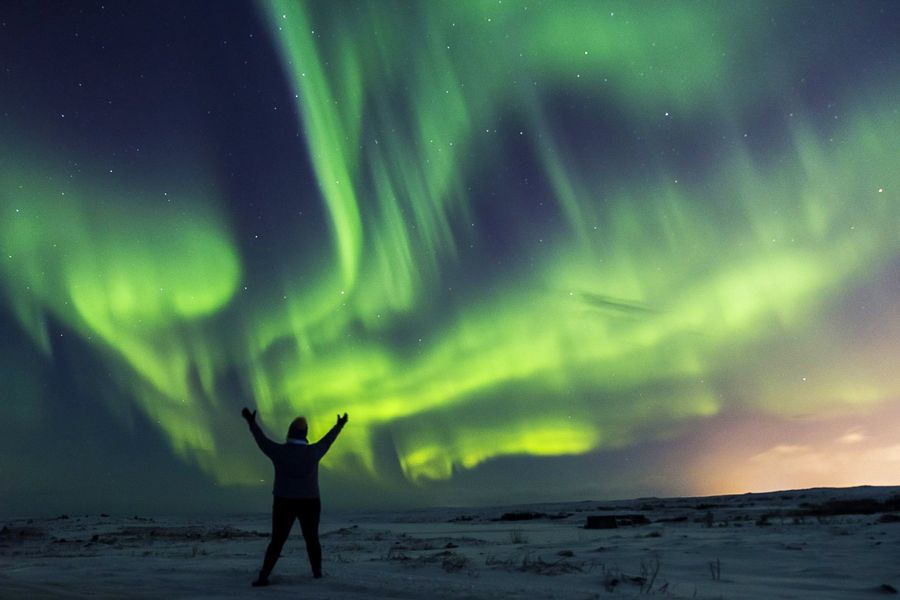
A bus ticket, a boat seat and a rental car all promise the same lights, and they do not deliver the same trip. The choice that actually matters is not which operator has the nicest photos online, it is how much control over timing you are willing to trade for how much comfort. A big coach with forty seats cannot chase a clear patch of sky the way a small group or a self-drive can, and a photographer with a tripod needs a different stop than someone who wants to watch from a warm cabin. The season narrows the field before format does: displays only show against a dark sky, which in Reykjavik runs from late August to mid-April, and the Icelandic Meteorological Office's aurora forecast is the one to check before booking any date, not after.
 Our pick
From Reykjavik: Northern Lights Bus Tour with Hot Cocoa
Coach transport from Reykjavik, guide commentary, hot cocoa
First-time visitors without a car who want a low-cost, no-planning option
The big bus: cheapest, and the one most likely to change plans on you
The mistake with a bus tour is booking one date and assuming it will run as sold. Operators reschedule bus departures on cloudy nights, sometimes with only a few hours' notice, and a coach of thirty or forty people moves as one unit: if the driver picks a viewing spot, everyone on board goes there, and nobody on a bus tour chooses to drive another twenty minutes to a darker field because the group vote would never carry it.
What a bus buys is price and simplicity. It is the cheapest way onto a northern lights excursion, it needs no rental car, no unfamiliar roads in the dark, and no decision about where to park. For a visitor without a car who wants one evening set aside for a chance at the lights, with a guide handling the route and the rebooking if the sky does not cooperate, a bus tour does what it is meant to do. It suits a group that is not built around one photographer with specific equipment needs, and it suits anyone uneasy about driving on unlit Icelandic roads after dark.
The trade is flexibility. A coach cannot pull over on request, it cannot linger for an extra twenty minutes because the aurora just started to move, and it returns to Reykjavik on a schedule set before anyone saw the sky. Cocoa on board is a comfort, not a substitute for a clear night, and no operator can guarantee the display itself: the tour buys transport and a rebooking policy, not the lights.
| Format | Typical group size | Route control | Rebooking on clouds |
|---|---|---|---|
| Big bus | Large group | Fixed stop, set by driver | Common, operator-led |
| Small group / minibus | Small group | Some input on route | Common, operator-led |
| Boat | Small to mid-size group | None, fixed at sea | Common, operator-led |
| Self-drive | Own party only | Full | None, own decision |
- Typical group size
- Large group
- Route control
- Fixed stop, set by driver
- Rebooking on clouds
- Common, operator-led
- Typical group size
- Small group
- Route control
- Some input on route
- Rebooking on clouds
- Common, operator-led
- Typical group size
- Small to mid-size group
- Route control
- None, fixed at sea
- Rebooking on clouds
- Common, operator-led
- Typical group size
- Own party only
- Route control
- Full
- Rebooking on clouds
- None, own decision
Small group and super jeep: paying for the ability to move
A minibus or super jeep tour costs more than a coach seat for one reason that shows up the first time clouds sit over Reykjavik: a small vehicle can drive away from them. Guides running smaller groups watch the same forecast everyone else does, but with eight or twelve people instead of forty, they can choose a different valley or a different stretch of coast without a vote, and they can leave a viewing spot the moment it stops working.
This suits two kinds of traveller badly served by a bus. The first is anyone who wants more say in the evening, a guide who will explain what is showing on the forecast and adjust the plan rather than run a fixed script. The second is a photographer who needs five or ten minutes at a tripod without forty people walking through the frame, since a smaller group simply has fewer people competing for the same dark patch of ground.
None of this changes what a forecast can promise. A super jeep still needs a clear sky to find, and no guide creates one. What the format buys is the ability to act on the forecast rather than sit inside a fixed itinerary built around it, which matters most on a marginal night when the difference between a clear patch forty minutes away and a cloudy one outside Reykjavik is exactly what a smaller, more mobile group can chase and a coach cannot.
{'activity_id': '248622', 'title': 'Reykjavik: Whale Watching and Marine Life Cruise', 'includes': 'Boat departure from Reykjavik harbour, guide', 'best_for': 'Visitors who want time on the water in the same season; not a dedicated aurora sailing', 'link': '{{AFF_GYG_WHICH_NORTHERN_LIGHTS_TOUR_6}}'}
Boat trips: open sky, and no shelter from the wind
A boat tour trades the ability to drive away from clouds for an unobstructed view in every direction, with no streetlights, buildings or hillsides cutting off the horizon the way they can from a spot on land near Reykjavik. That open view is the entire case for going out on the water, and for a clear night it is a real one.
What it costs is comfort. A boat sits exposed to the wind on open water in a season that runs into winter, and anyone prone to seasickness has no way off the vessel until it returns. Dressing for a boat means dressing for the coldest part of the trip, not the walk from a car park, since there is no vehicle to retreat to for warmth between viewing spells the way there is on a bus or jeep tour. A boat also cannot outrun weather the way a small vehicle on land can; the captain works with the same sky as everyone else and the route is fixed by the sea, not by cloud cover.
For a visitor who wants an open horizon and is comfortable on the water in cold weather, a boat is a reasonable choice within the season. For anyone unsure about seasickness or the cold, or anyone who wants the option to change location if the first spot disappoints, a boat is the format with the least room to adapt once departure happens.
Self-drive: full control, and the roads that come with it
Renting a car removes every constraint the tours above accept. There is no group vote on where to stop, no fixed departure time, no operator deciding whether the night is worth going out for at all. A self-driving visitor can watch the forecast through the evening and leave the moment a clear patch appears anywhere within reach of Reykjavik, then leave again if it closes over.
That control is bought with the one thing a tour absorbs on the visitor's behalf: risk. Driving unfamiliar, often unlit roads at night in a season that includes ice and wind is a different task from driving the same roads in daylight, and a rental's own insurance terms are the place to check what is and is not covered before setting out. Anyone without recent experience driving in winter conditions, or without a US or UK licence recognised for the rental, is better served by a tour that puts someone experienced behind the wheel.
Self-drive suits a visitor confident on unlit roads, travelling with a car already, or wanting a level of control that no group tour offers, including a photographer who wants to set up a shot and wait without anyone else's schedule attached to it. It does not suit a visitor who would rather hand the driving and the decision-making to someone else for one evening.
{'activity_id': '400599', 'title': 'Reykjavik: Sky Lagoon Entrance Pass With 7-Step Spa Ritual', 'includes': 'Sky Lagoon entry, 7-step ritual access', 'best_for': 'An evening plan that pairs a warm soak with clear late-season skies, without committing to a dedicated aurora departure', 'link': '{{AFF_GYG_WHICH_NORTHERN_LIGHTS_TOUR_10}}'}
Matching the format to the traveller
A solo traveller or couple without a rental car and with no strong photography goal is usually best served by a bus tour: it is the lowest cost way into the season and needs no planning beyond picking a date. A group that wants more input into the evening, or a photographer who needs room to set up a tripod away from a crowd, gets more from a small group or super jeep tour, at a higher price for that flexibility.
A visitor comfortable on the water and wanting an open horizon with no buildings or hills in the frame should look at a boat departure within the season, accepting that the vessel cannot change plan once it leaves harbour. A confident driver with winter experience, or one already renting a car for other days of the trip, gets the most control from self-driving, along with the responsibility for reading the Icelandic Meteorological Office's aurora forecast and the road conditions before setting out.
None of the four formats can manufacture a display. Every one of them, bus, small group, boat or self-drive, depends on the same dark, clear sky, and the format only decides how much say a visitor has in finding one.
Common questions
Can I see the northern lights in June?
No format sells this honestly. Reykjavik has around 21.2 hours of daylight in June, so the sky never gets dark enough for a display to be visible, whatever a tour listing claims.
Do I need to book a specific date in advance?
Most tours take a booking for a date but reschedule automatically if cloud cover rules it out, since the operator checks the same forecast a visitor would. Confirm the rebooking policy before paying.
Is a super jeep tour worth the extra cost over a bus?
It is worth it mainly for a smaller group that wants a guide able to relocate away from cloud, or for a photographer who needs space at a tripod. A visitor with no strong preference on location gets the same season either way.
Is a self-drive safer than joining a tour?
It depends on the driver's experience with unlit roads and winter conditions. A tour puts an experienced driver in charge; self-driving puts the visitor in charge, with a rental's own insurance terms setting what is covered.