How Much Is Gas in Iceland? (2026 Data)
Petrol and diesel prices in Iceland now and since 1996, why they changed twice in 2026, and how they compare with other countries.
- Published
- Updated
- 9 sources
- 86 statistics
- 11 min read

- M.Sc. in Atmospheric Sciences, University of Iceland (Háskóli Íslands), with a minor thesis on North Atlantic storm-track variability
- Former research assistant at the Icelandic Meteorological Office (Veðurstofa Íslands), working on subarctic climate modeling and volcanic-ash dispersion forecasting
- B.A. in Sociology, also from the University of Iceland, with fieldwork on rural depopulation and tourism's impact on small fishing communities (Westfjords focus)
- Grew up in Akureyri, spent seven years living in Reykjavík and two in a small village in the Westfjords - brings first-hand experience of Iceland's regional weather extremes and community life
- Fluent in Icelandic and English; has translated Icelandic Met Office public advisories for international outlets
- Published field notes and data-driven pieces on glacier retreat (Vatnajökull), aurora forecasting, and the socioeconomic effects of overtourism in the Golden Circle

- M.A. in Journalism, University of Iceland, with additional coursework in Environmental Communication at the University of Bergen (Norway), giving a comparative Nordic lens
- 12+ years in Icelandic media, including editorial roles at RÚV (Iceland's national broadcaster) covering weather-related public safety reporting (storms, volcanic eruptions, road closures)
- Former fact-checking lead for a travel-and-culture desk, specializing in verifying tourism statistics, safety advisories, and climate data against primary sources (Vedur.is, Statistics Iceland)
- Has overseen editorial standards for bilingual (Icelandic/English) publications, ensuring both cultural nuance and accuracy for international readers
- Advocate for citing primary sources (Icelandic Met Office, Icelandic Tourist Board / Ferðamálastofa) rather than secondhand reporting
Key findings
- 259 ISKPetrol costs about 259 ISK a litre in Iceland as of mid-September 2026 (about $2.13, or $8.07 a gallon).
- 293 ISKDiesel costs about 293 ISK a litre in Iceland as of mid-September 2026, about $2.41 or $9.13 a gallon.
- 27.4%Petrol prices fell 27.4% in January 2026 alone after Iceland replaced fuel taxes with a per-kilometre road charge.
- 466 ISKIn today's money, petrol cost about 466 ISK a litre in Apr 2012, more than it costs right now.
- 11%Iceland temporarily cut VAT on fuel from 24% to 11% between May and August 2026, before reverting on 1 September.
- $2.09At $2.09 a litre, Iceland's petrol is cheaper than Norway's or Denmark's but pricier than the United States'.
- 222 ISKThe cheapest petrol in Iceland is at Costco, about 222 ISK a litre, 48 ISK below the priciest station.
- 7.5 litresIceland's road-tax reform assumes an average petrol car uses 7.5 litres per 100 km, about 31 miles per gallon.
In September 1996 a litre of petrol in Iceland cost 76.5 ISK1 - worth about 298 ISK2 in today's money once inflation is counted. Nearly thirty years on, the pump price is 258.6 ISK3 a litre, and this year alone it has moved twice: Iceland scrapped its old fuel taxes for a distance-based road charge on 1 January 2026, then cut VAT on fuel for four months over the summer before letting it snap back on 1 September. Neither change was really about the world price of oil.
This report tracks what petrol and diesel cost in Iceland right now, per litre and per US gallon, how the price has moved since 1996, and how Iceland compares with other countries. Fill a 50-litre tank today and it costs about 12,929 ISK2 ($$107); drive the whole Ring Road and it runs closer to 25,387 ISK2. Norwegians and Danes pay more for the same litre; Americans pay much less.
How much is gas in Iceland right now
As of 2026-09-15, the Gasvaktin price tracker puts the nationwide average petrol price at 258.6 ISK3 a litre and diesel at 292.8 ISK3. A day-by-day snapshot of all 2453 tracked filling stations, taken 2026-09-16, shows petrol ranging from 222.3 ISK3 at the cheapest pump to 270.4 ISK3 at the priciest - a spread of about 48 ISK depending on which station you stop at.
By company, N13 is the most expensive on average at 267.5 ISK3 a litre, while Costco3, which requires a membership, is cheapest at 222.3 ISK3. Loyalty-card discounts bring most companies' prices down further still.
| Petrol, nationwide average | 258.6 ISK/L ($2.13) | 2026-09-15 |
| Diesel, nationwide average | 292.8 ISK/L ($2.41) | 2026-09-15 |
| Petrol across 245 stations | mean 261.3, range 222.3–270.4 ISK/L | 2026-09-16 |
| Diesel across 245 stations | mean 296.5, range 261.5–305.5 ISK/L | 2026-09-16 |
| Cheapest station (petrol) | Kauptún, Costco Iceland: 222.3 ISK/L | 2026-09-16 |
| Priciest station (petrol) | Ártúnshöfði, N1: 270.4 ISK/L | 2026-09-16 |
| Petrol per US gallon | 979 ISK ($8.07) | 2026-09-15 |
| Diesel per US gallon | 1,108 ISK ($9.13) | 2026-09-15 |
| Exchange rate | 1 USD = 121.33 ISK; 1 GBP = 163.59 ISK | 2026-09-15 |
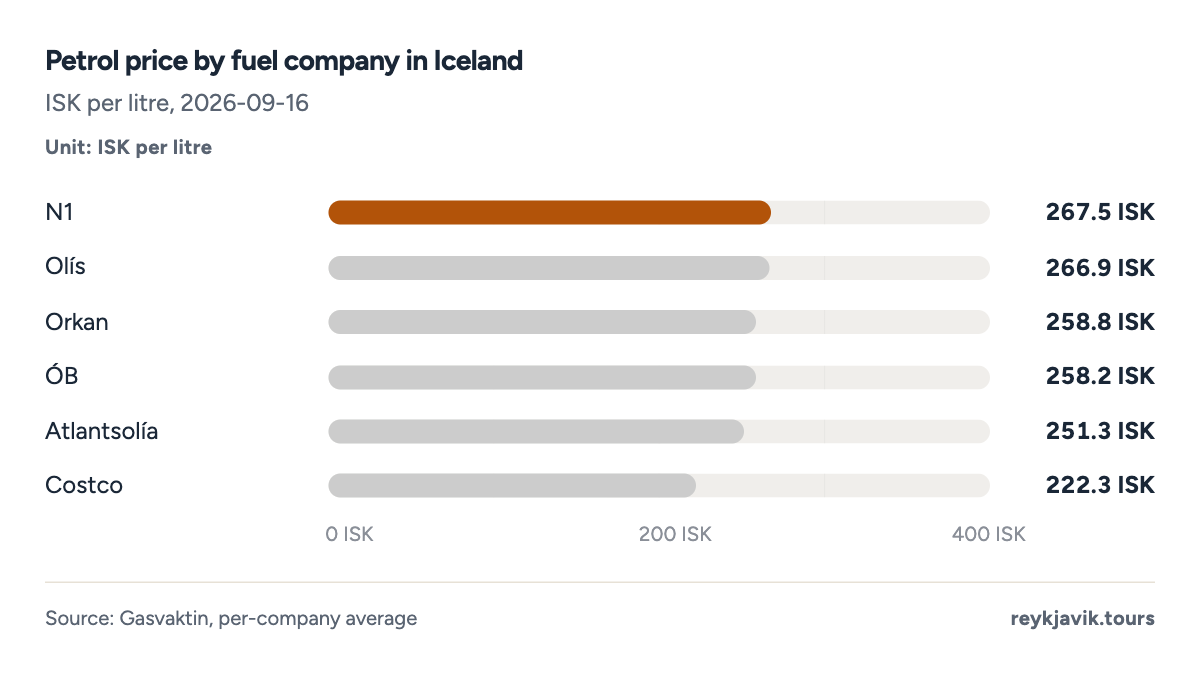
- N1 averages 267.5 ISK a litre.
- Costco is cheapest at 222.3 ISK.
How much is gas in Iceland per gallon
A US gallon is 3.785 litres, so at today's average price petrol works out to about 979 ISK2 a gallon, or $8.072. Diesel comes to about 1,108 ISK2 a gallon, or $9.132. So how much is a liter of gas in Iceland in the reader's own currency? At the litre level it is $2.132 for petrol and $2.412 for diesel, using the Central Bank of Iceland's mid rate of 121.33 ISK4 to the US dollar on 2026-09-15.
How much is gas in Reykjavik
Fuel is, on average, cheaper in the capital than outside it: stations in the Reykjavík capital area average 255.8 ISK2 a litre for petrol, against 263.7 ISK2 in the rest of the country, a gap of about 7.9 ISK (own calculation from each station's coordinates). More filling stations compete for business in and around Reykjavík - 75 of the 245 tracked stations sit in the capital region - which keeps prices there a little lower than in small towns with only one or two pumps.
Average Petrol Price: Iceland, 2025 per Liter
Petrol in Iceland cost just 76.5 ISK1 a litre in 1996. It climbed through the 2008 financial crisis, when the króna lost roughly half its value against the dollar, past 200 ISK1 by 2010 and on to an all-time nominal high of 318.0 ISK1 in 2023. Average petrol price Iceland recorded for 2025 was 309.8 ISK1 a litre (about $2.41), barely changed from 2023 and 2024. Then came 2026: with January's reform included, the partial-year average so far is 228.5 ISK1, the lowest since 2018.
The chart fits a straight line to the years since 2005 and projects it to 2050 - a naïve trend only, since it cannot see policy changes like January's reform coming. Read it as a baseline, not a forecast.
Projection: linear trend of 2005–2026 yearly values, 95% prediction range. Our calculation, not a forecast.
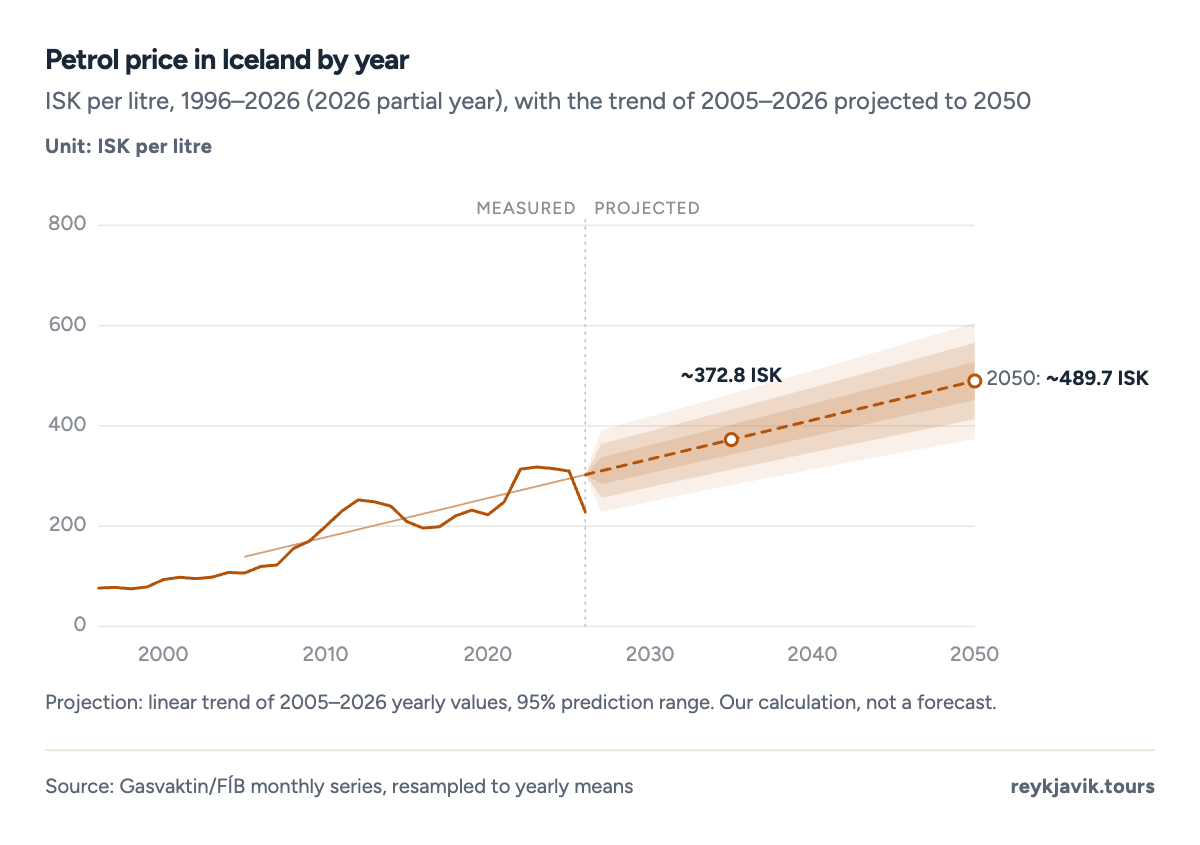
- Petrol peaked at 318.0 ISK a litre in 2023.
- The 2026 average so far is 228.5 ISK.
| 1996 | 76.5 | – | $1.15 |
| 1997 | 78.0 | – | $1.1 |
| 1998 | 75.0 | – | $1.05 |
| 1999 | 78.7 | – | $1.09 |
| 2000 | 93.4 | – | $1.18 |
| 2001 | 98.1 | – | $1.0 |
| 2002 | 95.4 | – | $1.04 |
| 2003 | 98.2 | – | $1.28 |
| 2004 | 107.5 | – | $1.53 |
| 2005 | 106.5 | 109.9 | $1.69 |
| 2006 | 119.5 | 116.9 | $1.71 |
| 2007 | 122.4 | 122.9 | $1.91 |
| 2008 | 155.2 | 170.1 | $1.76 |
| 2009 | 170.4 | 172.7 | $1.38 |
| 2010 | 199.6 | 198.0 | $1.64 |
| 2011 | 230.4 | 234.0 | $1.99 |
| 2012 | 252.3 | 256.3 | $2.02 |
| 2013 | 248.6 | 249.7 | $2.03 |
| 2014 | 240.0 | 236.0 | $2.06 |
| 2015 | 209.3 | 201.6 | $1.59 |
| 2016 | 196.0 | 184.9 | $1.62 |
| 2017 | 198.8 | 188.4 | $1.86 |
| 2018 | 220.5 | 215.9 | $2.03 |
| 2019 | 232.1 | 226.3 | $1.89 |
| 2020 | 222.8 | 215.2 | $1.65 |
| 2021 | 248.1 | 232.6 | $1.95 |
| 2022 | 313.6 | 310.2 | $2.32 |
| 2023 | 318.0 | 317.9 | $2.3 |
| 2024 | 315.0 | 318.4 | $2.28 |
| 2025 | 309.8 | 317.8 | $2.41 |
| 2026 | 228.5 | 256.4 | $1.85 |
How much is diesel in Iceland
Diesel has generally tracked petrol closely, though the ranking flipped: since 2022, diesel has cost slightly more than petrol most years, the opposite of the pattern before 2020. Iceland diesel price per liter 2025 average was 317.8 ISK1, and the partial 2026 figure is 256.4 ISK1.
For comparison, the average gasoline price Iceland 2025 per liter figure - "gasoline" being the American word for the same 95-octane petrol sold at Icelandic pumps - was 309.8 ISK1, just below diesel's 2025 average.
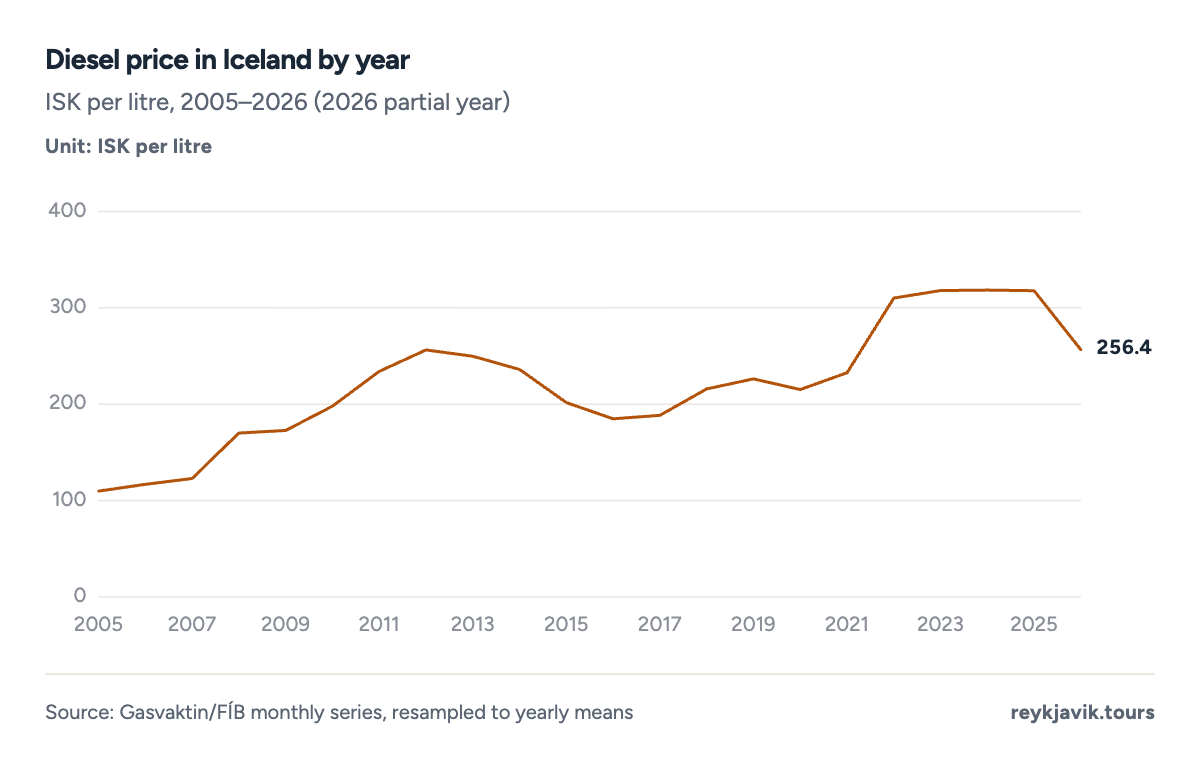
- Diesel peaked at 318.4 ISK a litre in 2024.
- The 2026 average so far is 256.4 ISK.
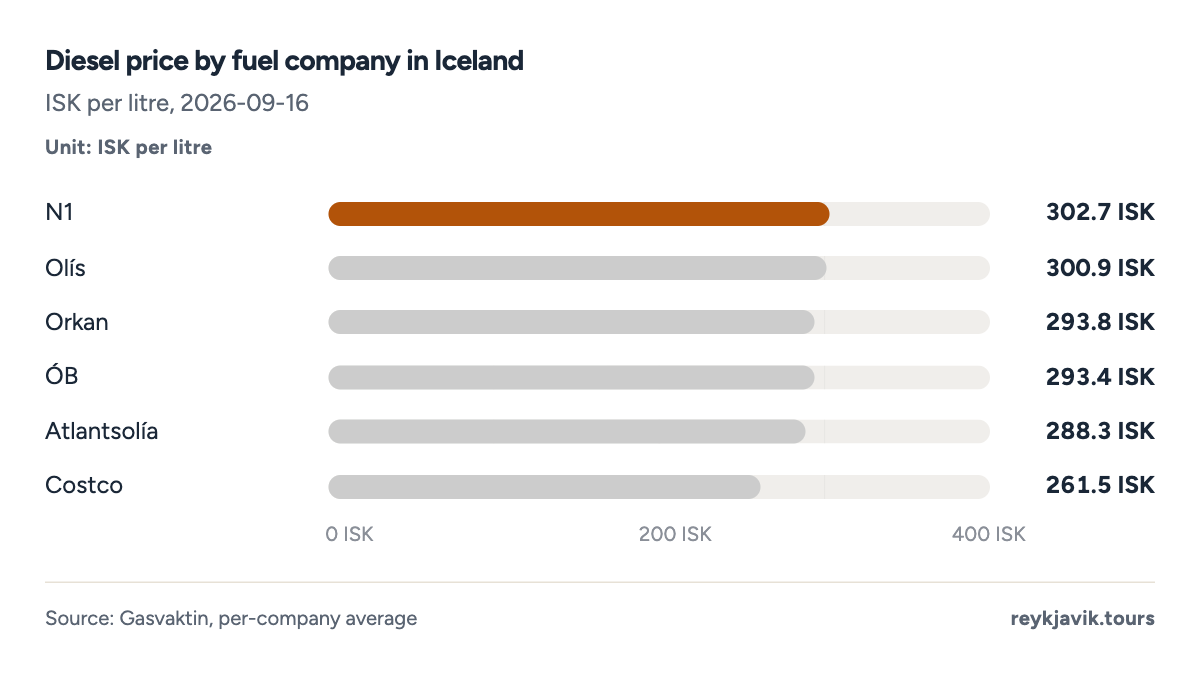
- N1 averages 302.7 ISK a litre.
- Costco is cheapest at 261.5 ISK.
Why gas got cheaper in Iceland in 2026
Two policy changes, not the world oil price, explain most of this year's swings. On 1 January 2026, Iceland abolished the excise duty and oil fee charged on every litre of petrol and diesel, raised the carbon tax a little, and introduced a per-kilometre road charge for every vehicle instead. Statistics Iceland's consumer price index shows the effect directly: petrol fell 27.4% and diesel 24.2% in January alone, knocking 0.68 and 0.26 points respectively off that month's headline inflation figure.5 Our own before-and-after calculation, comparing December 2025 with February 2026 monthly averages, finds a similar-sized drop: petrol down 86 ISK2 a litre (29.2%) and diesel down 81 ISK2 (26.5%) - close to the government's own estimate of a 95–105 ISK cut for petrol and 80–88 ISK for diesel.6
A second, temporary change followed in May: facing an oil-price shock from the conflict in the Middle East, the government cut VAT on fuel from 24% to 11% for four months.7 Our calculation shows petrol averaging 224.0 ISK2 a litre during that window, versus 243.7 ISK2 in April before the cut - a drop of about 8.1%. The cut expired at midnight on 31 August, VAT reverted to 24%, and by mid-September petrol had climbed back to 254.5 ISK2, up about 13.6% from the summer average.
- Petrol
- Diesel
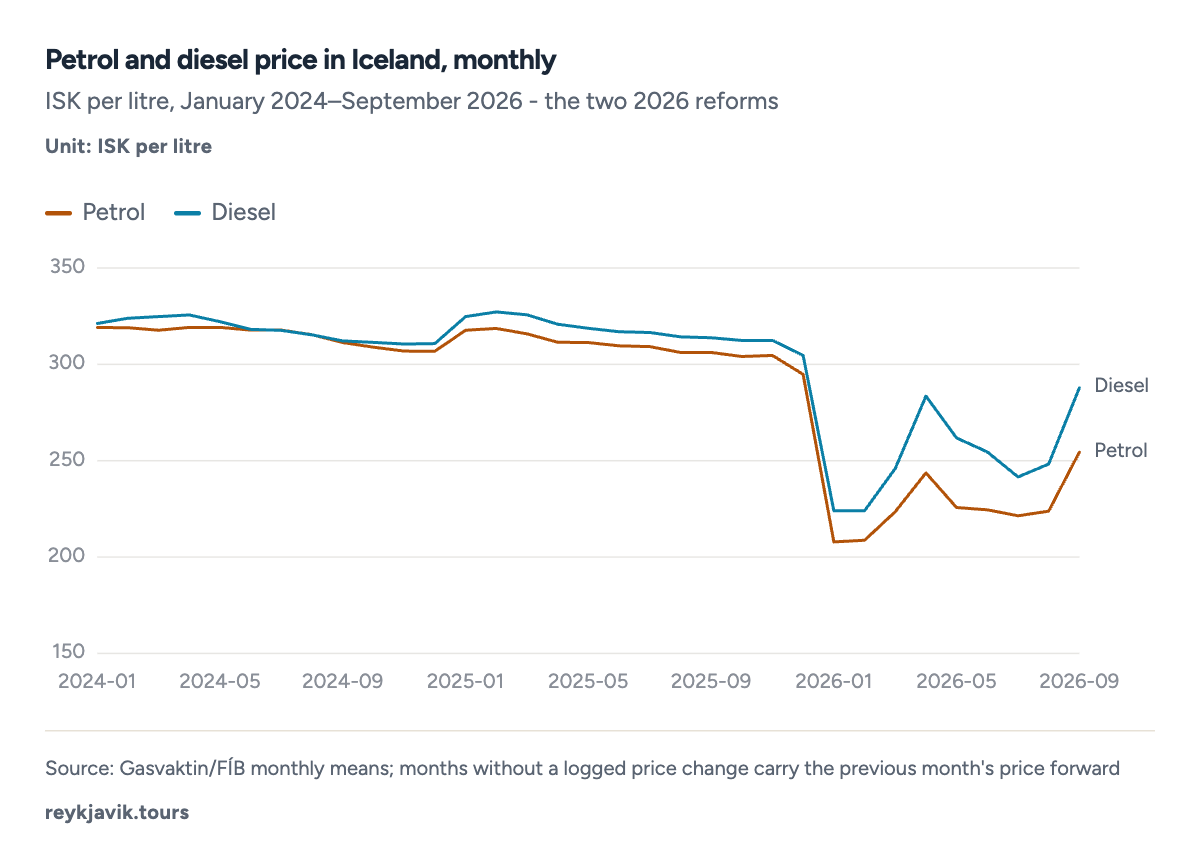
- Petrol dropped to 207.9 ISK in January 2026.
- It was back up to 254.5 ISK by September.
| Dec 2025 | 294.8 | 304.7 | Before the kilometre-fee reform |
| Jan 2026 | 207.9 | 224.0 | Fuel taxes replaced by the km fee |
| Feb 2026 | 208.7 | 224.1 | Reform settled in |
| Apr 2026 | 243.7 | 283.5 | Before the VAT cut |
| May–Aug 2026 | 224.0 | 250.1 | VAT cut, 24% → 11% |
| Sept 2026 | 254.5 | 287.9 | VAT back to 24% |
How much is gas in Iceland in US dollars
Converting at the Central Bank of Iceland's mid rate of 121.33 ISK4 to the dollar on 2026-09-15, today's average works out to $2.132 a litre for petrol and $2.412 for diesel. Because the króna moves against the dollar from year to year, the yearly table above converts each year at that year's own average exchange rate rather than today's rate, so a past year's dollar figure reflects what it actually cost at the time.
For British visitors: how much is petrol in Iceland in pounds? At the Central Bank's mid rate of 163.59 ISK4 to the pound, that same litre of petrol costs about £1.582, or roughly £5.98 a gallon.
How much was gas in Iceland in past years
How much is gas in Iceland 2016
In 2016, petrol in Iceland averaged 196.0 ISK1 a litre and diesel 184.9 ISK1, which worked out to about $1.622 and $1.532 at that year's average exchange rate of 120.67 ISK2 to the dollar. Prices were near a post-crisis low that year, before oil markets tightened again.
How much is gas in Iceland 2017
The following year barely moved: petrol averaged 198.8 ISK1 a litre (about $1.86) and diesel 188.4 ISK1 (about $1.76), even though the króna strengthened sharply that year, which is why the dollar price rose more than the ISK price.
How much is gas in Iceland 2022
That year has a clear answer: prices spiked. Petrol jumped from 268.4 ISK1 a litre in January to 341.9 ISK1 in July, as Russia's invasion of Ukraine drove world oil prices higher, before easing slightly to end the year at 322.6 ISK1. The full-year average was 313.6 ISK1 (about $2.32), Iceland's highest nominal yearly average until then.
| 2016 | 196.0 | $1.62 | 184.9 | $1.53 |
| 2017 | 198.8 | $1.86 | 188.4 | $1.76 |
| 2022 | 313.6 | $2.32 | 310.2 | $2.29 |
| 2025 | 309.8 | $2.41 | 317.8 | $2.48 |
| 2026 (through Sept) | 228.5 | $1.85 | 256.4 | $2.07 |
Is Iceland's gas price a record right now
Not once inflation is taken into account. The nominal average gas price in Iceland has risen almost every decade, but Iceland has also had high inflation, so a like-for-like comparison needs today's money. Rescaling every month of the Gasvaktin/FÍB series by Statistics Iceland's price-level index, 76.5 ISK1 in September 1996 turns out to be worth about 298 ISK2 today - nearly what petrol costs right now. The real peak came later: petrol touched 466 ISK2 a litre in today's money in Apr 2012, and diesel a similar 463 ISK2 the month before, when oil prices were high and the króna was weak after the financial crisis. Even 2023's nominal record of 318.0 ISK1 was only 372 ISK2 in today's terms - well short of 2012.
- Nominal price
- In today's money
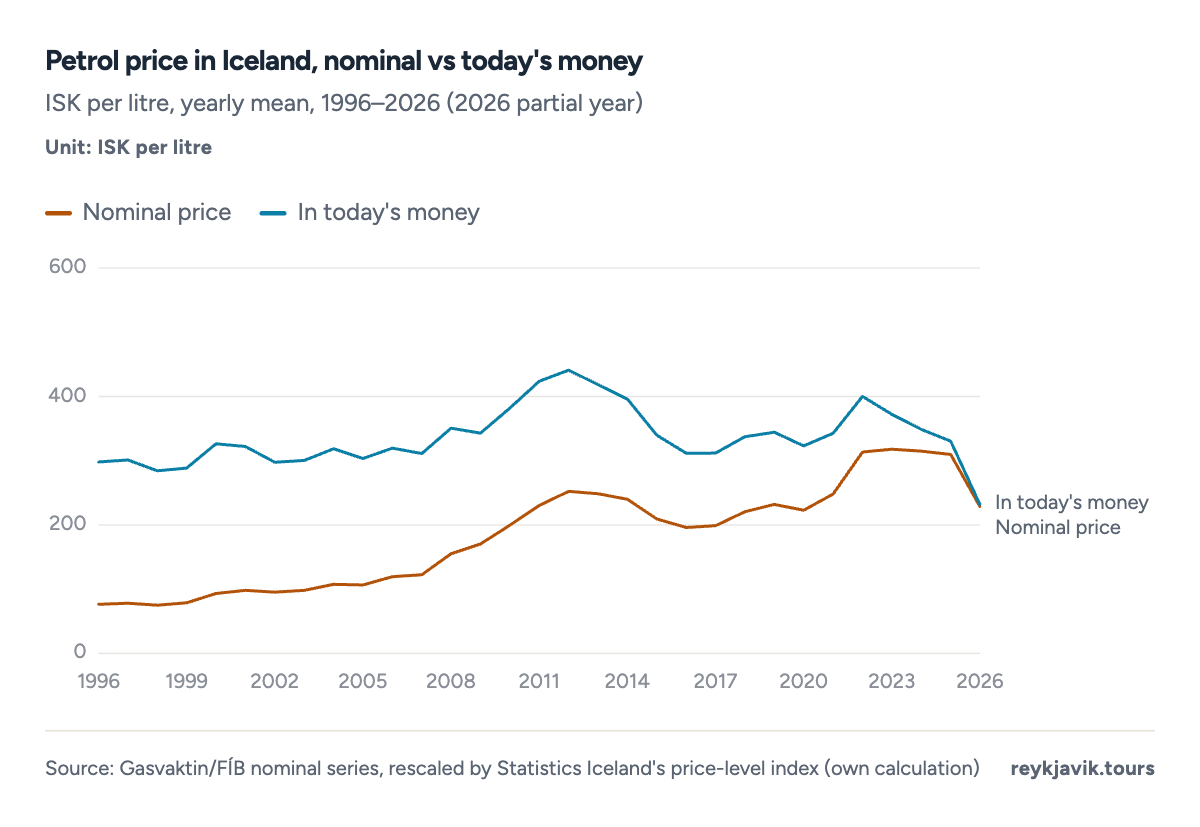
- In today's money, 2012 peaked at 441 ISK a litre.
- The nominal 2023 record was only 372 ISK in today's terms.
Average Fuel Price: Iceland, 2025, ISK per Liter - What It's Made Of
Before the 2026 reform, the Icelandic Automobile Association (FÍB) broke down exactly what was in a litre of fuel. On its analysis, taxes made up about half: 51.5%8 of the petrol price and just under 48%8 of the diesel price, with margin, transport and other costs taking another 23–24%8 and the underlying import and product cost - the part that actually moves with the world oil price - only about a quarter8. On a 310 ISK litre of petrol, FÍB calculated close to 160 ISK8 went to the treasury in excise duty, carbon tax and VAT; filling a 50-litre tank meant paying roughly 8,000 ISK8 in tax alone.
That old structure no longer applies. The 88 ISK/L petrol excise duty and 75.40 ISK/L diesel oil fee are gone, replaced by the per-kilometre charge; the carbon tax went up instead, and VAT still applies to everything else. No official breakdown of the new price has been published yet, so the chart below shows the pre-reform structure, clearly dated, as the most detailed public explanation of how Icelandic fuel pricing works.
- Taxes and levies51.551.5%
- Import and product cost25.025%
- Margin, distribution & other23.523.5%
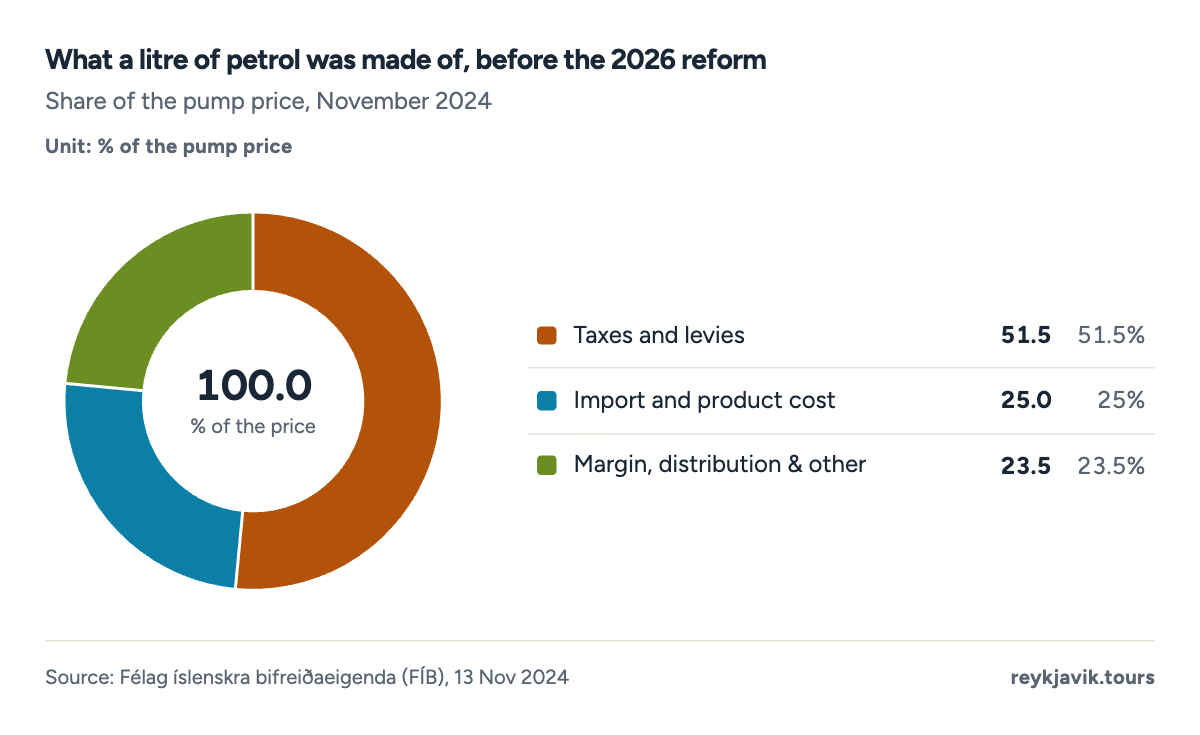
- Taxes took about 51.5% of the petrol price before the reform.
- Import and product cost was only about 25%.
Before January 2026, a rise in the pump price often meant a rise in tax revenue too; since the reform, fuel tax is a smaller, flatter part of the price and drivers instead pay for the roads by the kilometre, however much or little fuel their car needs.
Fuel Price by Company in Iceland
Six companies sell fuel in Iceland: N1 and Olís run full-service forecourts and shops, while Orkan, ÓB, Atlantsolía and Costco are largely unstaffed, self-service pumps that undercut them. The table below lists every company's average and lowest logged price with a loyalty card, alongside how many of the 245 tracked stations each one runs.
How much is gasoline in Iceland
"Gasoline" is simply the American English word for what Icelanders call bensín and the British call petrol - all three describe the same 95-octane fuel sold at every Icelandic pump; there is no separate "gasoline" grade to compare. Some stations also sell a higher-octane 98 blend at a small premium, but 95-octane is what the prices on this page describe unless stated otherwise.
| 1 | N1 | 267.5 | 237.6 | 302.7 | 277.9 | 81 |
| 2 | Olís | 266.9 | 258.7 | 300.9 | 294.3 | 19 |
| 3 | Orkan | 258.8 | 235.3 | 293.8 | 276.5 | 73 |
| 4 | ÓB | 258.2 | 235.5 | 293.4 | 276.6 | 47 |
| 5 | Atlantsolía | 251.3 | 235.4 | 288.3 | 276.6 | 24 |
| 6 | Costco | 222.3 | 222.3 | 261.5 | 261.5 | 1 |
How Much Is Fuel in Iceland by Month
Iceland's pump price does not follow a fixed seasonal calendar the way, say, heating costs do - it moves with world oil prices and the exchange rate, which can shift in any month. The clearest recent example is 2022, when petrol climbed for seven months in a row: from 268.4 ISK1 in Jan to a high of 341.9 ISK1 in July, as the invasion of Ukraine pushed crude oil prices to their highest since 2008, before drifting back down to end the year at 322.6 ISK1.
- 268.4JanJ
- 276.7FebF
- 293.2MarM
- 299.6AprA
- 309.5MayM
- 337.6JunJ
- 341.9JulJ
- 331.8AugA
- 322.4SepS
- 325.1OctO
- 327.5NovN
- 322.6DecD
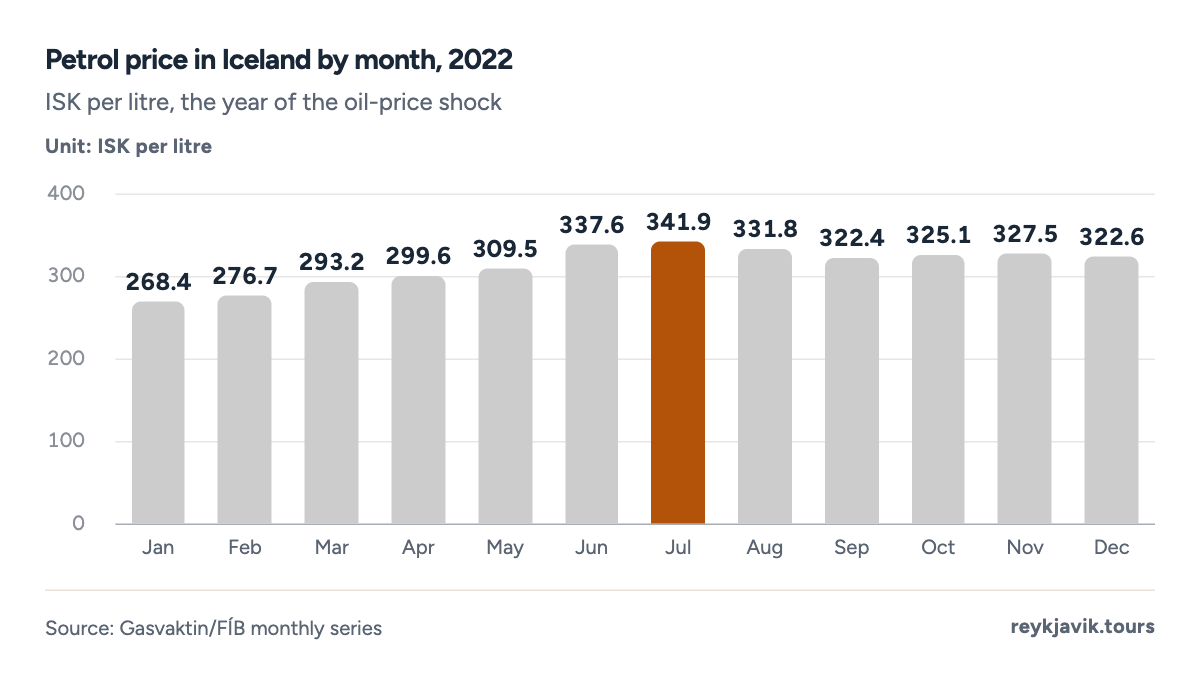
- Petrol peaked at 341.9 ISK in July 2022.
- It was lowest in Jan, at 268.4 ISK.
How Iceland's Gas Prices Compare With Other Countries
At $2.099 a litre, petrol in Iceland sits in the middle of the Nordic and western European pack: cheaper than in Norway ($3.169) or Denmark ($3.09), similar to the United Kingdom ($2.279), and well above the United States ($1.239), where fuel carries far less tax. Diesel follows a similar order, at $2.389 in Iceland against $3.149 in Denmark and $1.669 in the US.
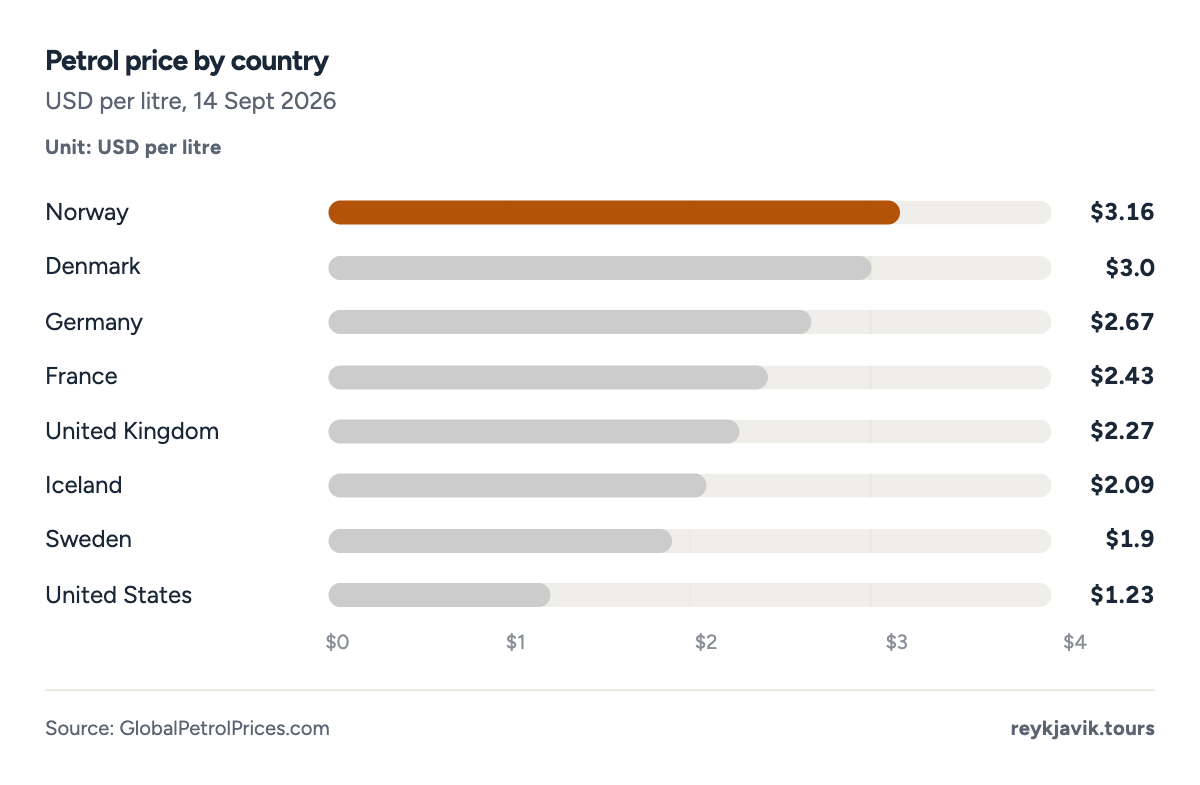
- Norway is priciest at $3.16 a litre.
- The United States is cheapest at $1.23.
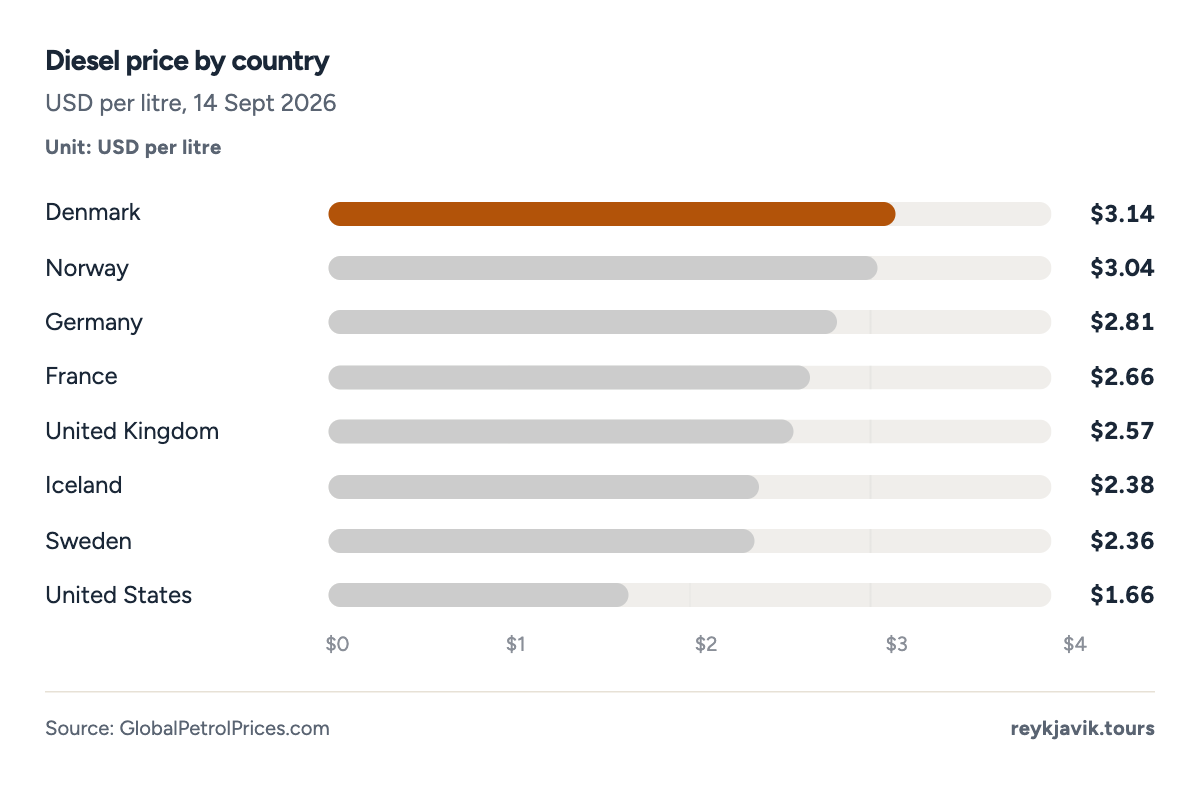
- Denmark is priciest at $3.14 a litre.
- The United States is cheapest at $1.66.
| Norway | 3.16 | 3.04 |
| Denmark | 3.0 | 3.14 |
| Germany | 2.67 | 2.81 |
| France | 2.43 | 2.66 |
| United Kingdom | 2.27 | 2.57 |
| Iceland | 2.09 | 2.38 |
| Sweden | 1.9 | 2.36 |
| United States | 1.23 | 1.66 |
How Much Fuel Does a Car Use in Iceland
Iceland's road-tax reform had to settle on an answer to the average fuel consumption car Iceland runs, because the whole 6.95 ISK/km charge was set to match what that car paid in fuel tax before. The government's working assumption: a petrol passenger car using 7.5 litres6 per 100 km (about 31 miles per US gallon) and covering 14,000 km6 a year (about 8,699 miles).6
On that assumption, monthly costs stay close to flat: about 28,244 ISK6 a month under the old, fuel-tax system versus 26,580 ISK6 under the new per-kilometre one. The charge itself is 6.95 ISK6 per km for cars and SUVs under 3.5 tonnes, 4.15 ISK6 for motorcycles (40% less), and up to 45.17 ISK6 per km for the heaviest trucks, spread across 29 weight bands. An electric car costs roughly 13,850 ISK6 a month less to run than a comparable petrol car under the new system, since it pays no carbon tax and less vehicle tax and VAT.
| Average petrol car (7.5 L/100 km, 14,000 km/yr), monthly cost | 28,244 ISK | 26,580 ISK | Government comparison, 2026 basis |
| Passenger car / SUV up to 3.5 t, per km | - | 6.95 ISK | |
| Motorcycle, per km | - | 4.15 ISK | 40% less than a passenger car |
| Heaviest vehicles (up to 32 t + trailer), per km | - | up to 45.17 ISK | 29 weight categories |
| Electric car, monthly cost vs. an average petrol car | - | about 13,850 ISK less | No carbon tax; lower vehicle tax and VAT |
| Road-usage revenue collected per km driven | 12.2 ISK (2006) | 7.0 ISK (2023, pre-reform) | Revenue had fallen 43% in 17 years |
How Much to Budget for Gas in Iceland
For a rough trip budget, work from the per-litre price and how far you plan to drive. A small petrol car doing the full 1,309 km (813-mile) Ring Road at 7.5 L/100 km would use about 98.2 litres2 of petrol, costing around 25,387 ISK2 ($$209); a thirstier diesel 4x4 would spend closer to 28,745 ISK2 ($$237). That is on top of the kilometre fee itself, which comes to 9,098 ISK6 for the same distance at 6.95 ISK/km.
How much is a tank of gas in Iceland
Filling a 50-litre tank - typical for a small hatchback - costs about 12,929 ISK2 ($$107) with petrol or 14,640 ISK2 ($$121) with diesel at today's prices. Larger 4x4s and campervans often carry 60–80-litre tanks, so budget proportionally more.
| Full tank (50 L) | 12,929 ISK ($$107) | 14,640 ISK ($$121) |
| Per US gallon | 979 ISK ($8.07) | 1,108 ISK ($9.13) |
| Ring Road, 1,309 km (98.2 L at 7.5 L/100 km) | 25,387 ISK ($$209) | 28,745 ISK ($$237) |
| Ring Road kilometre fee (6.95 ISK/km, all fuel types) | 9,098 ISK | 9,098 ISK |
What the 2026 Reform Means for Drivers
For the average petrol car the reform was designed to be close to cost-neutral - 28,244 ISK a month became 26,580 ISK - but "average" hides real winners and losers. A rural driver in a heavier, thirstier vehicle now pays the same per-kilometre rate as a city driver in an efficient small car, so the fuel-tax savings can outweigh the new charge; drivers of the most efficient petrol and hybrid cars, who paid the least fuel tax before, see the smallest gain. Electric-car owners keep a clear cost advantage, about 13,850 ISK a month, since they pay no carbon tax at all.
The summer's VAT cut and its reversal was a separate, temporary story layered on top: petrol was about 8.1% cheaper during the four-month cut than the month before it, and climbed roughly 13.6% once the standard rate returned in September. None of this reflects a change in the world price of oil - it is entirely the result of two Icelandic tax decisions made months apart in the same year.
Conclusions
- Two Icelandic tax decisions, not the world oil price, explain almost all of this year's price swings: the January kilometre-fee reform cut petrol about 27% and diesel about 24%, and the May–August VAT cut and its September reversal moved petrol a further 8.1% down and then 13.6% back up.
- Today's price is not a record. Once inflation is counted, petrol cost more in Apr 2012 (about 466 ISK a litre in today's money) than it does now, even though the nominal price has risen more than threefold since 1996.
- Where and who you buy from moves the price more than the national average suggests: choosing Costco over the priciest station, or filling up in the capital rather than a small town, is worth tens of ISK a litre - a bigger swing than many single-year moves in the chart above.
- The reform redistributes the burden rather than raising it: a rural driver in a heavier vehicle now pays the same per kilometre as a city driver in an efficient small car, while electric-car owners keep the roughly 13,850-ISK-a-month advantage they already had.
Methodology
- Prices 1996–2026
- Country comparison 14 Sept 2026
- 245 stations, 6 companies
- Checked Sept 16, 2026
Definition. Petrol means 95-octane unleaded fuel (bensín), sold at every station in this dataset; a separate 98-octane grade exists at some stations but is not tracked here. Diesel is standard automotive diesel. Prices are pump (retail) prices including all taxes unless stated. "Right now" figures are dated 15–16 September 2026 and will drift as prices change.
Data sources. Historical petrol and diesel prices, 1996–2026, are the Icelandic Automobile Association's (FÍB) monthly average up to 2016 and the Gasvaktin project's logged station prices from 2016 onward, compiled at gasvaktin.is;1 Statistics Iceland does not publish a raw retail price series, only consumer-price-index percentage effects, used here to confirm the two 2026 reforms.5 The live 245-station snapshot and per-company averages are Gasvaktin's own station data, fetched 16 September 2026.3 The per-kilometre charge, its rates and the government's fuel-consumption assumption are from Vegir okkar allra, the official reform website.6 The pre-reform tax breakdown is FÍB's own published analysis.8 Country prices are GlobalPetrolPrices.com.9 Exchange rates are Central Bank of Iceland mid rates.4
Calculations. Yearly figures are the mean of all logged prices in that calendar year (2026 covers January–15 September only). Inflation-adjusted ("real", today's-money) prices rescale each month's nominal price by Statistics Iceland's price-level index, both ultimately Central Bank of Iceland-linked series compiled by the Gasvaktin project. Capital-region vs rest-of-country prices classify each station by its published coordinates against a bounding box covering Reykjavík, Kópavogur, Hafnarfjörður, Garðabær, Mosfellsbær and Seltjarnarnes. USD figures for a given year use that year's average Central Bank of Iceland rate; "now" figures use the rate on {usd_now_date}. The trend projection is a least-squares line fitted to 2005–2026 yearly averages with a 95% prediction range, extended to 2050 - a mechanical baseline, not a forecast, and one the January 2026 reform already breaks.
Limitations. The historical series is compiled by a community project (Gasvaktin) from FÍB's published averages and its own automated station monitoring, not a government statistical office; it is cross-checked here against Statistics Iceland's official percentage changes for both 2026 reforms and matches closely. Monthly averages before 2016 and irregular months since are based on price-change events logged that month, which can differ slightly from a strict calendar-month mean; a few months in the 2024–2026 chart with no logged change carry the previous month's price forward. No official, itemised breakdown of the post-reform fuel price has been published, so the tax/margin/cost chart shows the last published (pre-reform) structure, clearly dated.
Sources
- Gasvaktin. “Fuel price history: monthly mean petrol and diesel price in Iceland (FÍB 1996–2016, Gasvaktin project 2016–2026).” Gasvaktin / Félag íslenskra bifreiðaeigenda (FÍB). gasvaktin.is. Accessed 16 Sept. 2026. Back to text
- Reykjavik Tours research. “Iceland fuel price calculations: yearly and real-terms averages, station, company and regional splits, tank and Ring Road budgets.” Reykjavik Tours. reykjavik.tours. Accessed 16 Sept. 2026. Back to text
- Gasvaktin. “Fuel prices at Icelandic filling stations, live snapshot.” Gasvaktin, 16 Sept. 2026. gasvaktin.is. Accessed 16 Sept. 2026. Back to text
- Central Bank of Iceland (Seðlabanki Íslands). “Official exchange rates, USD/ISK and GBP/ISK.” Central Bank of Iceland, 15 Sept. 2026. sedlabanki.is. Accessed 16 Sept. 2026. Back to text
- Statistics Iceland (Hagstofa Íslands). “Consumer price index in January 2026.” Statistics Iceland, 29 Jan. 2026. statice.is. Accessed 16 Sept. 2026. Back to text
- Government of Iceland (Ministry of Infrastructure, Ministry of Economic Affairs and Trade, and the Prime Minister's Office). “Our roads to the future: the per-kilometre charge.” Vegir okkar allra (Government of Iceland). vegirokkarallra.is. Accessed 16 Sept. 2026. Back to text
- Statistics Iceland (Hagstofa Íslands). “Consumer price index in May 2026.” Statistics Iceland, 28 May 2026. statice.is. Accessed 16 Sept. 2026. Back to text
- Félag íslenskra bifreiðaeigenda (FÍB, the Icelandic Automobile Association). “Uppbygging eldsneytisverðs á Íslandi (How Iceland's fuel price is built up).” FÍB, 13 Nov. 2024. fib.is. Accessed 16 Sept. 2026. Back to text
- GlobalPetrolPrices.com. “Gasoline and diesel prices by country.” GlobalPetrolPrices.com, 14 Sept. 2026. globalpetrolprices.com. Accessed 16 Sept. 2026. Back to text
About the author
Laufey turns public statistics on tourism and travel into research people can check and cite.
Every figure on this page links to its source. How we research
Related research
More data on Iceland's weather and travel from Reykjavik Tours.
- PricesHow Much Is Food in Iceland? (2026 Data)44% above the EU average for food pricesRead the research →
- Travel costsHow Much Are Hotels in Iceland? (2026 Data)$196 a night for a typical hotel roomRead the research →
- Travel planningHow Many Miles Is the Ring Road in Iceland? (2026 Data)822 mi the Ring Road around IcelandRead the research →
- TravelHow Many Days in Iceland? (2026 Data)7.1 nights average stay of foreign visitorsRead the research →
- TravelHow Much Is a Trip to Iceland? (2026 Data)$1,766 average a visitor spends in IcelandRead the research →
- HousingAverage Rent in Iceland (2026 Data)ISK 269k average monthly rent in IcelandRead the research →