How Much Are Hotels in Iceland? (2026 Data)
Hotel prices in Iceland by type and season: Reykjavik nightly ranges, campsites, the bubble hotel, taxes and occupancy - official data where it exists, labelled booking data where it does not.
- Published
- Updated
- 11 sources
- 29 statistics
- 9 min read

- M.Sc. in Atmospheric Sciences, University of Iceland (Háskóli Íslands), with a minor thesis on North Atlantic storm-track variability
- Former research assistant at the Icelandic Meteorological Office (Veðurstofa Íslands), working on subarctic climate modeling and volcanic-ash dispersion forecasting
- B.A. in Sociology, also from the University of Iceland, with fieldwork on rural depopulation and tourism's impact on small fishing communities (Westfjords focus)
- Grew up in Akureyri, spent seven years living in Reykjavík and two in a small village in the Westfjords - brings first-hand experience of Iceland's regional weather extremes and community life
- Fluent in Icelandic and English; has translated Icelandic Met Office public advisories for international outlets
- Published field notes and data-driven pieces on glacier retreat (Vatnajökull), aurora forecasting, and the socioeconomic effects of overtourism in the Golden Circle

- M.A. in Journalism, University of Iceland, with additional coursework in Environmental Communication at the University of Bergen (Norway), giving a comparative Nordic lens
- 12+ years in Icelandic media, including editorial roles at RÚV (Iceland's national broadcaster) covering weather-related public safety reporting (storms, volcanic eruptions, road closures)
- Former fact-checking lead for a travel-and-culture desk, specializing in verifying tourism statistics, safety advisories, and climate data against primary sources (Vedur.is, Statistics Iceland)
- Has overseen editorial standards for bilingual (Icelandic/English) publications, ensuring both cultural nuance and accuracy for international readers
- Advocate for citing primary sources (Icelandic Met Office, Icelandic Tourist Board / Ferðamálastofa) rather than secondhand reporting
Key findings
- $196A typical mid-range hotel room in Iceland costs about $196 a night (2025-2026).
- $250-779Downtown Reykjavik 4-star rooms run $250-779 a night; budget doubles start at $143.
- $71The cheapest bookable hotel rooms in Iceland start at $71 a night.
- $12-27Campsites charge $12-27 per person per night - about 13 times less than hotels.
- 183Iceland has 183 registered hotels; 59 stand in the capital region.
- 87.8%July room occupancy hits 87.8% versus 46.9% in January - why summer costs double.
Iceland has no official room-rate statistic - the statistics office counts hotels, guests and occupied rooms, but never prices. So the honest answer to how much are hotels in Iceland is a range compiled from live booking data: a downtown Reykjavik room costs $143-249 a night at the budget level, $250-779 at 4 stars, Iceland-wide listings start at $711, and the cheap end of the market - campsites - runs $12-272 a night.
The expensive reputation is real and measurable: restaurants and hotels in Iceland sit at 167.33 on the Eurostat price index where the EU average is 100 - second only to Switzerland3. This page prices every accommodation type, maps where the country's 183 hotels actually are, and explains why a July night costs double a January one.
How much are hotels in Iceland?
If you are weighing how much do hotels cost in Iceland against other Europe trips, the answer starts with the national average: the average hotel price in Iceland lands near $150-2004 for a mid-range double, and a typical night costs about $1964; downtown Reykjavik runs from $1434 at the budget end to $779 at top 4-stars, and Iceland-wide the cheapest listings start at $711. Outside the capital the same chain hotel is typically 20-30% cheaper than its Reykjavik twin. The average cost of hotels in Iceland depends almost entirely on two dials: the season and the star rating - a July downtown room and a February room in Akureyri can differ by a factor of four for the same bed.
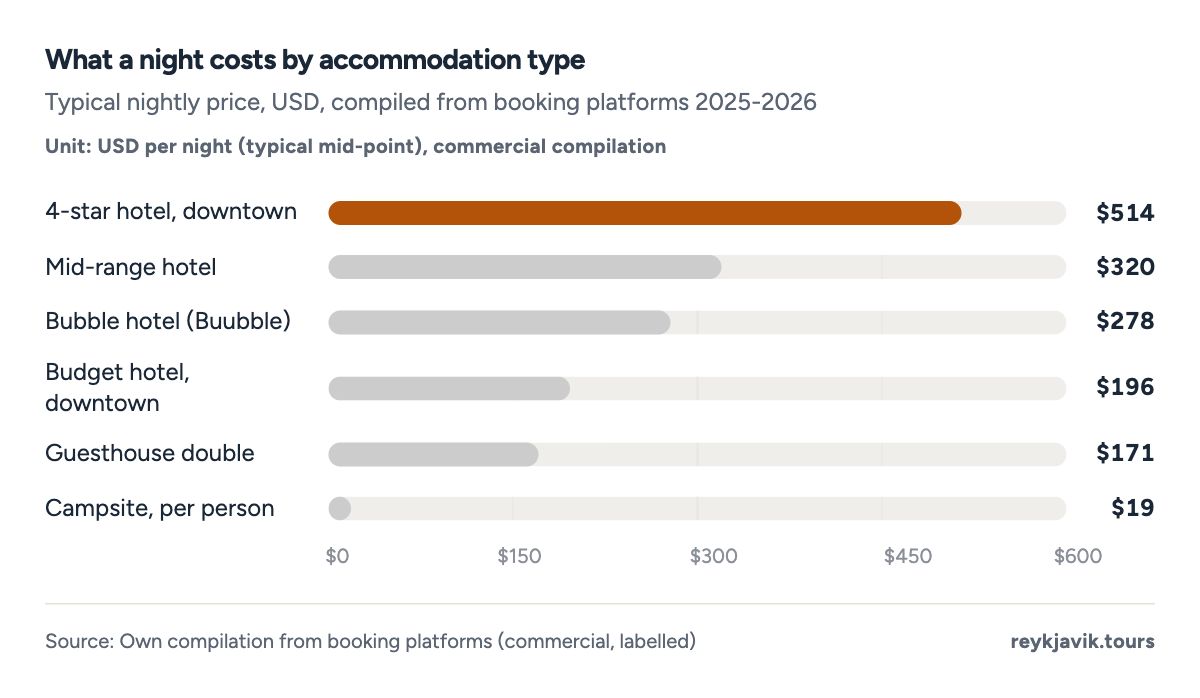
- A campsite pitch costs about 13 times less than a mid-range hotel room.
- The bubble hotel sits between guesthouse and 4-star prices.
- Downtown 4-star rooms average about 514 dollars a night.
| 4-star hotel, downtown | 514 | 65,982 |
| Mid-range hotel | 320 | 41,078 |
| Bubble hotel (Buubble) | 278 | 35,686 |
| Budget hotel, downtown | 196 | 25,160 |
| Guesthouse double | 171 | 21,951 |
| Campsite, per person | 19 | 2,439 |
What does a hotel cost in Iceland? The price table
The full price table, type by type, in dollars and kronur at the 2025 average exchange rate (128.4 ISK6 per dollar): campsites from $122 a night per person, guesthouse doubles around $1712, budget hotels $1964, mid-range $3204, 4-star $5144, and the transparent bubble hotels $2785 on average. Every one of these is a booking-platform figure - none is an official statistic, because none exists.
How much does a hotel cost in Iceland at the very top? The luxury tier - the Retreat at the Blue Lagoon or suite-level rooms in the capital - starts near $1,000 and passes $2,000 in high summer, but those are single properties, not a market price.
What the money buys has a distinctly Icelandic flavour at every level. Budget hotels here are clean, quiet and heated like saunas, but a "double" can measure 12 square metres - space is the first casualty of construction costs. Mid-range rooms typically include the famous breakfast buffer of skyr, smoked fish and pickled herring that many travellers turn into two meals a day. At the top end, the view is part of the price: a corner room facing Hallgrimskirkja or a floor-to- ceiling window on a fjord adds a visible premium over an identical room facing a stairwell. And almost every property, whatever its stars, will hand you the same practical assurances: a kettle, blackout curtains for the midnight sun, and a wake-up call worth of northern-lights alerts4.
Why so expensive? Three structural reasons, none of them gouging. First, construction: nearly every material - timber, concrete, elevators, even the labour - arrives by air or sea across a ocean, and new hotels here cost per room what a European city pays per suite. Second, season compression: the country sells most of its rooms in roughly ninety summer nights, so rates must recover a full year of costs in a single quarter - hence the July-to-January price ratio you will see in the occupancy section. Third, scale: with 183 hotels in the whole country, Iceland's entire hotel market is smaller than one mid-sized European city's, and small markets rarely produce bargains7. A note on room class that surprises first-time visitors: Iceland has relatively few true 5-star properties outside the capital, so the ladder from budget to luxury compresses into fewer rungs than in continental Europe. A "4-star" here often means a well-run 2010s-build with a restaurant and lagoon access, not marble lobbies and concierge desks. That is partly the market's age - mass tourism barely existed before 2010, so the stock is young but shallow - and partly geography: building a resort in a lava field an hour from anywhere prices out all but the boldest developer4.
Number of hotels in Iceland: where they are
Iceland counts 1837 registered hotels with 12,6967 bedrooms - and they are strikingly concentrated. The capital region has 597 and the South 557; together that is 62% of all hotels, while the entire Westfjords has 27 and the Northwest 37.
The count itself keeps climbing: the register held about 1507 hotels a decade ago and passes 1807 today, growth driven almost entirely by the tourism boom and by road-hotel development around the ring road7. Wondering how many Hilton hotel in Iceland options exist? Exactly one4 - the Hilton Reykjavik Nordica. Beyond it, the international chains are thin on the ground (the Hilton Reykjavik Nordica), a handful of Marriotts concentrated around Keflavik, and no Hyatts - the market is dominated by Icelandic groups such as Icelandair Hotels, Fosshotel and Berjaya1.
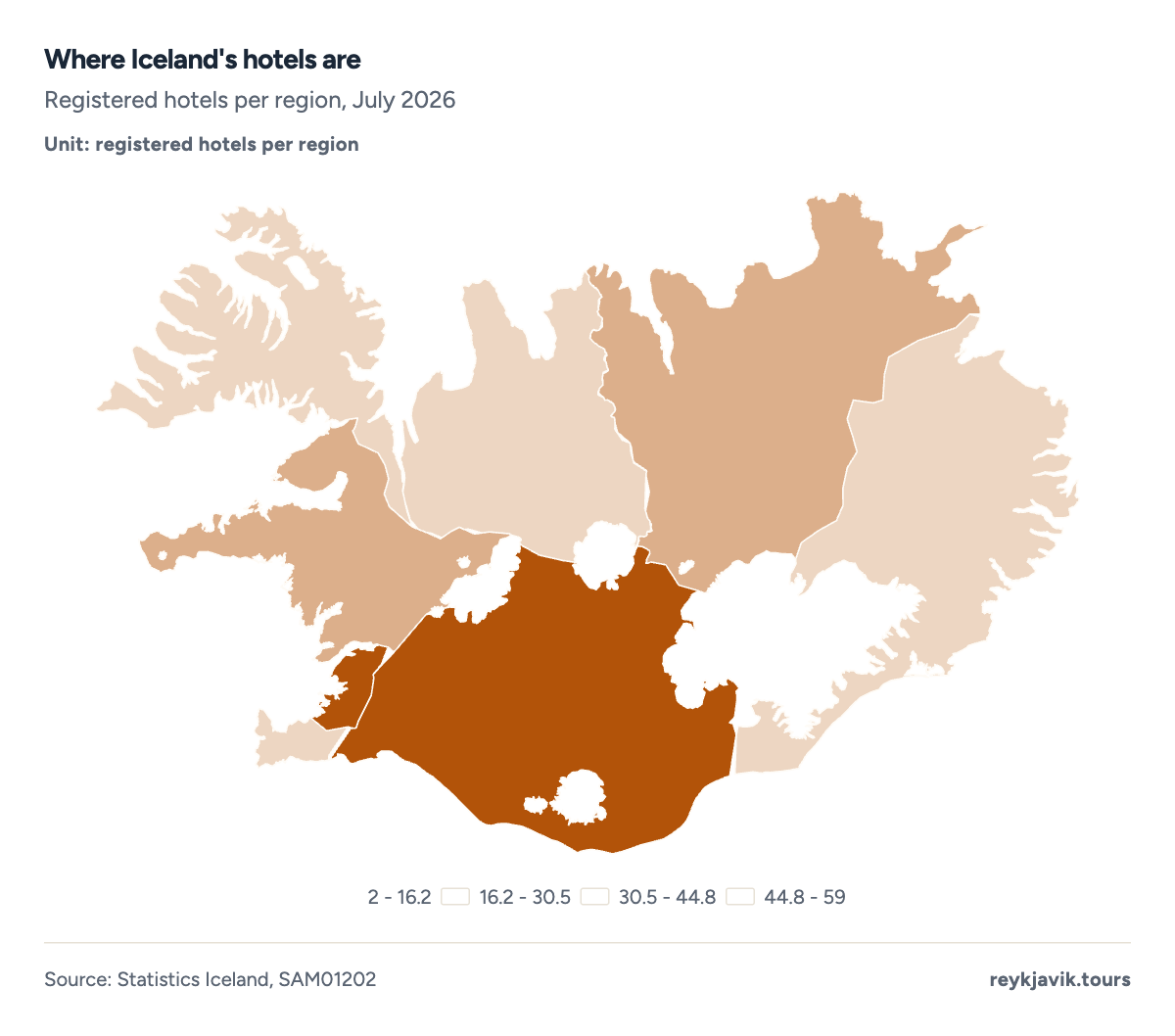
- The capital region holds 59 of Iceland's 183 registered hotels.
- The Westfjords and Northwest have 5 hotels between them.
- Two regions - capital and South - hold over 60% of all hotels.
| Capital region | 59 | 5,670 | 12,458 |
| South | 55 | 3,215 | 7,134 |
| Northeast | 21 | 1,288 | 2,812 |
| West | 18 | 854 | 1,831 |
| Southwest | 15 | 902 | 1,938 |
| East | 10 | 424 | 914 |
| Northwest | 3 | 182 | 413 |
| Westfjords | 2 | 161 | 561 |
| Total | 183 | 12,696 | 28,061 |
| 2015 | 96 |
| 2017 | 127 |
| 2019 | 148 |
| 2021 | 107 |
| 2023 | 156 |
| 2025 | 156 |
| 2026 | 163 |
Iceland hotel price per night: Reykjavik vs the country
The Iceland hotel price per night in Reykjavik 2025 listings: budget doubles at $143-249, 4-star at $250-779, with the cheapest bookable rooms in the capital from $921. Keflavik hotel rooms start slightly higher at $1061 - an airport premium - while along the south coast and in Akureyri, roadside hotels typically ask $150-250 in summer.
The average hotel price Reykjavik per night 2025 trackers publish sits near $180 for booked rooms, and price also moves with the calendar more than with the map. The same room that costs $180 in February sells for $350-500 in late July, and weekend rates in the capital run visibly above midweek ones. If your dates are fixed to high summer, book early; if they are flexible, the shoulder months of May-June and September deliver the same rooms at a third less.
Occupancy: why summer costs double
Hotel rooms occupied in July: 87.8%8. In January: 46.9%8. That gap is the whole pricing story: in high summer nearly nine in ten rooms are sold, so properties push rates up to the ceiling, while in winter half the beds stand empty and discounts do the selling.
The occupancy line also tells the industry's modern history. It climbed steadily from the low fifties in 2000 to a peak above 89%8 in the boom summers, collapsed to 46%8 in the 2020 pandemic year, and was back at 88.6%8 by the summer of 20238. Rooms are also being added every year - over 12,0007 bedrooms now - which keeps the national occupancy lower than the big-brand markets even in peak season.
For booking strategy, the occupancy curve translates directly into rules of thumb. Anything bookable in July within the capital region will not get cheaper - the 88% occupancy leaves no incentive to discount, so the first price you see is close to the floor. January and February are the reverse: half the rooms stand empty, walk-in rates are negotiable, and packages appear that would be unthinkable in summer. The shoulder months of May and September are the compromise the occupancy chart points to - above 70% in recent years, but with rates still visibly below the July ceiling8.
- July
- January
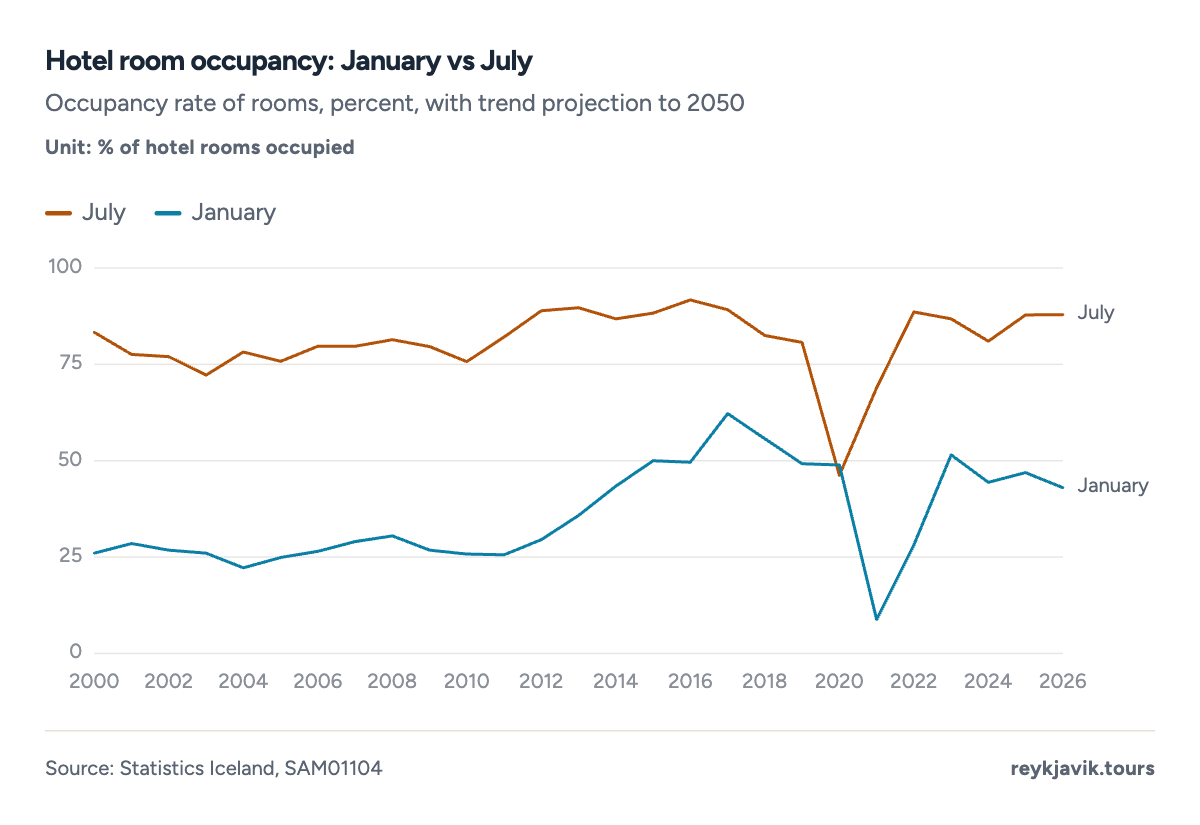
- July occupancy runs near 88%, January near 47% - the summer premium in one number.
- Occupancy collapsed to 46% in the 2020 pandemic year and recovered by 2023.
| January | 26.0 | 25.8 | 49.2 | 44.4 | 46.9 |
| July | 83.3 | 75.7 | 80.7 | 81.0 | 87.8 |
| August | 80.6 | 74.7 | 82.5 | 86.1 | 89.8 |
| Total | 52.7 | 46.5 | 64.5 | 65.9 | 67.2 |
How much are campsites in Iceland?
The budget alternative is dramatically cheaper: campsites charge 1,500-3,500 ISK2 per person per night - $12-272 - and that price is per person, not per vehicle; electricity, showers and laundry cost extra2. A campervan couple therefore pays roughly $24-54 a night before extras, versus $286 or more for a modest hotel room.
Between tent and hotel sits Iceland's most photographed bed: the bubble hotel. How much is the bubble hotel in Iceland? Buubble's transparent domes start around $1535 a night in low season and have reached $4045 in peak summer - for a transparent pod under the sky, breakfast included and a shared washroom nearby5.
Asking how much to stay in the ice hotel Iceland searches return nothing, because - there is no ice hotel in Iceland. The original ICEHOTEL operates in Jukkasjarvi, Sweden, with a Norway year-round variant9. Iceland's cold-season equivalents are the bubbles, mountain huts and countryside lodges; anyone selling you an "Iceland ice hotel" is selling a flight to Sweden with extra steps.
How much is hotel tax in Iceland?
Iceland charges a lodging tax on every night: 800 ISK10 per room-night (about $6.20) at hotels, guesthouses and licensed rentals, and 400 ISK10 at campsites and caravan sites, from 1 January 202510. The tax is included in quoted rates at licensed properties but charged separately at some smaller operations - worth checking when a price looks too good.
It stacks onto the general price level: hotels and restaurants together cost 67%3 more than the EU average, the second-highest markup in Europe after Switzerland3.
For the complete picture of what a night really costs, add three line items to the rack rate: the lodging tax above, which licensed properties fold into the quoted price; service, which carries no tipping obligation in Iceland - staff are salaried and adding a tip is a courtesy, not a duty; and the breakfast you may not need to buy, because the Nordic hotel breakfast is generous enough that locals joke about engineering an entire day's eating around it10. None of this makes Iceland a budget destination, but it does mean the sticker price, unusually for a capital city, is close to the final one.
Who fills the hotels
Hotels and guesthouses sold 6.75 million11 overnight stays in 2025, up from 5.57 million in 2017, with foreigners accounting for 89%11 of every night sold. The monthly column shows the seasonality behind the prices: July and August each clear a million nights while January manages roughly a third of that11.
The projection extends the pre-pandemic trend to 2050 - our calculation, not a forecast - and the honest range around it is wide, as 2020 erased 64% of demand in a single year11. What the official numbers cannot show is price: Iceland publishes occupancy and counts, but no average room rate, which is why this page's price figures come from live booking data and are labelled as such.
The citizenship split inside the stays table carries one more useful signal for price-watchers. Icelanders themselves took about 711,00011 hotel nights in 2025 - roughly two nights per islander per year, a figure that barely moves across a decade, because it reflects weddings, confirmations and hospital visits rather than tourism. The foreign line contains the entire demand curve that sets your room rate: when it doubles, so do prices; when it halved in 2020, rates followed within weeks11.
- 339JanJ
- 432FebF
- 498MarM
- 452AprA
- 536MayM
- 697JunJ
- 849JulJ
- 860AugA
- 698SepS
- 606OctO
- 424NovN
- 354DecD
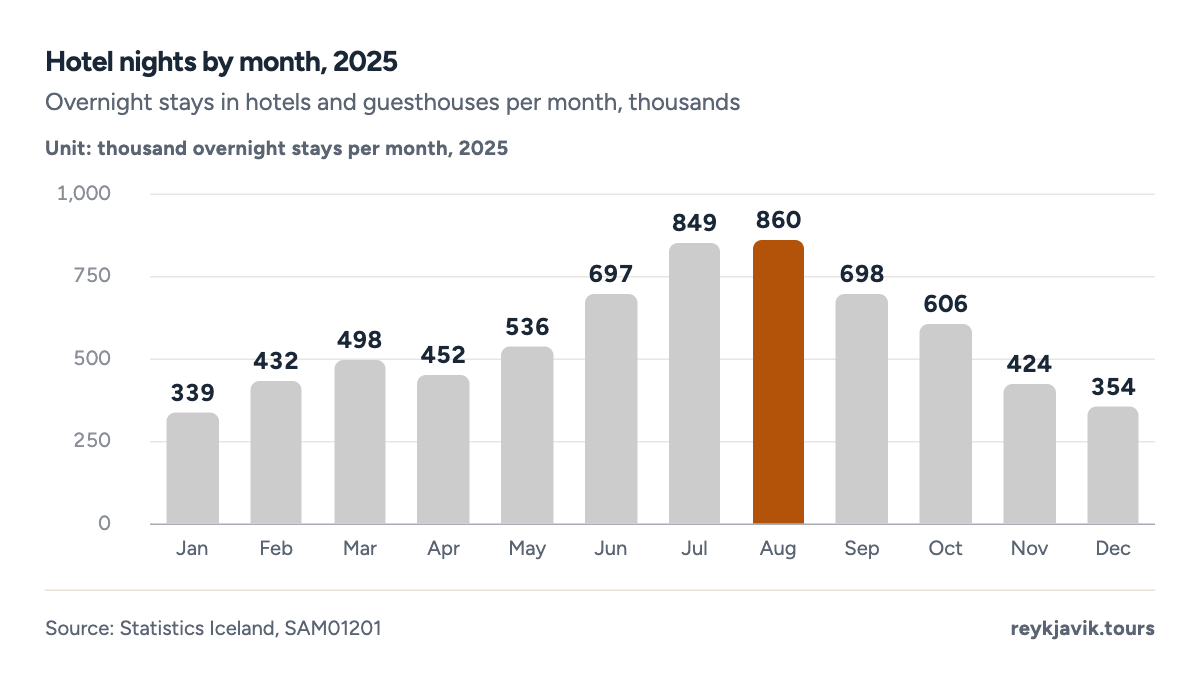
- July and August each pass a million hotel nights.
- January is the quietest month at roughly a third of the July level.
Projection: linear trend of 2017–2025 yearly values, 95% prediction range. Our calculation, not a forecast.
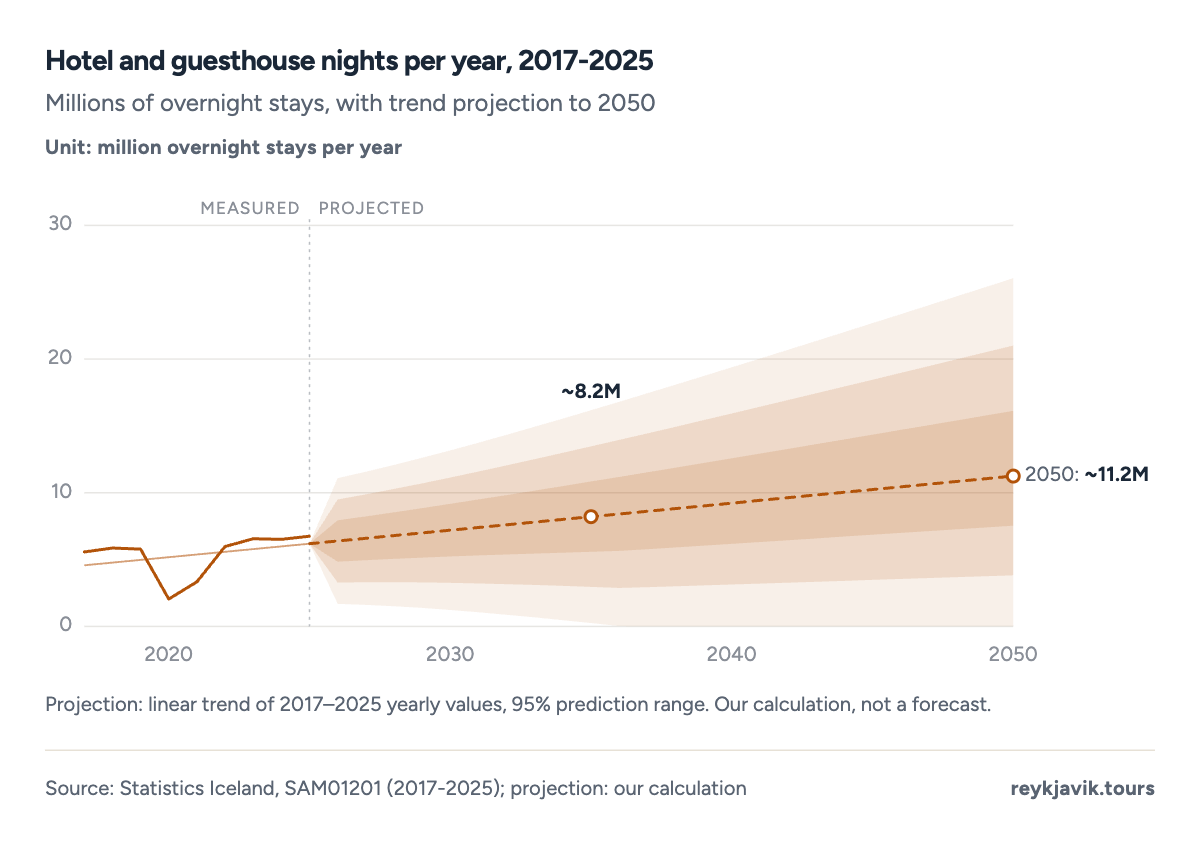
- Nights grew from 5.57M (2017) to 6.75M (2025), with the 2020 pandemic dip in between.
- Foreigners account for about 89% of all hotel nights.
| 2017 | 5.57 | 0.6 | 4.97 | 89.3 |
| 2018 | 5.86 | 0.66 | 5.2 | 88.7 |
| 2019 | 5.79 | 0.58 | 5.21 | 90.0 |
| 2020 | 2.05 | 0.72 | 1.33 | 65.0 |
| 2021 | 3.34 | 0.97 | 2.37 | 70.8 |
| 2022 | 5.98 | 0.95 | 5.03 | 84.1 |
| 2023 | 6.56 | 0.89 | 5.66 | 86.4 |
| 2024 | 6.51 | 0.98 | 5.53 | 85.0 |
| 2025 | 6.75 | 0.71 | 6.03 | 89.5 |
Conclusions
The numbers on this page circle one practical truth: Iceland's hotel bill is decided by when you book and where you stay, more than by any property choice or loyalty programme. Read the occupancy chart before the price table and the whole market makes sense. The specifics:
- Expect to pay $1964 a night for a typical mid-range double, $143-249 at the budget level downtown and $250-779 for 4 stars - prices compiled from booking platforms, because Iceland publishes no official room-rate statistic.
- The season is the multiplier: 87.8% July occupancy against 46.9% in January means the same room sells for roughly double in summer8.
- Geography concentrates the supply - 62% of Iceland's 183 hotels sit in the capital region and the South, which is exactly where prices are highest7.
- The cheap end is genuinely cheap: campsites at $12-27 a night per person undercut the cheapest hotel bed by a factor of eight, and the bubble hotels sell a $153-404 experience no hotel matches2.
- Budget the extras: 800 ISK lodging tax per night and a 67% price premium over the EU average are already inside every rate you are quoted10.
Methodology
- Hotel register (count, bedrooms, bedplaces): monthly to July 2026 (SAM01202)
- Occupancy of rooms: 2000-2026 (SAM01104)
- Overnight stays in hotels and guesthouses: 2017-2026 (SAM01201)
- Prices: booking-platform compilations, 2025-2026 (labelled commercial)
Definition. Hotels here means licensed hotels and guesthouses in the Statistics Iceland register. Occupancy rate of rooms = occupied room-nights over available room-nights. No official average room price is published in Iceland; all monetary price figures on this page are compiled from commercial booking platforms and labelled as such.
Data sources. Statistics Iceland tables SAM01202, SAM01104 and SAM01201; Skatturinn for the lodging tax; Eurostat price-level index; KAYAK, Guide to Iceland, Camping Card, Buubble and ICEHOTEL for commercial rates; Central Bank of Iceland for the 2025 average USD/ISK rate (128.37).
Calculations. ISK amounts are converted at the 2025 average rate of 128.37 ISK per USD. Typical nightly prices use the midpoint of each observed range. The foreigners' share divides foreign-citizen overnight stays by all stays. Projections are ordinary least-squares linear trends with a 95% prediction interval, computed by the renderer.
Limitations. No official price statistic exists; the price table reflects compiled booking data and moves with the market. The 2026 overnight-stay year is partial (to July) and excluded from the yearly chart. Campsite fees vary by site and services; the range shown covers the common interval. Bubble-hotel rates change by season and location.
Sources
- KAYAK. “Iceland hotels: nightly rates from booking data.” KAYAK (commercial), 2026. kayak.com. Accessed 2026-09-17. Back to text
- Guide to Iceland / Camping Card. “Campsite fees in Iceland, per person per night.” commercial sources, labelled, 2026. guidetoiceland.is. Accessed 2026-09-17. Back to text
- Eurostat. “Price level index for restaurants and hotels, EU=100.” European Commission, 2025. ec.europa.eu. Accessed 2026-09-17. Back to text
- Reykjavik Tours (own compilation). “Reykjavik hotel rates compiled from booking platforms, 2025-2026.” commercial rates, labelled, 2026. reykjavik.tours. Accessed 2026-09-17. Back to text
- Buubble. “Bubble hotel rates, Hrosshagi and locations.” Buubble (commercial), 2026. buubble.com. Accessed 2026-09-17. Back to text
- Central Bank of Iceland. “Average USD/ISK exchange rate 2025.” Central Bank of Iceland, 2026. cb.is. Accessed 2026-09-17. Back to text
- Statistics Iceland. “Number of hotels, bedrooms and bedplaces in regions (SAM01202).” Statistics Iceland, 2026. hagstofa.is. Accessed 2026-09-17. Back to text
- Statistics Iceland. “Occupancy rate of rooms in hotels 2000-2026 (SAM01104).” Statistics Iceland, 2026. hagstofa.is. Accessed 2026-09-17. Back to text
- ICEHOTEL. “ICEHOTEL, Jukkasjarvi, Sweden - the original ice hotel.” ICEHOTEL Sweden, 2026. icehotel.com. Accessed 2026-09-17. Back to text
- Skatturinn (Iceland Revenue and Customs). “Lodging tax from 1 January 2025.” Skatturinn, 2025. skatturinn.is. Accessed 2026-09-17. Back to text
- Statistics Iceland. “Overnight stays in hotels and guesthouses (SAM01201).” Statistics Iceland, 2026. hagstofa.is. Accessed 2026-09-17. Back to text
About the author
Laufey turns public statistics on tourism and travel into research people can check and cite.
Every figure on this page links to its source. How we research
Related research
More data on Iceland's weather and travel from Reykjavik Tours.
- TravelHow Much Is a Trip to Iceland? (2026 Data)$1,766 average a visitor spends in IcelandRead the research →
- TransportHow Many Airports in Iceland? (2026 Data)33 airports in IcelandRead the research →
- TravelHow Many Days in Iceland? (2026 Data)7.1 nights average stay of foreign visitorsRead the research →
- NatureHow Many Waterfalls in Iceland? (2026 Data)1,624 named waterfalls in IcelandRead the research →
- PricesHow Much Is Food in Iceland? (2026 Data)44% above the EU average for food pricesRead the research →
- PricesHow Much Is Gas in Iceland? (2026 Data)259 ISK average petrol price in Iceland, per litreRead the research →