How Many Days in Iceland? (2026 Data)
How long visitors really stay, where they spend their nights, and how many days the Golden Circle, the South Coast and the Ring Road need in summer and winter.
- Published
- Updated
- 15 sources
- 117 statistics
- 9 min read

- M.Sc. in Atmospheric Sciences, University of Iceland (Háskóli Íslands), with a minor thesis on North Atlantic storm-track variability
- Former research assistant at the Icelandic Meteorological Office (Veðurstofa Íslands), working on subarctic climate modeling and volcanic-ash dispersion forecasting
- B.A. in Sociology, also from the University of Iceland, with fieldwork on rural depopulation and tourism's impact on small fishing communities (Westfjords focus)
- Grew up in Akureyri, spent seven years living in Reykjavík and two in a small village in the Westfjords - brings first-hand experience of Iceland's regional weather extremes and community life
- Fluent in Icelandic and English; has translated Icelandic Met Office public advisories for international outlets
- Published field notes and data-driven pieces on glacier retreat (Vatnajökull), aurora forecasting, and the socioeconomic effects of overtourism in the Golden Circle

- M.A. in Journalism, University of Iceland, with additional coursework in Environmental Communication at the University of Bergen (Norway), giving a comparative Nordic lens
- 12+ years in Icelandic media, including editorial roles at RÚV (Iceland's national broadcaster) covering weather-related public safety reporting (storms, volcanic eruptions, road closures)
- Former fact-checking lead for a travel-and-culture desk, specializing in verifying tourism statistics, safety advisories, and climate data against primary sources (Vedur.is, Statistics Iceland)
- Has overseen editorial standards for bilingual (Icelandic/English) publications, ensuring both cultural nuance and accuracy for international readers
- Advocate for citing primary sources (Icelandic Met Office, Icelandic Tourist Board / Ferðamálastofa) rather than secondhand reporting
Key findings
- 7.1 nightsForeign visitors spend 7.1 nights in Iceland on average, according to the Icelandic Tourist Board.
- 6.2 nightsAmerican visitors stay 6.2 nights in Iceland on average, shorter than Germans at 9.8 nights.
- 8.4 nightsVisitors stay longest in August, 8.4 nights on average, and shortest in February and December, 5.4 nights.
- 20.6 hoursIceland's Ring Road is about 813 miles long, and a non-stop loop from Reykjavík takes about 20.6 hours.
- 5 daysA Ring Road trip needs about 5 days in summer and 8 days in winter, by our calculation.
- 157 milesThe Golden Circle loop from Reykjavík is 157 miles and takes about 4 hours of driving.
- 86%Most foreign visitors, 86%, spend time in the capital region, while 15% reach the Westfjords.
- 2.5 to 3.5 hoursA typical Blue Lagoon visit lasts 2.5 to 3.5 hours, according to the operator.
The average foreign visitor spends about a week in Iceland: 7.1 nights1 in 2025. That sounds generous until the map comes out. A non-stop loop of the Ring Road from Reykjavík takes about 20.6 hours2 of driving, and in the middle of winter Reykjavík gets only 4.3 hours3 of daylight. Too few days, and a trip to Iceland becomes a trip spent in the car.
The numbers also show how differently people use their week. Americans, the largest group of visitors,1 stay 6.2 nights4, far shorter than Germans at 9.8 nights4. By our calculation, the full Ring Road needs about 5 days5 in summer but 8 days5 in winter, and while almost every visitor sees the capital region, only 15%1 make it to the Westfjords. This report combines Icelandic Tourist Board surveys, Statistics Iceland's accommodation data and map routing to show how long visitors stay and how many days each trip really needs.
How long visitors actually stay
The Icelandic Tourist Board asks departing visitors at Keflavík Airport how long they stayed. In 2025 the average was 7.1 nights1, similar to the year before. Stays have grown slightly longer since 2018: 6.3 nights6 in 2018, 6.6 nights6 in 2019 and 7.4 nights6 in 2022. No yearly average was published for 2020 and 2021, and 2024 was reported only as similar to 2025. The Tourist Board's separate survey of visitors from May to December 2022 found an average of 7.6 nights7 for that part of the year, which includes the long summer stays.
| 2018 | 6.3 |
| 2019 | 6.6 |
| 2022 | 7.4 |
| 2023 | 7.0 |
| 2025 | 7.1 |
How many nights in Iceland do visitors stay?
An average hides very different trips. In the Tourist Board's survey of May to December 2022, 36%7 of visitors stayed one to three nights, just under half stayed four to eight nights, and just under a fifth stayed nine nights or more. The same survey shows how they moved around:
- Rental car: three in five visitors named it as a means of transport
- Organised bus tour: about a fifth
- Public transport: about 3%7
- Other means: about 14%7
The month matters too. Summer visitors stay longest: 8.4 nights4 in August and 8.2 nights4 in July. The shortest trips fall in February and December, at 5.4 nights4.
- 5.8JanJ
- 5.4FebF
- 6.3MarM
- 6.5AprA
- 6.7MayM
- 7.8JunJ
- 8.2JulJ
- 8.4AugA
- 7.8SepS
- 6.9OctO
- 5.6NovN
- 5.4DecD
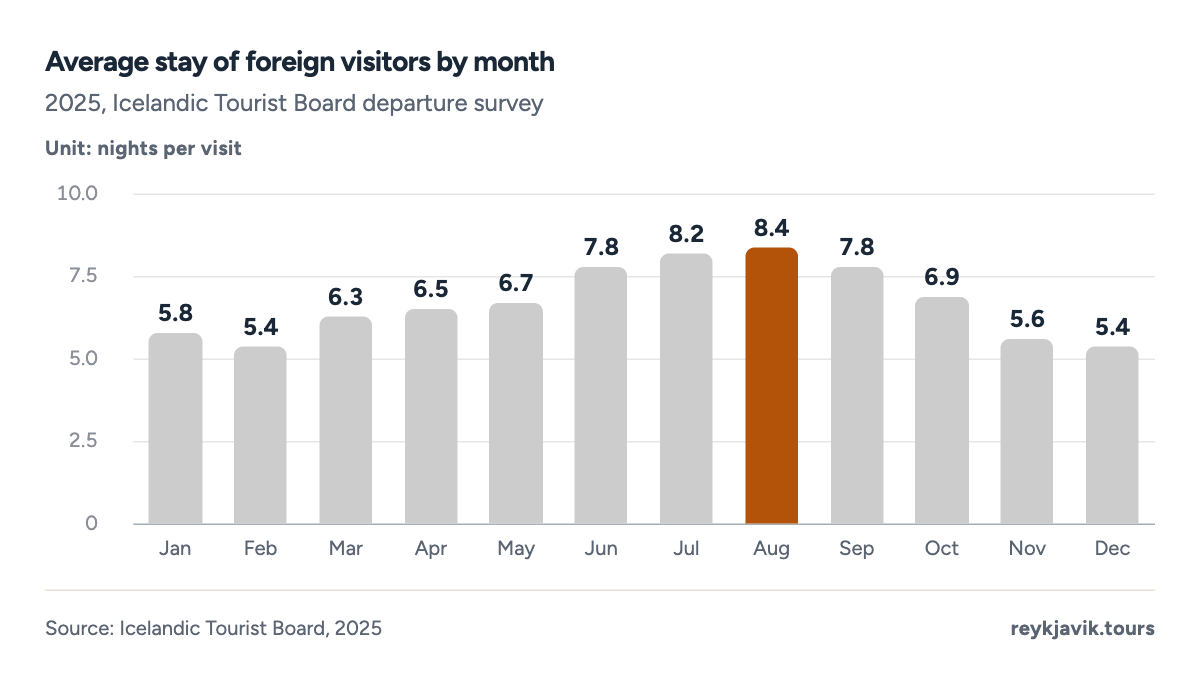
- August has the longest average stay at 8.4 nights.
- February and December have the shortest at 5.4 nights.
Nationality makes an even bigger difference. Among the ten largest groups of visitors in 2025, Germans stayed longest at 9.8 nights4 and the French next at 9.3 nights4. Visitors from the United States, by far the largest group,1 stayed 6.2 nights4. Only Chinese visitors, at 5.9 nights4, and British visitors, at 5.0 nights4, stayed for less. In between came visitors from Spain (8.14 nights), Italy (7.84), Poland (7.14), Denmark (7.04) and Canada (6.74).
American stays have grown over time, from 5.4 nights6 in 2018 and 5.6 nights6 in 2019 to 6.6 nights6 in 2022, then 6.4 nights6 in 2023, before easing to 6.2 nights4 in 2025.
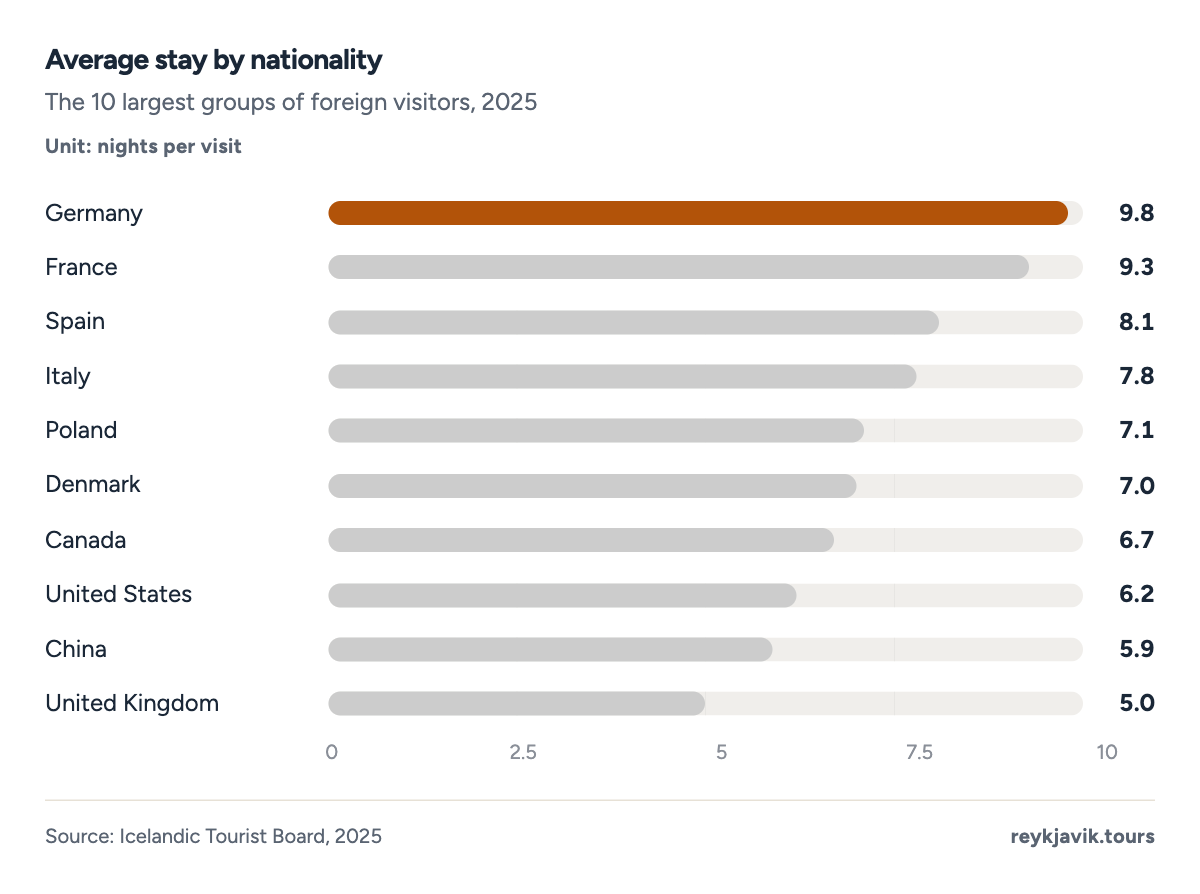
- German visitors stay longest at 9.8 nights.
- British visitors stay shortest at 5.0 nights.
| United States | 6.2 | 6.4 | 6.6 | 5.6 | 5.4 |
| United Kingdom | 5.0 | 4.9 | 5.4 | – | – |
| Germany | 9.8 | 9.6 | 9.8 | – | – |
| China | 5.9 | 6.2 | – | – | – |
| France | 9.3 | 9.4 | 9.1 | – | – |
| Italy | 7.8 | 7.9 | 8.4 | – | – |
| Canada | 6.7 | 7.0 | 7.2 | – | – |
| Poland | 7.1 | 6.5 | 8.4 | – | – |
| Spain | 8.1 | 8.6 | 8.5 | – | – |
| Denmark | 7.0 | – | 6.9 | – | – |
| Netherlands | – | 7.9 | 8.6 | – | – |
Where visitors spend their nights
A week in Iceland is, for most visitors, a week in the southwest. In 2025, 86%1 of foreign visitors spent time in the capital region and 79%1 in the South. The Reykjanes peninsula, home to the international airport, drew 65%1. Further away, the shares drop quickly: 49%1 visited the West, 34%1 the North, 31%1 the East and 15%1 the Westfjords.
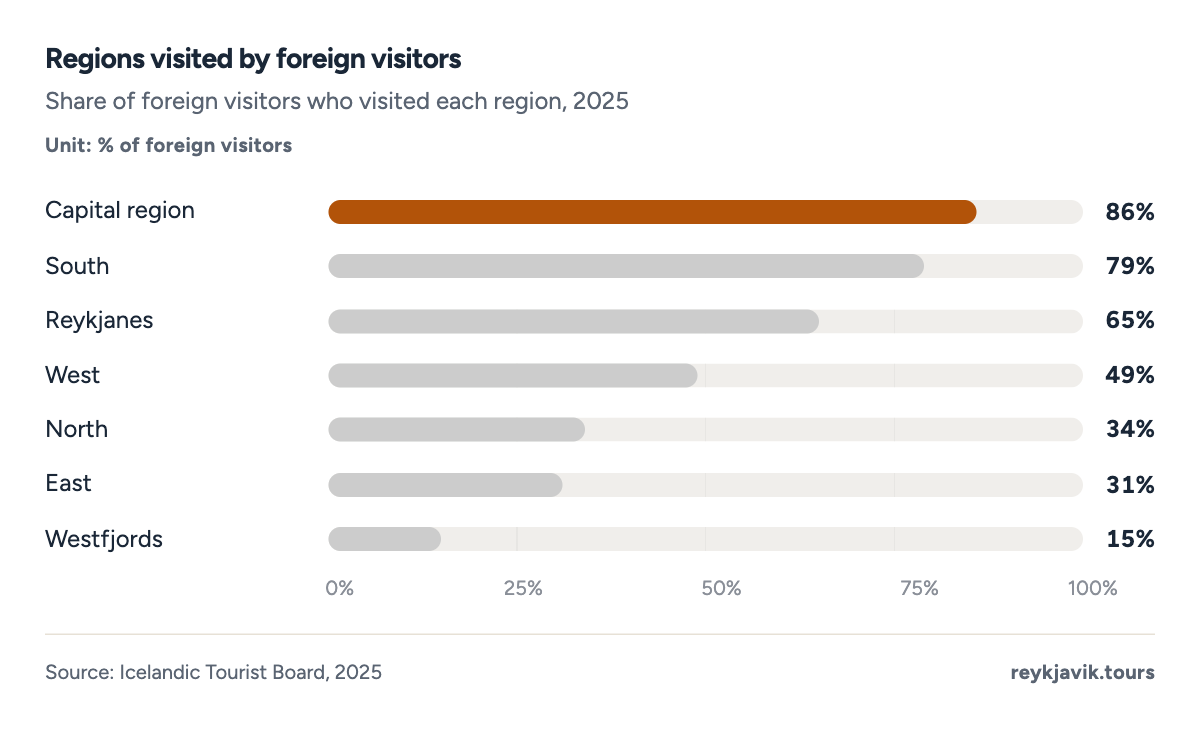
- The capital region was visited by 86% of visitors.
- The Westfjords were visited by 15%.
Those who stay overnight in a region do not stay long. In the 2022 survey, visitors who slept in the capital region spent an average of 3.3 nights7 there, and those who slept in the South 3.2 nights7. In the North and the Westfjords it was 2.5 nights7, and in other regions just under two.
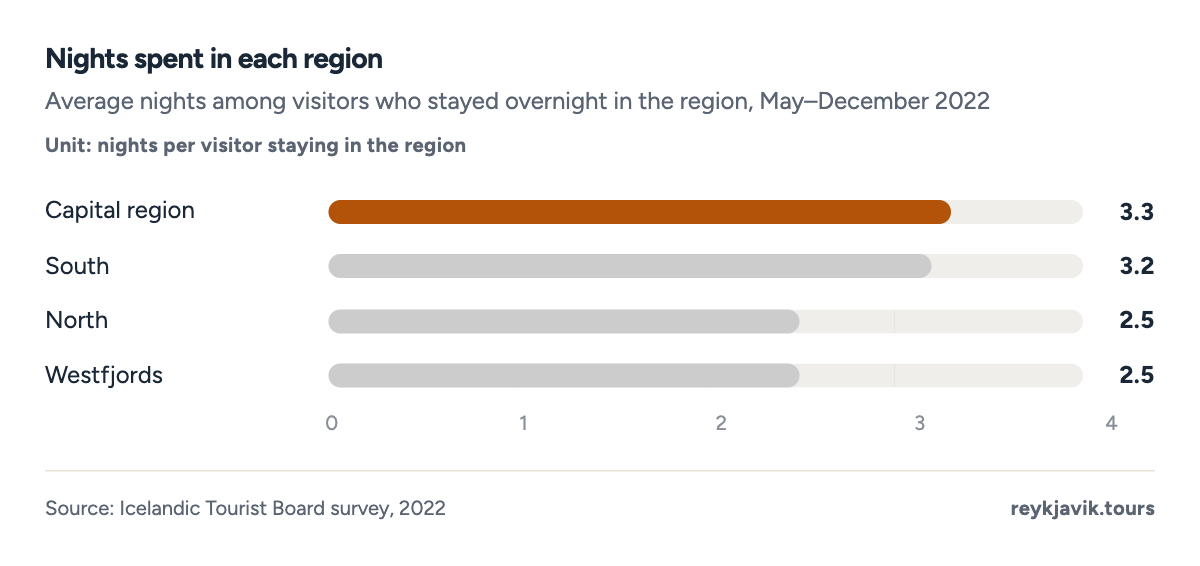
- Visitors staying in the capital region spend 3.3 nights there.
- Visitors staying in the South spend 3.2 nights there.
Statistics Iceland's accommodation figures confirm the pattern. Foreign guests booked 8,553,5828 overnight stays in registered accommodation in 2025. The capital region took 40.1%8 of them and the South 30.0%8, together seven in ten nights. The busiest month was July, with 1,315,6348 overnight stays, almost four times as many as in January. August followed closely with 1,298,1948, and June brought 950,8968; December had just 387,8578.
Outside the two biggest regions, the Northeast had 743,9518 foreign overnight stays, the West 562,7908 and the Southern Peninsula around the airport 555,3498. The East had 393,2048, while the Westfjords, with 159,2748, and the Northwest, with 146,5378, together accounted for under 4% of all nights.
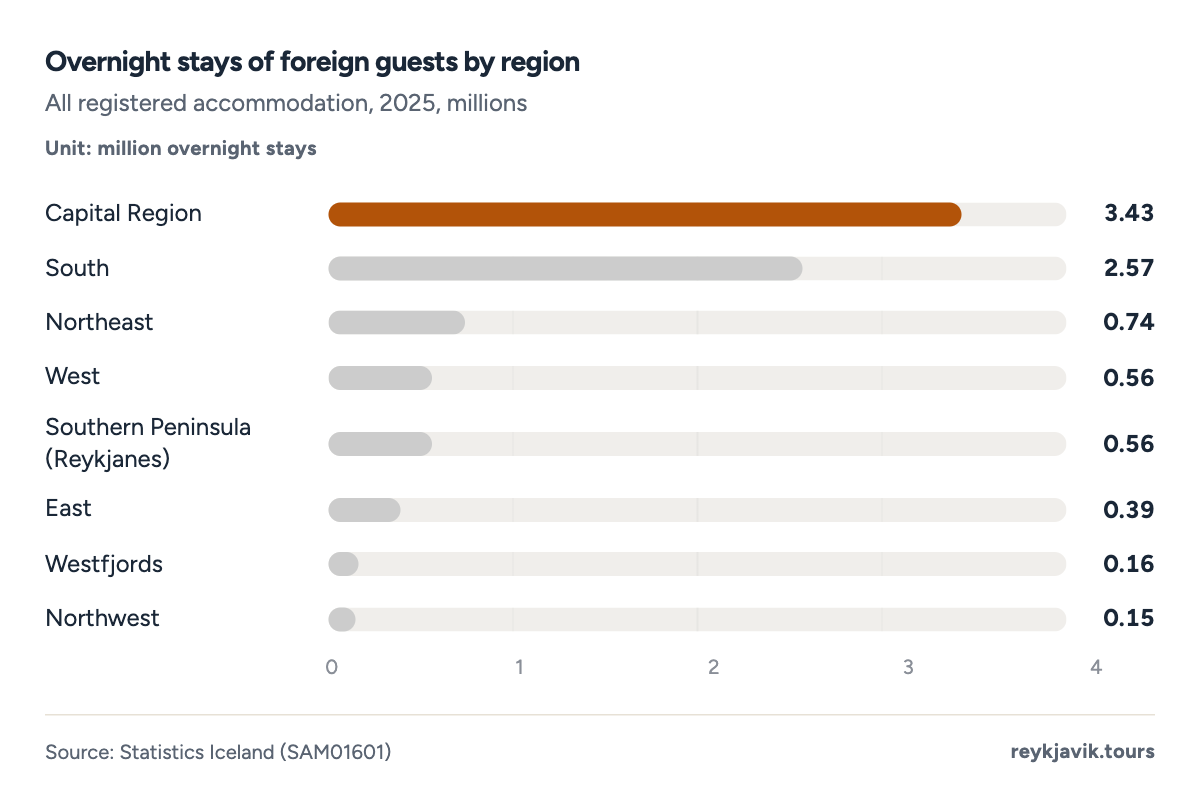
- The capital region had 3.43 million foreign overnight stays.
- The South had 2.57 million.
- 0.35JanJ
- 0.48FebF
- 0.56MarM
- 0.53AprA
- 0.64MayM
- 0.95JunJ
- 1.32JulJ
- 1.30AugA
- 0.90SepS
- 0.70OctO
- 0.45NovN
- 0.39DecD
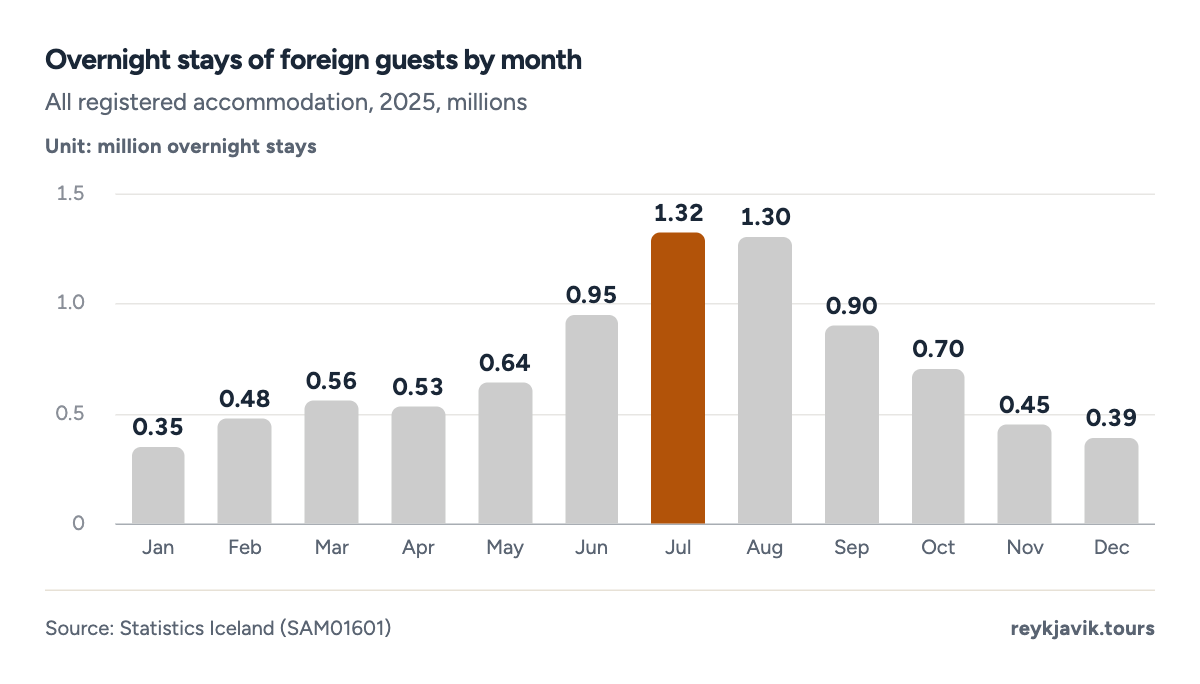
- July had the most foreign overnight stays, 1.32 million.
- January had the fewest, 0.35 million.
| Capital Region | 3,425,940 | 40.1 |
| South | 2,566,537 | 30.0 |
| Northeast | 743,951 | 8.7 |
| West | 562,790 | 6.6 |
| Southern Peninsula (Reykjanes) | 555,349 | 6.5 |
| East | 393,204 | 4.6 |
| Westfjords | 159,274 | 1.9 |
| Northwest | 146,537 | 1.7 |
So how many days does a trip really need?
How many days in Iceland is enough
To turn distances into days, this report uses a simple rule. A day includes no more than 5 hours5 of driving. In summer, a sightseeing day lasts up to 10 hours5; in winter it is limited to the daylight, which in mid-January is only 5.3 hours3 in Reykjavík. Each stop gets a typical visit time, such as 1.5 hours5 at Þingvellir or at Jökulsárlón. A trip needs as many days as either the driving or the total time requires, whichever is more.
Speed limits set the pace. Icelandic law caps speeds at 31 mph9 (50 km/h) in towns, 50 mph9 (80 km/h) on gravel roads and 56 mph9 (90 km/h) on paved roads, and no road may be signed above 68 mph9 (110 km/h).
With those rules, the Golden Circle fits into one summer day and the South Coast to Vík into two. A trip to the Jökulsárlón glacier lagoon needs 3 days5 in summer and 4 days5 in winter, and the full Ring Road 5 days5 in summer and 8 days5 in winter. The South Coast to Vík and back combines 5.9 hours5 of driving with about 3.5 hours5 at Seljalandsfoss, Skógafoss and the black-sand beach, so it takes 2 days5 in either season. The Snæfellsnes peninsula needs 2 days5 as well, and a Blue Lagoon visit fits into 1 day5 all year. These are minimums for seeing the main stops, not relaxed itineraries.
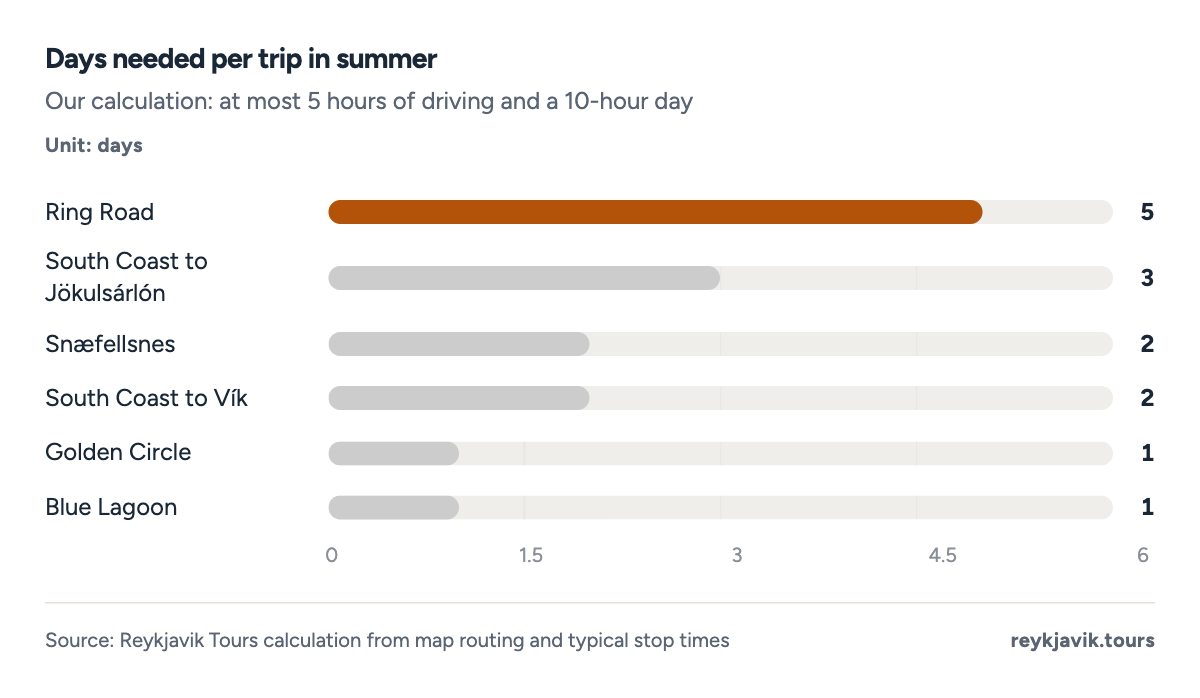
- The Ring Road needs 5 days in summer.
- The Golden Circle fits into 1 day.
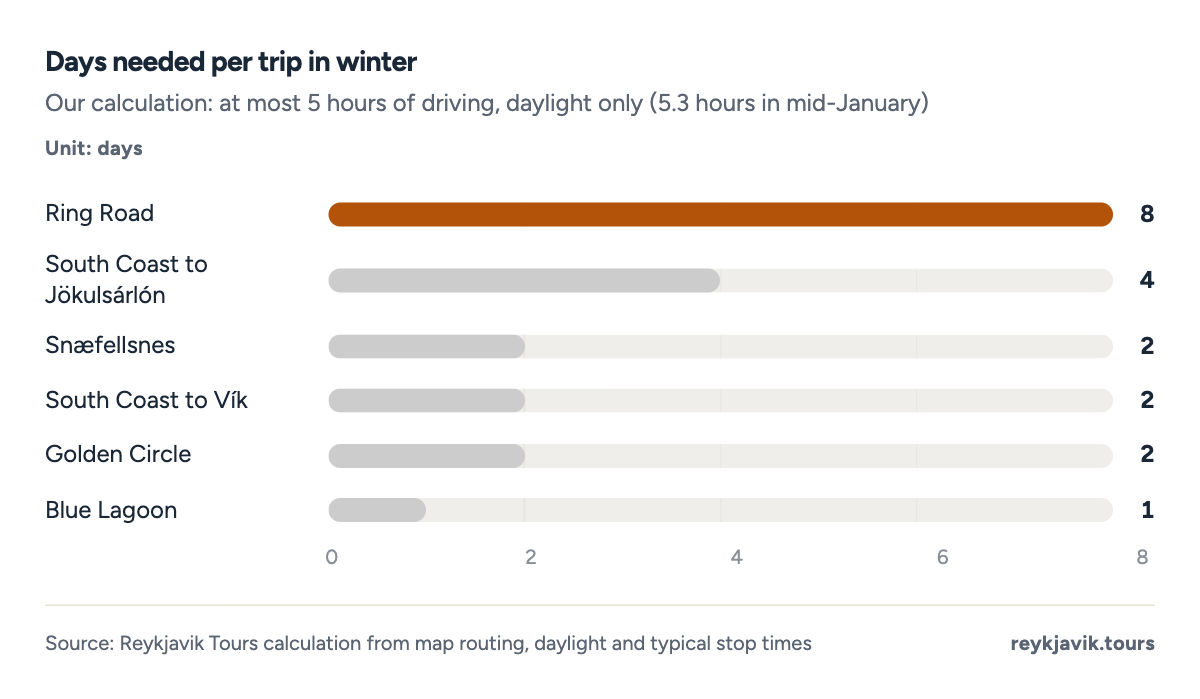
- The Ring Road needs 8 days in winter.
- The Golden Circle needs 2 days.
| Ring Road | 20.6 | 828 | 20.0 | 5 | 8 |
| South Coast to Jökulsárlón | 11.8 | 475 | 5.0 | 3 | 4 |
| Snæfellsnes | 6.6 | 266 | 3.0 | 2 | 2 |
| South Coast to Vík | 5.9 | 238 | 3.5 | 2 | 2 |
| Golden Circle | 4.0 | 157 | 4.0 | 1 | 2 |
| Blue Lagoon | 1.6 | 60 | 3.0 | 1 | 1 |
| Towns and built-up areas | 31 | 50 |
| Gravel roads | 50 | 80 |
| Paved roads | 56 | 90 |
| Highest limit that may be signed | 68 | 110 |
How many days to drive around Iceland
Iceland's Ring Road, Route 1, has long been cited as about 1,321–1,322 km10, and the new Hornafjörður section that opened on 24 June 2026 shortened it by 12 km11. That makes today's Ring Road about 813 miles11 (1,309 km). A routed loop that starts and ends in central Reykjavík comes to 828 miles2 (1333 km) and about 20.6 hours2 of driving without a single stop.
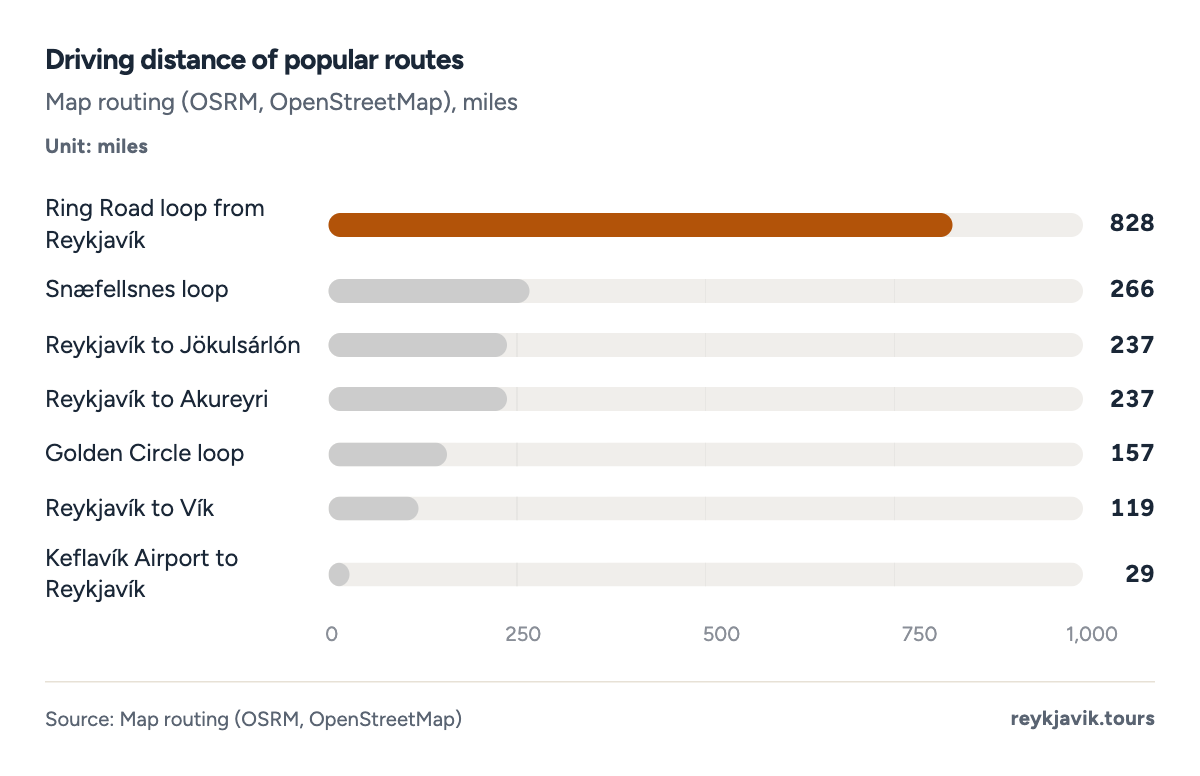
- The Ring Road loop is 828 miles.
- The Golden Circle loop is 157 miles.
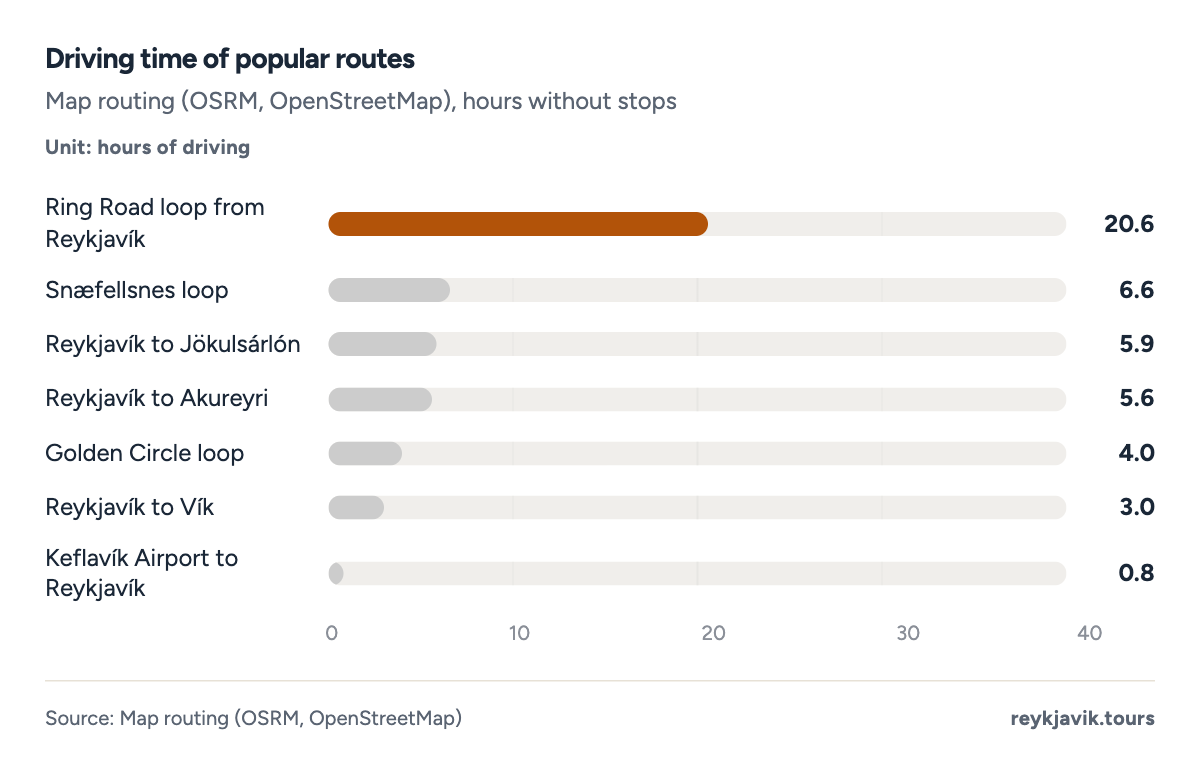
- The Ring Road loop takes 20.6 hours of driving.
- The airport transfer takes 46 minutes.
| Ring Road loop from Reykjavík | 828 | 1,333 | 20.6 |
| Snæfellsnes loop | 266 | 428 | 6.6 |
| Reykjavík to Jökulsárlón | 237 | 382 | 5.9 |
| Reykjavík to Akureyri | 237 | 381 | 5.6 |
| Golden Circle loop | 157 | 253 | 4.0 |
| Reykjavík to Vík | 119 | 191 | 3.0 |
| Keflavík Airport to Reykjavík | 29 | 46 | 0.8 |
Iceland Ring Road: how many days?
The routed loop in this report follows Route 1 through Borgarnes, Akureyri, Reykjahlíð (Mývatn), Egilsstaðir, Fáskrúðsfjörður, Höfn, Jökulsárlón, Vík and Selfoss before returning to Reykjavík. Driving time is only part of the answer. Split into days of no more than 5 hours at the wheel, the 20.6 hours2 of driving need at least five days on their own. Add about 20 hours5 for stops along the way, and the calculation arrives at 5 days5 in summer. In winter, when a day of daylight is little more than 5 hours, the same loop needs 8 days5.
How many days for Golden Circle, Iceland?
The classic loop from Reykjavík via Þingvellir, Geysir, Gullfoss and the Kerið crater is 157 miles2 (253 km) and about 4.0 hours2 of driving. The legs are short: Reykjavík to Þingvellir is 28.9 miles2, Þingvellir to Geysir 37.6 miles2, and Geysir to Gullfoss only 14.6 miles2, about 22 minutes2. The return via Kerið adds 33.9 miles2 and then 41.9 miles2 back to the city. With about 4 hours5 at the stops, it fills a single summer day. In winter the same plan does not fit into the light, so it becomes a 2-day5 trip or a shorter loop.
The South Coast adds distance quickly. Reykjavík to Vík, via the Seljalandsfoss and Skógafoss waterfalls, is 119 miles2 and 3.0 hours2 one way; continuing to Jökulsárlón makes it 237 miles2 and 5.9 hours2. The Snæfellsnes peninsula loop is 266 miles2 and 6.6 hours2, and the drive from Reykjavík to Akureyri in the north takes 5.6 hours2 one way.
How many days in Reykjavik
Reykjavík is the one part of a trip that needs no long drives. Keflavík Airport is 29 miles2 away, about 46 minutes2 by car. Visitors who stay overnight in the capital region spend an average of 3.3 nights7 there, the longest of any region. The capital also takes the largest share of foreign overnight stays, 3,425,9408 in 2025, and its hotel rooms were 74.8%1 occupied over the year, against 67.3%1 for Iceland as a whole. Across the country, hotels accounted for 53.5%1 of all registered overnight stays in 2025, and other types of registered accommodation made up the rest.
For travellers crossing the Atlantic, a short stay can be added to the flight itself. Icelandair's stopover programme lets passengers "add a Stopover in Iceland at no additional airfare" and "stay for a night, or up to a week".12
How much time do you need at Blue Lagoon, Iceland?
The Blue Lagoon is about 30 miles2 from Reykjavík, roughly 48 minutes2 by car. The operator gives two answers. Its guide says that "2.5 to 3.5 hours is the typical length of a Blue Lagoon visit",13 with 1.5 to 2 hours enough on a tight schedule, and it suggests allowing at least 4 to 5 hours for visitors who also want to use the facilities and sit down for a proper meal. Its support page puts the average total time at four hours14, with about two hours in the water. Either way, it takes half a day including the drive.
Daylight and season
The season decides how much of each day can be used. In Reykjavík, daylight on the 15th of the month ranges from 4.3 hours3 in December to 21.0 hours3 in June. Akureyri in the north has even bigger swings: 3.3 hours3 in December and 23.0 hours3 in June.
The spring and autumn months sit in between: mid-March has about 11.6 hours3 of daylight in Reykjavík and mid-September about 13.2 hours3, enough for most day trips.
The crowds follow the light. In 2025, 312,96415 foreign visitors left through Keflavík in August, the busiest month, and 302,05715 in July, against 120,01615 in December and 121,59015 in January. The busiest months are also the months with the longest stays, so summer brings both more visitors and longer trips.
- Reykjavík
- Akureyri
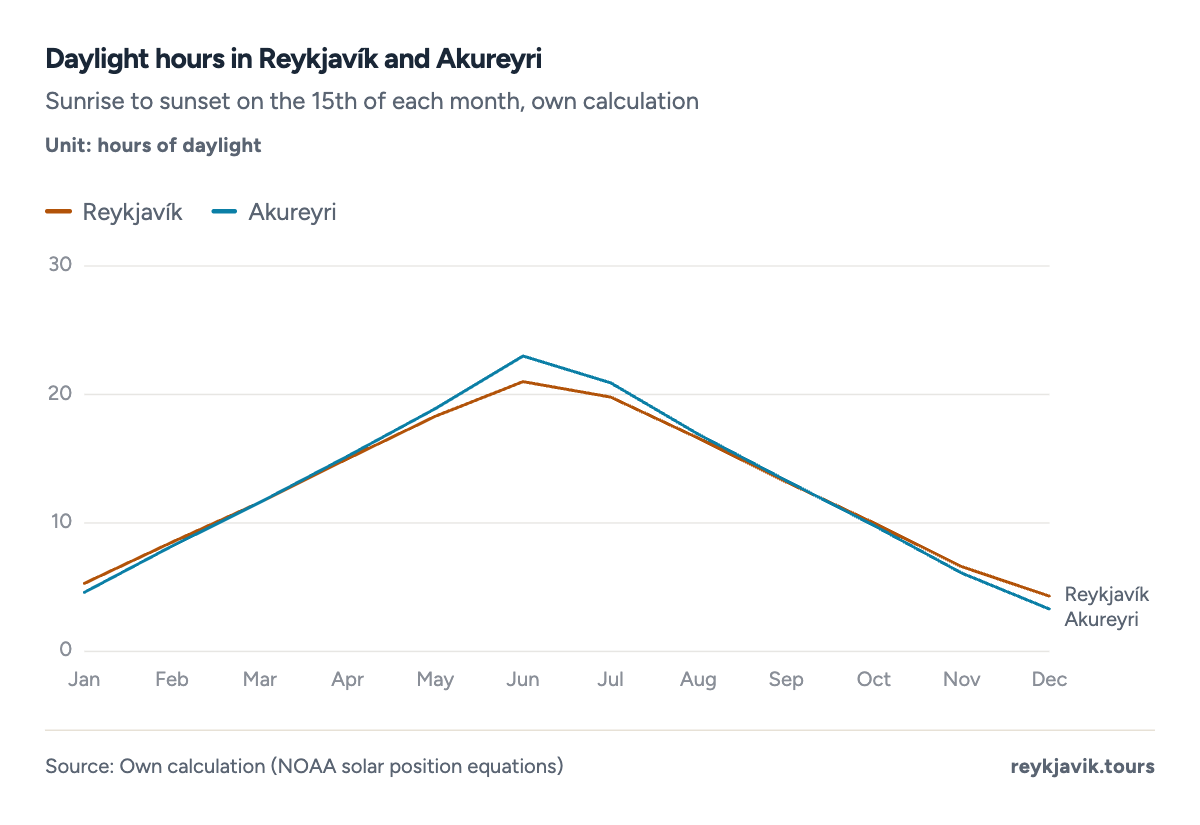
- Akureyri has 23.0 h of daylight in mid-June.
- Reykjavík has 4.3 h in mid-December.
- 122JanJ
- 149FebF
- 152MarM
- 149AprA
- 160MayM
- 234JunJ
- 302JulJ
- 313AugA
- 224SepS
- 201OctO
- 142NovN
- 120DecD
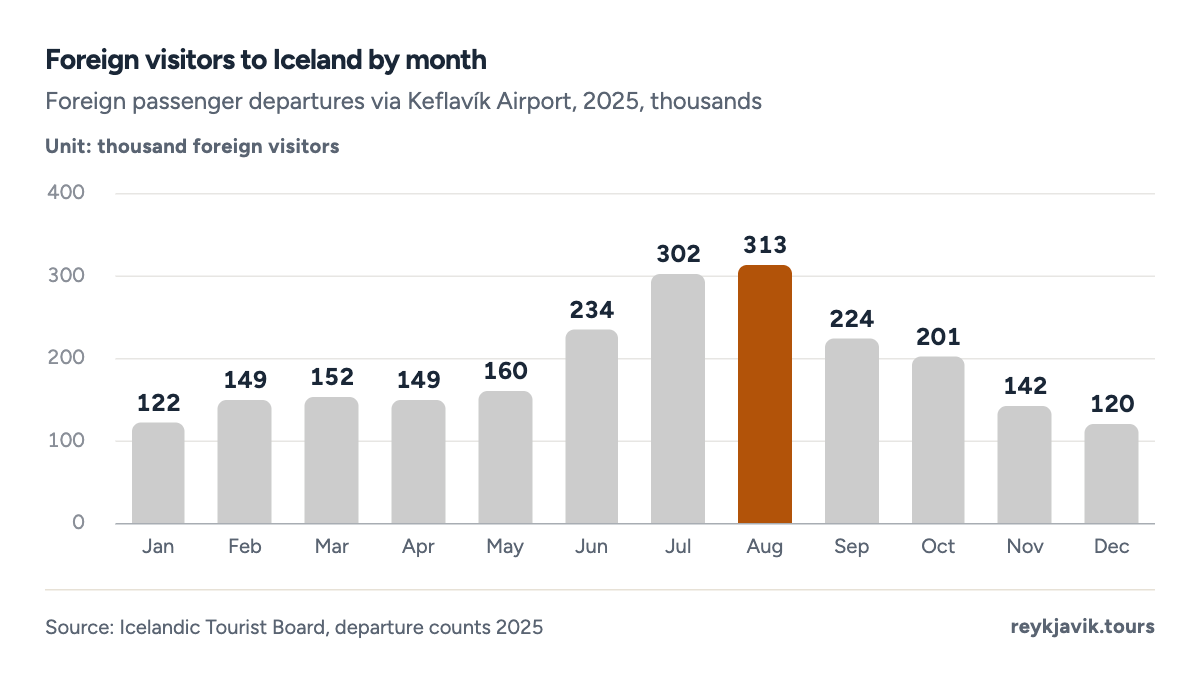
- August had 312,964 foreign departures.
- December had 120,016.
| January | 5.3 | 4.6 |
| February | 8.5 | 8.2 |
| March | 11.6 | 11.6 |
| April | 15.0 | 15.2 |
| May | 18.3 | 18.9 |
| June | 21.0 | 23.0 |
| July | 19.8 | 20.9 |
| August | 16.6 | 16.9 |
| September | 13.2 | 13.3 |
| October | 10.0 | 9.8 |
| November | 6.6 | 6.1 |
| December | 4.3 | 3.3 |
| Jan | 121,590 |
| Feb | 148,657 |
| Mar | 152,485 |
| Apr | 149,123 |
| May | 159,571 |
| Jun | 233,802 |
| Jul | 302,057 |
| Aug | 312,964 |
| Sep | 224,182 |
| Oct | 201,422 |
| Nov | 141,769 |
| Dec | 120,016 |
What the numbers mean for planning
The average week in Iceland, 7.1 nights1, matches what most visitors actually do: the capital region, the South and the Reykjanes peninsula. Those three areas are visited by far more travellers than the North, the East or the Westfjords, and a week is enough to see them without long days at the wheel.
The Ring Road is a different matter. By our calculation it needs about 5 days5 in summer before any extra stops or bad weather, so a one-week trip only fits it in the long summer days. In winter the same loop needs 8 days5. Visitors who do head further away tend to stay only briefly in each place: those who slept in the North or the Westfjords spent an average of 2.5 nights7 there in the 2022 survey. Shorter trips gain the most from careful choices: in winter, even the Golden Circle is easier across 2 days5, and the trips to Jökulsárlón and around the Ring Road need more days than in summer.
Conclusions
- A week is the norm, but it is a week in the southwest. The average stay is 7.1 nights1, and while 86%1 of visitors see the capital region, only 15%1 reach the Westfjords.
- The season changes the answer as much as the distance. The same Ring Road needs about 5 days5 in summer and 8 days5 in winter, because daylight, not the road, limits the day: Reykjavík has 5.3 hours3 of daylight in mid-January against 21.0 hours3 in mid-June.
- Americans, the largest group, stay shorter than most big markets. At 6.2 nights4, only British (5.04) and Chinese (5.94) visitors stay less, so US itineraries are among the most compressed.
- Winter adds days to the Golden Circle and the longest routes. The Golden Circle goes from 1 day5 to 25, Jökulsárlón from 35 to 45 and the Ring Road from 55 to 85.
Methodology
- Stays 2018–2025
- Accommodation 2025
- 7 routes
- Checked Sept 16, 2026
Definition. Length of stay is the number of nights foreign visitors spent in Iceland, as reported in the Icelandic Tourist Board's departure survey at Keflavík Airport. Overnight stays count nights in all registered accommodation. Distances are in miles with kilometres in brackets.
Data sources. Average stays by year, month and nationality and regions visited from the Icelandic Tourist Board;1 stay lengths and travel modes from its 2022 visitor survey;7 overnight stays from Statistics Iceland;8 foreign departures by month from the Tourist Board's counts;15 the Ring Road change from Vegagerðin;11 speed limits from the Traffic Act;9 driving distances and times from map routing on OpenStreetMap data;2 Blue Lagoon visit times from the operator;13 and the stopover offer from Icelandair.12
Calculations. The current Ring Road length is the commonly cited 1,321 km minus the 12 km shortening of 2026. Days needed per trip = the larger of (driving hours ÷ 5) and ((driving + stop hours) ÷ day length), rounded up; day length is 10 hours in summer and Reykjavík's daylight on 15 January (5.3 hours) in winter. Stop times are typical short visits (for example 1.5 hours at Þingvellir and Jökulsárlón). Daylight uses NOAA's solar position equations for the 15th of each month.
Limitations. Driving times come from map routing without stops, traffic or weather; winter road closures can add days. The stay-length distribution and travel modes are from May–December 2022 only. No average stay was published for 2020, 2021 or 2024. Statistics Iceland's overnight stays (8.55 million) differ from the Tourist Board's rounded 8.8 million; this page uses the Statistics Iceland table.
Sources
- Ferðamálastofa (Icelandic Tourist Board). “Ferðaþjónusta í tölum: samantekt fyrir árið 2025.” Ferðamálastofa, 4 Feb. 2026. ferdamalastofa.is. Accessed 16 Sept. 2026. Back to text
- Project OSRM and OpenStreetMap contributors. “Map routing: driving distances and times (OSRM on OpenStreetMap data).” OSRM / OpenStreetMap (map routing). project-osrm.org. Accessed 16 Sept. 2026. Back to text
- Reykjavik Tours research. “Day length in Reykjavík and Akureyri by month (NOAA solar position equations).” Reykjavik Tours. gml.noaa.gov. Accessed 16 Sept. 2026. Back to text
- Ferðamálastofa (Icelandic Tourist Board). “Ferðaþjónusta í tölum: janúar 2026 (length of stay by month and nationality).” Ferðamálastofa, Jan. 2026. ferdamalastofa.is. Accessed 16 Sept. 2026. Back to text
- Reykjavik Tours research. “Days needed per itinerary: calculation and assumptions.” Reykjavik Tours. reykjavik.tours. Accessed 16 Sept. 2026. Back to text
- Ferðamálastofa (Icelandic Tourist Board). “Ferðaþjónusta í tölum: janúar 2023 and janúar 2024.” Ferðamálastofa. ferdamalastofa.is. Accessed 16 Sept. 2026. Back to text
- Ferðamálastofa (Icelandic Tourist Board). “Hvað gerðu erlendir ferðamenn í fyrra? (visitor survey May–December 2022).” Ferðamálastofa, 16 Mar. 2023. ferdamalastofa.is. Accessed 16 Sept. 2026. Back to text
- Statistics Iceland (Hagstofa Íslands). “Overnight stays and arrivals in all types of registered accommodation (SAM01601).” Statistics Iceland. px.hagstofa.is. Accessed 16 Sept. 2026. Back to text
- Alþingi. “Umferðarlög nr. 77/2019, 37. gr. (Traffic Act, speed limits).” Alþingi. althingi.is. Accessed 16 Sept. 2026. Back to text
- Wikipedia. “Route 1 (Iceland).” Wikipedia (aggregator). en.wikipedia.org. Accessed 16 Sept. 2026. Back to text
- Vegagerðin (Icelandic Road and Coastal Administration). “New Hornafjörður Ring Road section opens June 24th.” Vegagerðin, 24 June 2026. vegagerdin.is. Accessed 16 Sept. 2026. Back to text
- Icelandair. “Stopover in Iceland.” Icelandair (operator). icelandair.com. Accessed 16 Sept. 2026. Back to text
- Blue Lagoon Iceland. “How long should you spend at the Blue Lagoon?.” Blue Lagoon (operator). bluelagoon.com. Accessed 16 Sept. 2026. Back to text
- Blue Lagoon Iceland. “What is the average length of time spent experiencing the Blue Lagoon?.” Blue Lagoon (operator). support.bluelagoon.com. Accessed 16 Sept. 2026. Back to text
- Ferðamálastofa (Icelandic Tourist Board). “Brottfarir erlendra farþega um Keflavíkurflugvöll (foreign departures via Keflavík).” Ferðamálastofa. ferdamalastofa.is. Accessed 16 Sept. 2026. Back to text
About the author
Laufey turns public statistics on tourism and travel into research people can check and cite.
Every figure on this page links to its source. How we research
Related research
More data on Iceland's weather and travel from Reykjavik Tours.
- TravelHow Much Is a Trip to Iceland? (2026 Data)$1,766 average a visitor spends in IcelandRead the research →
- WeatherIceland Temperature by Month (2026 Data)39 °F average temperature in IcelandRead the research →
- WeatherIceland Weather by Month (2026 Data)4.5 in rain in September, Iceland's wettest monthRead the research →
- WeatherAverage Wind Speed in Iceland (2026 Data)5.2 m/s average wind speed in IcelandRead the research →
- TransportHow Many Airports in Iceland? (2026 Data)33 airports in IcelandRead the research →
- Travel costsHow Much Are Hotels in Iceland? (2026 Data)$196 a night for a typical hotel roomRead the research →