How Many Airports in Iceland? (2026 Data)
Iceland's 33 airports counted and explained: runways, passengers, movements and cargo per airport, from official Isavia and Statistics Iceland data.
- Published
- Updated
- 7 sources
- 30 statistics
- 9 min read

- M.Sc. in Atmospheric Sciences, University of Iceland (Háskóli Íslands), with a minor thesis on North Atlantic storm-track variability
- Former research assistant at the Icelandic Meteorological Office (Veðurstofa Íslands), working on subarctic climate modeling and volcanic-ash dispersion forecasting
- B.A. in Sociology, also from the University of Iceland, with fieldwork on rural depopulation and tourism's impact on small fishing communities (Westfjords focus)
- Grew up in Akureyri, spent seven years living in Reykjavík and two in a small village in the Westfjords - brings first-hand experience of Iceland's regional weather extremes and community life
- Fluent in Icelandic and English; has translated Icelandic Met Office public advisories for international outlets
- Published field notes and data-driven pieces on glacier retreat (Vatnajökull), aurora forecasting, and the socioeconomic effects of overtourism in the Golden Circle

- M.A. in Journalism, University of Iceland, with additional coursework in Environmental Communication at the University of Bergen (Norway), giving a comparative Nordic lens
- 12+ years in Icelandic media, including editorial roles at RÚV (Iceland's national broadcaster) covering weather-related public safety reporting (storms, volcanic eruptions, road closures)
- Former fact-checking lead for a travel-and-culture desk, specializing in verifying tourism statistics, safety advisories, and climate data against primary sources (Vedur.is, Statistics Iceland)
- Has overseen editorial standards for bilingual (Icelandic/English) publications, ensuring both cultural nuance and accuracy for international readers
- Advocate for citing primary sources (Icelandic Met Office, Icelandic Tourist Board / Ferðamálastofa) rather than secondhand reporting
Key findings
- 33Iceland has 33 registered airports; 17 are public and 12 have scheduled flights.
- 92.2%Keflavík handled 8,159,461 passengers in 2025 - 92.2% of all traffic.
- 3,065 mKeflavík's runway is 3,065 m, almost 700 m longer than any other in Iceland.
- 21×Keflavík's annual passengers equal 21× Iceland's whole population (2025).
- 8×Keflavík arrivals grew 8× - from 342,921 in 1995 to 2,816,120 in 2023.
- 75%About 75% of Keflavík's passengers are foreign citizens, not Icelanders.
Iceland runs 331 registered airports for a population of 389,4442 - one airport for every 11,8002 residents, a density almost no other country matches. Most are short gravel or asphalt strips tucked into fjords, built for the era when winter roads could close for weeks and the sea or the air were the only ways out. Twelve still have scheduled service; the rest serve fishing boats' supply runs, air ambulances and the occasional adventurer.
The numbers behind that network are surprisingly top-heavy: 92.2%3 of all passengers in Iceland pass through a single airport, Keflavík, and the domestic network - for all its vital importance to the Westfjords and the islands - carries fewer passengers than a medium European airport handles in a fortnight. This page counts the airports, measures their runways and traffic, and explains why a country of this size needs so many fields.
How many airports are in Iceland?
Iceland has 331 airports and registered aerodromes with ICAO codes. The count depends on the definition, so all three official cuts are shown side by side:
- 33 registered aerodromes carry ICAO indicators beginning with BI1.
- 17 public certified airports appear in Iceland's official aviation publication, the eAIP4 - these are the fields with published instrument procedures.
- 12 airports have scheduled passenger service today1.
The difference between the counts is the difference between a landing strip and an airport: a registered aerodrome can be a 900-metre gravel runway with a wind sock, while a certified public aerodrome has published approach charts, rescue services and regular inspection. The full list of all 33, with runway lengths, is in the table below.
Why so many? Geography decided. Before the ring road was fully paved - parts of it were gravel into the 1970s - and before tunnels bored through the fjord walls, whole regions were cut off for weeks at a time in winter. Every fjord with a fishing fleet wanted its own strip: fish out, mail and supplies in, a doctor or a midwife when the sea was too rough. The strip at Gjögur1 in the Westfjords still serves a village of a few dozen people that has no road connection at all in bad weather4.
The eAIP's 17 certified fields are the ones with instrument approaches, meaning aircraft can land in cloud and darkness under published procedures - the difference between an air link that runs all winter and one that waits for visibility4.
- Under 1,200 m847.1%
- 1,200–1,999 m635.3%
- 2,000 m and longer317.6%
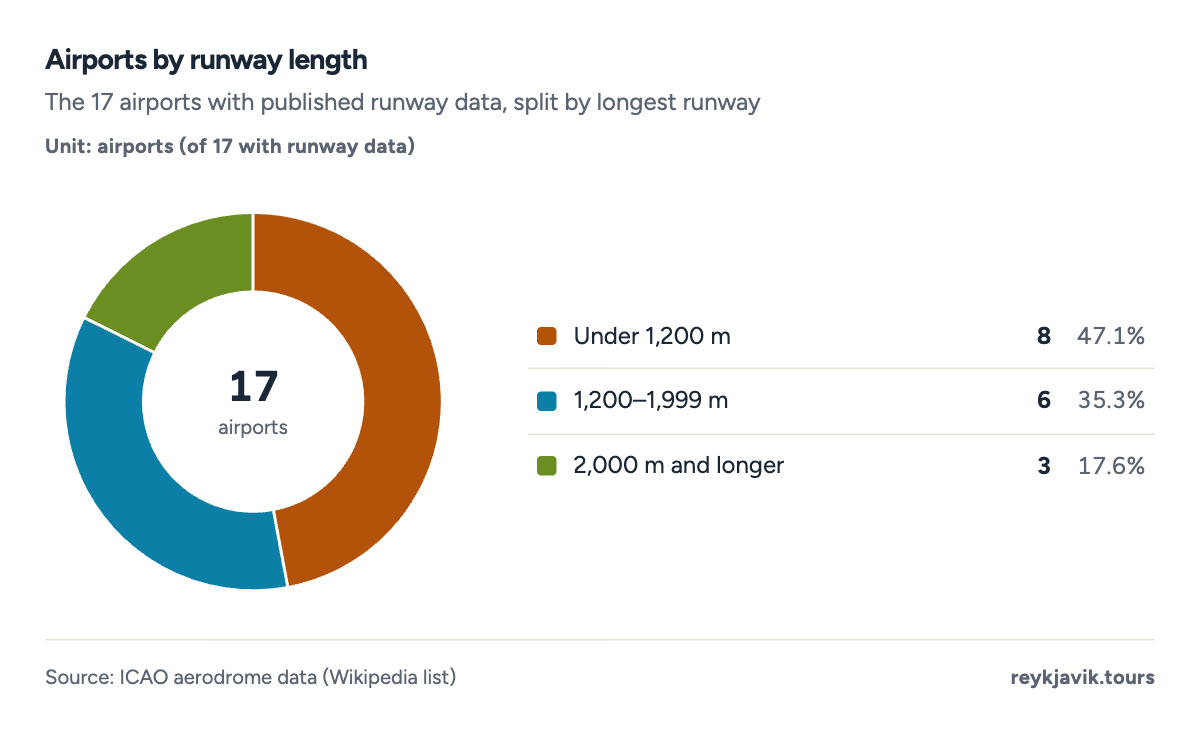
- Ten of the seventeen measured airports have runways under 1,200 m.
- Only three fields can take jet aircraft regularly - Keflavík, Akureyri and Egilsstaðir.
| Registered aerodromes with ICAO codes | 33 |
| Public certified aerodromes in the eAIP | 17 |
| Airports with scheduled passenger service | 12 |
| Main international gateway | 1 |
Every airport on the map
The runway data explains the geography at a glance. Only three airports can regularly take jet aircraft: Keflavík1 at 3,065 m, Akureyri1 at 2,400 m and Egilsstaðir1 at 2,000 m. Everything else is sized for turboprops - and the smallest fields, like Vopnafjörður1 at 885 m or Gjögur1 at 960 m, are reachable only by the smallest scheduled aircraft in commercial service.
More than half of the measured runways are under 1,200 metres long1. That is not an oversight; it is the design. A short strip that exists is worth more than a long one that does not, and in terrain like the Westfjords - where the road around a fjord can take an hour - a 15-minute flight is the practical connection.
The fleet matches the fields. Air Iceland Connect's De Havilland Dash 8 turboprops work the trunk routes from Reykjavík to Akureyri, Ísafjörður and Egilsstaðir, while smaller aircraft - including the tiny twin-engine types that can land on the shortest strips - serve the outer fields on subsidised public-service routes4. Norlandar flies the northern network out of Akureyri. This is aviation as public transport: the fares are not cheap, but the alternative, in midwinter, is often a day of driving.
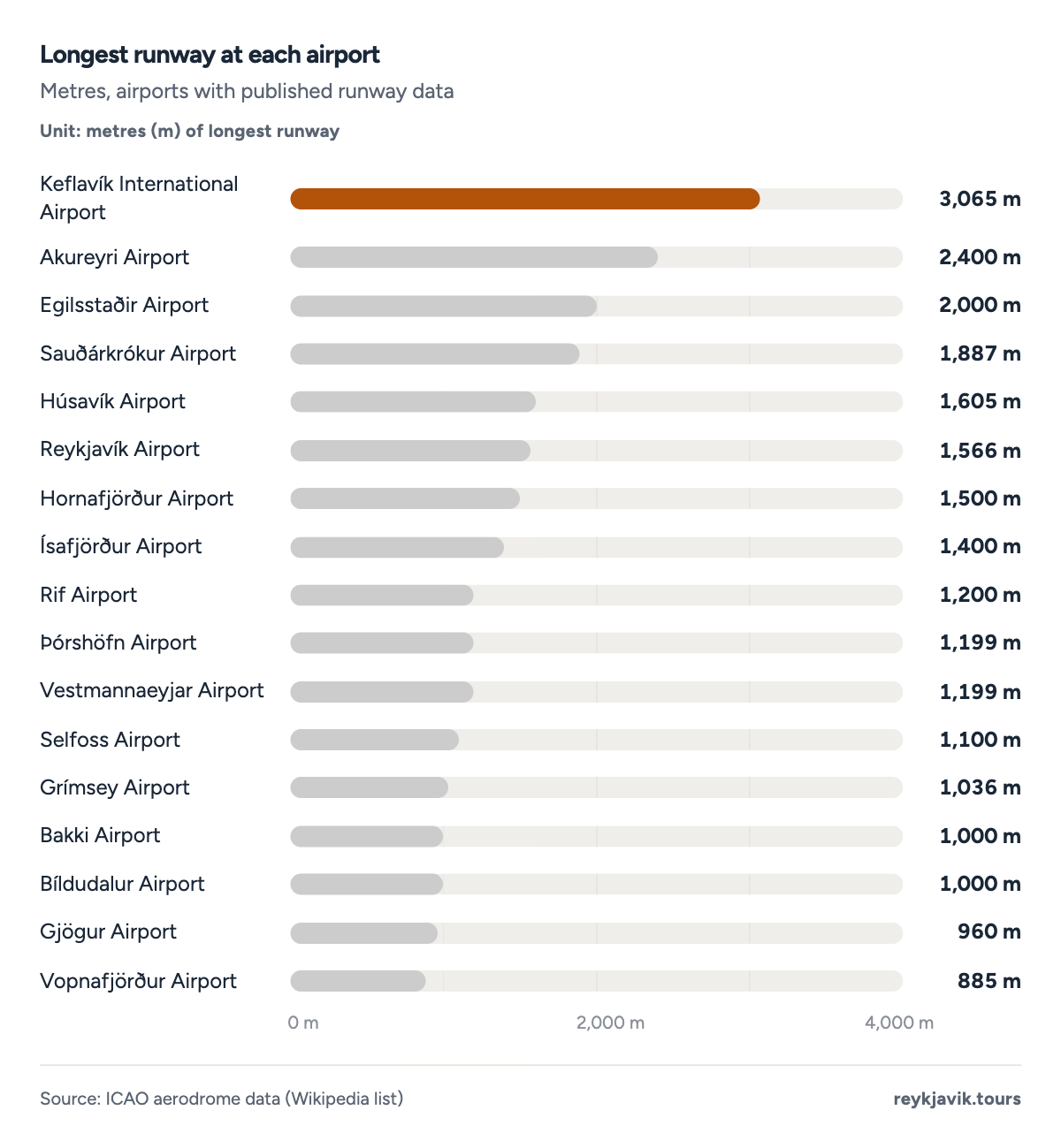
- Keflavík's 3,065 m runway is the longest in Iceland by almost 700 metres.
- Only three airports reach 2,000 m: Keflavík, Akureyri and Egilsstaðir.
- Most domestic fields have runways under 1,600 m - sized for turboprops.
| BIAR | AEY | Akureyri Airport | 2,400 | yes |
| BIBA | non | Bakki Airport | 1,000 | no |
| BIBD | BIU | Bíldudalur Airport | 1,000 | yes |
| BIBL | BLO | Blönduós Airport | no | |
| BIBV | BXV | Breiðdalsvík Airport | no | |
| BIDV | DJU | Djúpivogur Airport | no | |
| BIEG | EGS | Egilsstaðir Airport | 2,000 | yes |
| BIFM | FAG | Fagurhólsmýri Airport | no | |
| BIFF | FAS | Fáskrúðsfjörður Airport | no | |
| BIGJ | GJR | Gjögur Airport | 960 | yes |
| BIGR | GRY | Grímsey Airport | 1,036 | yes |
| BIGF | GUU | Grundarfjörður Airport | no | |
| BIHK | HVK | Hólmavík Airport | no | |
| BIHN | HFN | Hornafjörður Airport | 1,500 | yes |
| BIHU | HZK | Húsavík Airport | 1,605 | no |
| BIIS | IFJ | Ísafjörður Airport | 1,400 | yes |
| BIKF | KEF | Keflavík International Airport | 3,065 | yes |
| BIKP | OPA | Kópasker Airport | no | |
| BIRL | MVA | Mývatn Airport | no | |
| BINF | NOR | Norðfjörður Airport | no | |
| BIOF | OFJ | Ólafsfjörður Airport | no | |
| BIPA | PFJ | Patreksfjörður Airport | no | |
| BIRG | RFN | Raufarhöfn Airport | no | |
| BIRK | RKV | Reykjavík Airport | 1,566 | yes |
| BIRF | OLI | Rif Airport | 1,200 | no |
| BIKR | SAK | Sauðárkrókur Airport | 1,887 | no |
| BISF | SEL | Selfoss Airport | 1,100 | no |
| BISI | SIJ | Siglufjörður Airport | no | |
| BIST | SYK | Stykkishólmur Airport | no | |
| BITE | TEY | Þingeyri Airport | no | |
| BITN | THO | Þórshöfn Airport | 1,199 | yes |
| BIVM | VEY | Vestmannaeyjar Airport | 1,199 | yes |
| BIVO | VPN | Vopnafjörður Airport | 885 | yes |
The biggest airport in Iceland: Keflavík
Iceland's largest field is not in Reykjavík at all, but 50 km to the west: Keflavík International Airport (KEF), which handled 8,159,4613 passengers in 2025 - 92.2%3 of all passenger traffic in the country. It operates a single terminal with 135 jet-bridge gates and 17 remote stands, expanded repeatedly through the 2010s tourism boom5.
For scale: Keflavík's annual passengers equal roughly 212 times Iceland's population. Every resident could fly out and back ten times a year and the airport would still have spare capacity. The airport began as a US airbase in the 1940s, and its long runways - built for transatlantic military jets - are exactly what makes it a useful technical stop and passenger hub between Europe and North America today.
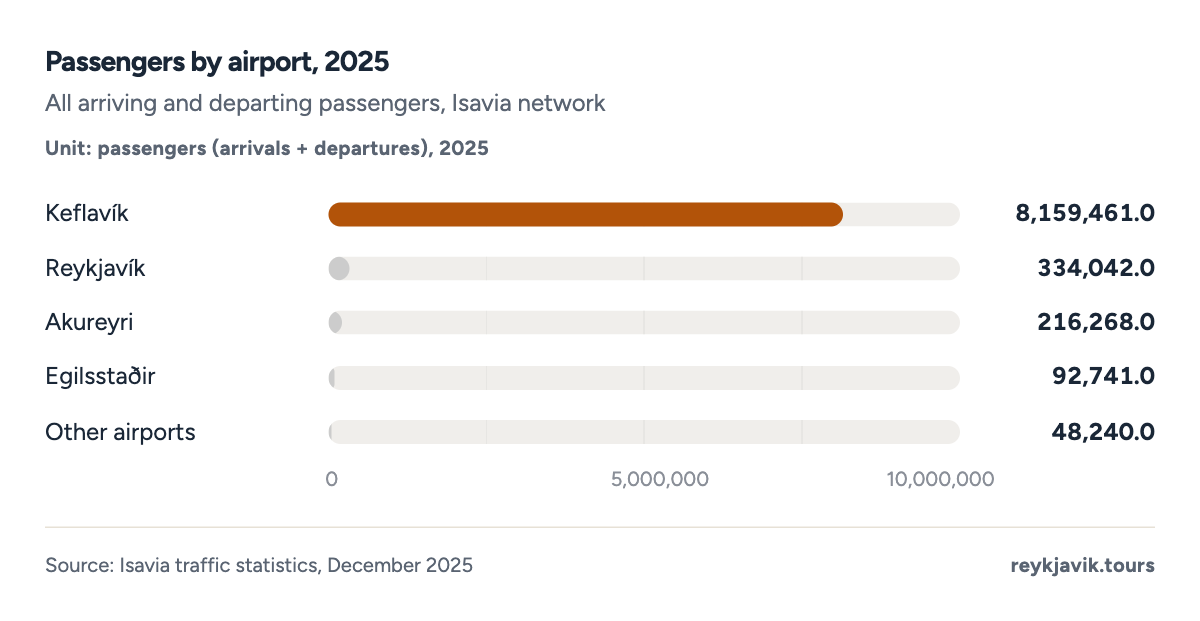
- Keflavík handled 8,159,461 passengers in 2025 - 92.2% of the national total.
- Reykjavík's domestic airport came second with 334,042 passengers.
- Akureyri and Egilsstaðir, the two regional hubs, added 309,009 between them.
- Keflavík (KEF)8,159,461.092.2%
- Reykjavík (RKV)334,042.03.8%
- Akureyri (AEY)216,268.02.4%
- Egilsstaðir (EGS)92,741.01%
- Other 13 public fields48,240.00.5%
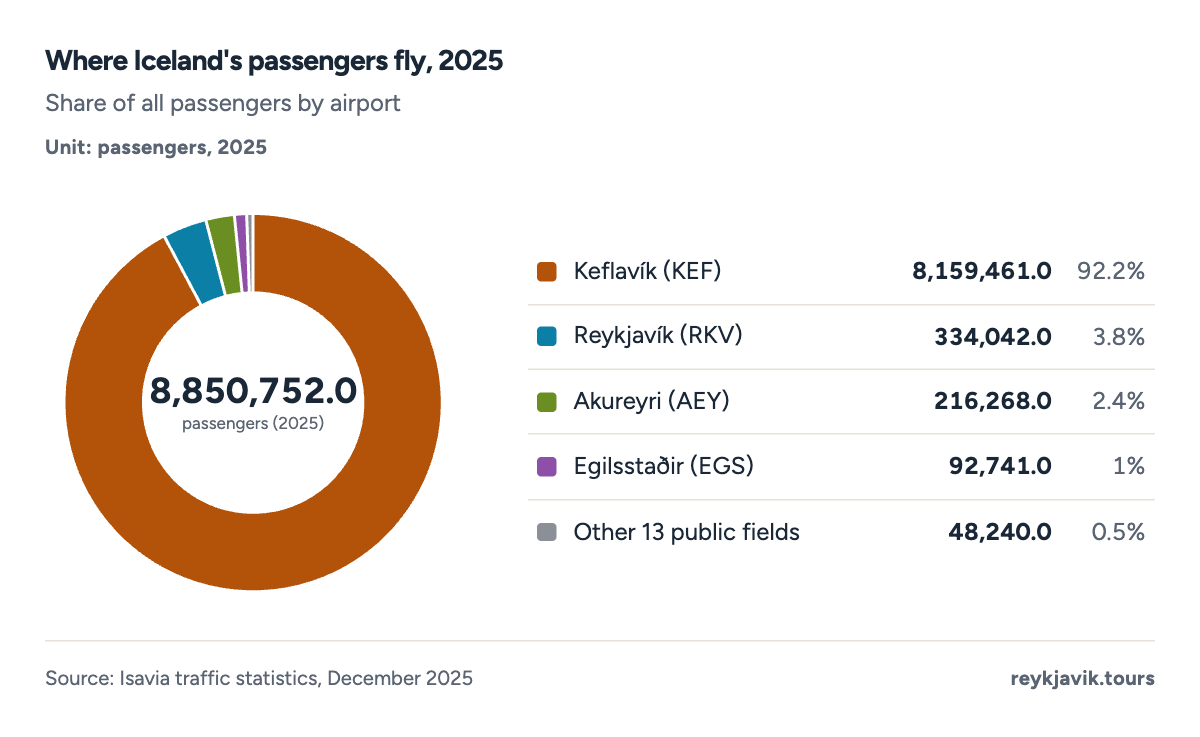
- Nine in ten passengers in Iceland pass through Keflavík.
- All domestic traffic combined is under 8% of the national total.
| Keflavik | 8,159,461.0 | 8,326,972.0 | 71,967.0 | 63,744.0 |
| Reykjavik | 334,042.0 | 353,153.0 | 36,059.0 | 618.6 |
| Akureyri | 216,268.0 | 200,968.0 | 12,647.0 | 365.2 |
| Egilsstadir | 92,741.0 | 92,014.0 | 2,615.0 | 147.1 |
| Other airports | 48,240.0 | 48,247.0 | 6,645.0 | 119.3 |
| Total | 8,850,752.0 | 9,021,354.0 | 129,933.0 | 64,994.2 |
How many international airports in Iceland?
Strictly speaking, Iceland has one3 main international airport: Keflavík. It is where every long-haul and nearly all European routes arrive. Around it, a softer category exists: Reykjavík3 and Akureyri3 both handle occasional international charters and seasonal flights, and Egilsstaðir has accepted international diversions - but none of them is a scheduled international gateway in the way Keflavík is.
The historical footnote belongs to Reykjavík Airport itself: transatlantic flights stopped at the city airport until the 1950s, when operations moved to the former base at Keflavík, where they have stayed5. Travellers connecting to domestic flights still collect their bags at Keflavík and transfer across the city to the domestic field - a quirk of the two-airport layout that surprises first-time visitors.
The future may add a wrinkle: Keflavík's growth has revived periodic proposals to move all aviation to one site or expand the city airport, and just as persistently triggered campaigns to protect Reykjavík Airport's prime downtown land. For now the answer stands: one international airport, with a supporting cast5.
How many airports are there in Reykjavík?
Reykjavík proper has two3 airports within its orbit. The city airport, Reykjavík (RKV), sits 2 km from the centre and is the domestic hub - 334,0423 passengers and 36,0593 aircraft movements in 2025. Fifty kilometres west is Keflavík, which most visitors also book as "Reykjavík" in search engines. So the honest answer: one airport inside the city, two that serve it.
Reykjavík Airport is also the reason the domestic network works: nearly every internal flight in Iceland starts or ends there, connecting to Akureyri3 in the north (216,268 passengers in 2025) and Egilsstaðir3 in the east (92,741) several times a day.
The city airport is older than the republic itself: flying started at this site in 1919, and the field has watched Reykjavík grow around it until today's airliners land between office blocks and apartment towers4. That position is both its charm and its controversy - the land it sits on is some of the most valuable in the country, and every few years a proposal surfaces to close it and move all flying to Keflavík. Every time, the counter-argument wins: with the domestic hub downtown, a business traveller can land at 9:00, be in a meeting by 9:20, and fly to Ísafjörður before lunch3.
For visitors, the practical translation is simple. If your ticket says Reykjavík (RKV), you are landing in the city and your connection to Akureyri or the Westfjords leaves from the same building. If it says Keflavík (KEF), you still have 50 km to travel - by Flybus, taxi or rental car - before the capital actually begins3.
Thirty years of Keflavík traffic
In 19956, 342,921 passengers arrived at Keflavík. By 20236 the figure was 2,816,120 - an eightfold rise in a generation6. The curve is the shape of Icelandic tourism itself: slow growth through the 1990s, acceleration after 2010 when low-cost carriers arrived, a peak around 2018, the pandemic collapse of 2020–2021, and a full recovery by 2023.
The projection on the chart extends the long-run trend to 2050, landing near 3.6 million arrivals a year. Our calculation, not a forecast - the honest range is wide, because Iceland's tourism is famously sensitive to external shocks, as 2010's ash cloud and 2020's border closure both demonstrated6.
Two episodes mark the curve. In 2010, the Eyjafjallajökull eruption closed European airspace for days - Iceland's own airport stayed busy repatriating stranded travellers while the continent ground to a halt. In 2020, border controls cut arrivals by an order of magnitude almost overnight; the line on the chart falls off a cliff that is visible from across the room6. Recovery took barely two years - by 2023 the count stood at 2,816,120, above the pre-pandemic trend line6. For an airport that had just lived through the deepest collapse in modern aviation, the rebound was remarkably complete, and the 2024–2025 totals from Isavia confirm the recovery held3.
Projection: linear trend of 1995–2023 yearly values, 95% prediction range. Our calculation, not a forecast.
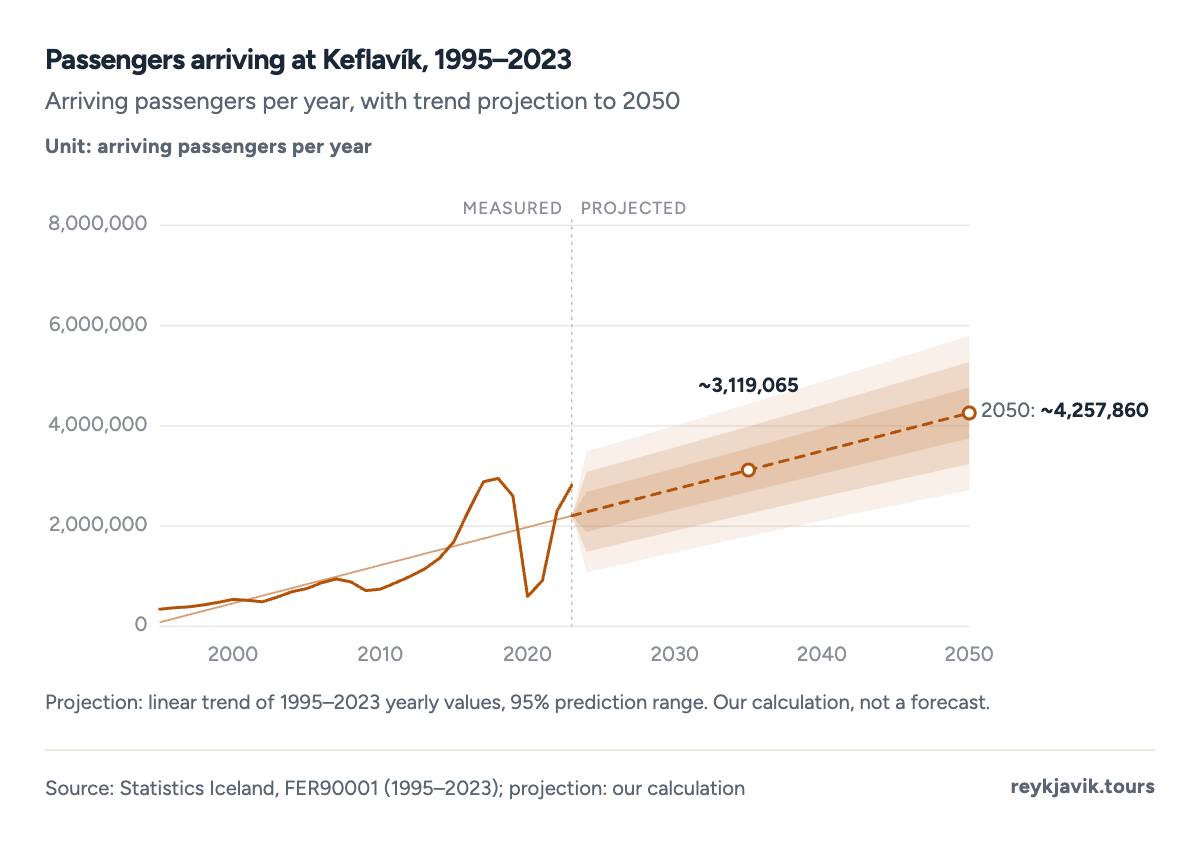
- Arrivals grew more than eightfold, from 342,921 in 1995 to 2,816,120 in 2023.
- The dip after 2019 is the pandemic; by 2023 traffic had fully recovered.
- The projection reaches roughly 3.6 million arrivals by 2050 - our calculation, not a forecast.
| 1995 | 342,921 |
| 1996 | 372,951 |
| 1998 | 430,529 |
| 2000 | 539,639 |
| 2002 | 493,643 |
| 2004 | 692,505 |
| 2006 | 868,042 |
| 2008 | 886,871 |
| 2010 | 742,579 |
| 2012 | 995,313 |
| 2014 | 1,358,332 |
| 2016 | 2,318,463 |
| 2018 | 2,951,338 |
| 2020 | 597,956 |
| 2022 | 2,301,765 |
| 2023 | 2,816,120 |
When Iceland flies
The monthly pattern is one of the most seasonal in European aviation: July6 carries roughly four times the arrivals of February6. The midnight sun draws the crowds; in midwinter the passenger mix flips to Icelanders visiting warmer places and a small, dedicated wave of aurora hunters6.
For a traveller planning an itinerary, the practical consequence is capacity: in peak summer every domestic flight and rental car is contended with hundreds of thousands of visitors, while in February the same infrastructure sits half-empty.
There is a second, subtler pattern inside the monthly data. The December figure does not follow the winter trough - it spikes, because Icelanders living abroad come home for Christmas and foreigners chase the holidays under the aurora6. February, by contrast, is the true quiet month: dark, cold, and the cheapest time of year to fly.
- 120,871JanJ
- 143,477FebF
- 150,235MarM
- 132,761AprA
- 157,782MayM
- 218,221JunJ
- 270,715JulJ
- 257,508AugA
- 189,872SepS
- 186,439OctO
- 144,137NovN
- 148,672DecD
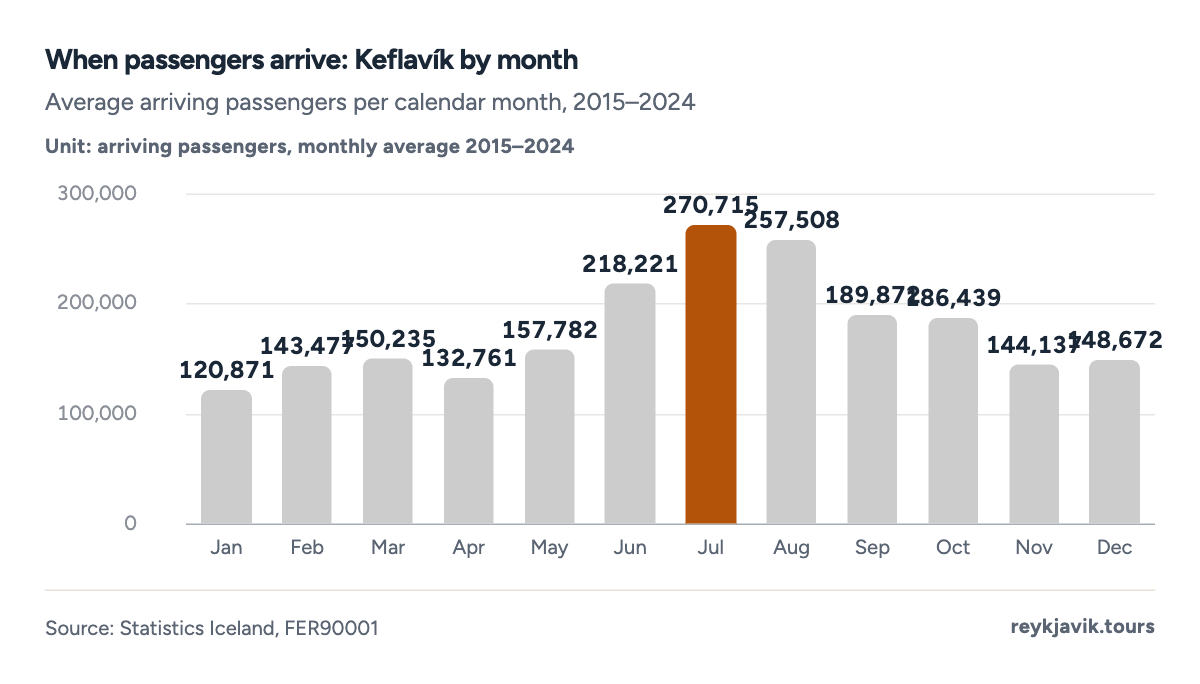
- July is the busiest month - roughly four times February.
- December holds its own thanks to holiday travel and visiting friends and family.
- The summer half-year (May–September) carries about two-thirds of all arrivals.
| Jan | 120,871 |
| Feb | 143,477 |
| Mar | 150,235 |
| Apr | 132,761 |
| May | 157,782 |
| June | 218,221 |
| July | 270,715 |
| Aug | 257,508 |
| Sept | 189,872 |
| Oct | 186,439 |
| Nov | 144,137 |
| Dec | 148,672 |
Who is flying
Statistics Iceland splits Keflavík's passengers by citizenship, and the split is remarkably stable: foreign citizens are about three-quarters7 of passengers year after year, with Icelanders making up the rest7. Icelandic traffic barely moves - a nation of 389,4442 flying home and away in predictable rhythm - while the foreign line contains the whole story of the tourism boom, the crash and the recovery.
That composition also explains the airport's economics: the domestic fields run on a steady trickle of residents, mail and fresh fish, while Keflavík's terminals swell and shrink with visitors whose numbers can halve in a bad year7.
Projection: linear trend of 2015–2019 yearly values, 95% prediction range. Our calculation, not a forecast.
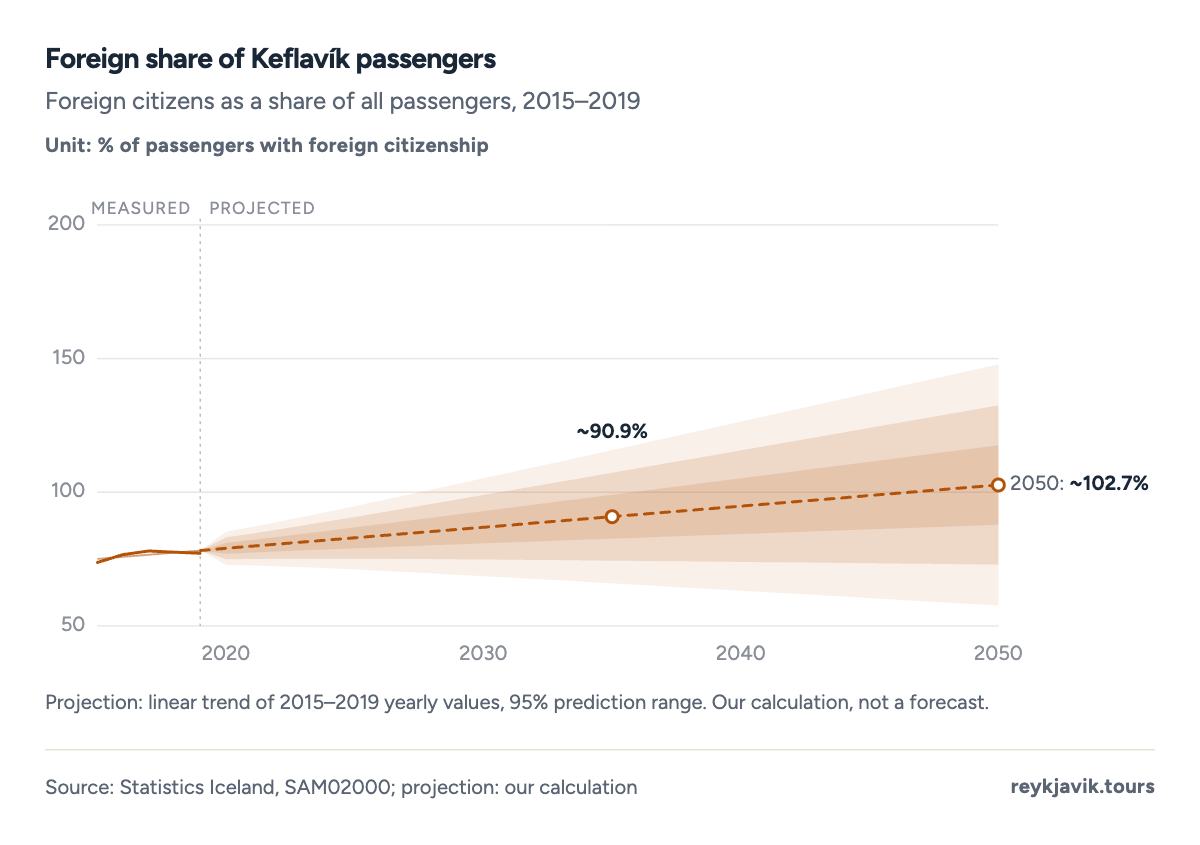
- Foreigners consistently account for roughly three-quarters of Keflavík's passengers.
- The foreign share peaked above 80% during the tourism boom years around 2017–2018.
- Foreigners
- Icelanders
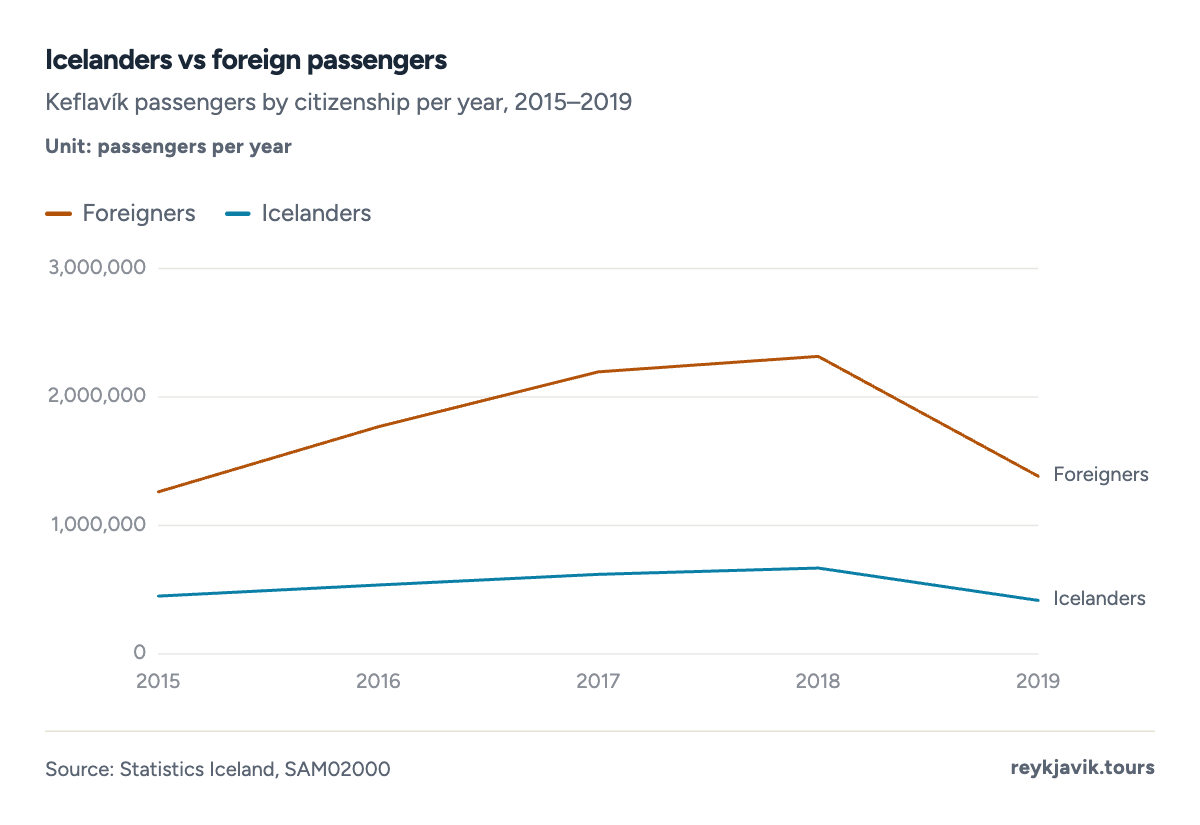
- Foreign passengers outnumber Icelanders roughly three to one at Keflavík.
- Icelandic passenger numbers are remarkably stable year to year; tourism drives the swings.
| 2016 | 2,303,983 | 536,257 | 1,767,726 | 76.7 |
| 2018 | 2,984,018 | 668,093 | 2,315,925 | 77.6 |
| 2019 | 1,790,700 | 415,919 | 1,382,931 | 77.2 |
Movements and cargo
Aircraft movements tell the quieter story. Keflavík logged 71,9673 movements in 2025 - take-offs and landings - while Reykjavík's domestic hub counted 36,0593. Between them, Akureyri (12,6473) and the thirteen other public fields (6,6453 combined) keep the national network alive3.
Cargo is even more concentrated than passengers: 63,744 tonnes3 of freight and mail moved through Keflavík in 2025, with Akureyri a distant second at about 365 tonnes3. Iceland's exports fly out mostly as fish - and its remoteness means everything from spare parts to medicine arrives by air.
The stakes of this system are easy to underestimate. The domestic network doubles as the medical evacuation system: a heart-attack patient in Ísafjörður is in a Reykjavík operating theatre within hours because a certified runway and an instrument approach exist 10 minutes from the hospital. When a volcanic eruption closed Keflavík briefly in 2014, the diversion of a single long-haul flight to Akureyri was national news4. For an island of 389,444 people spread across 103,000 km², the airports are not conveniences - they are the connective tissue2.
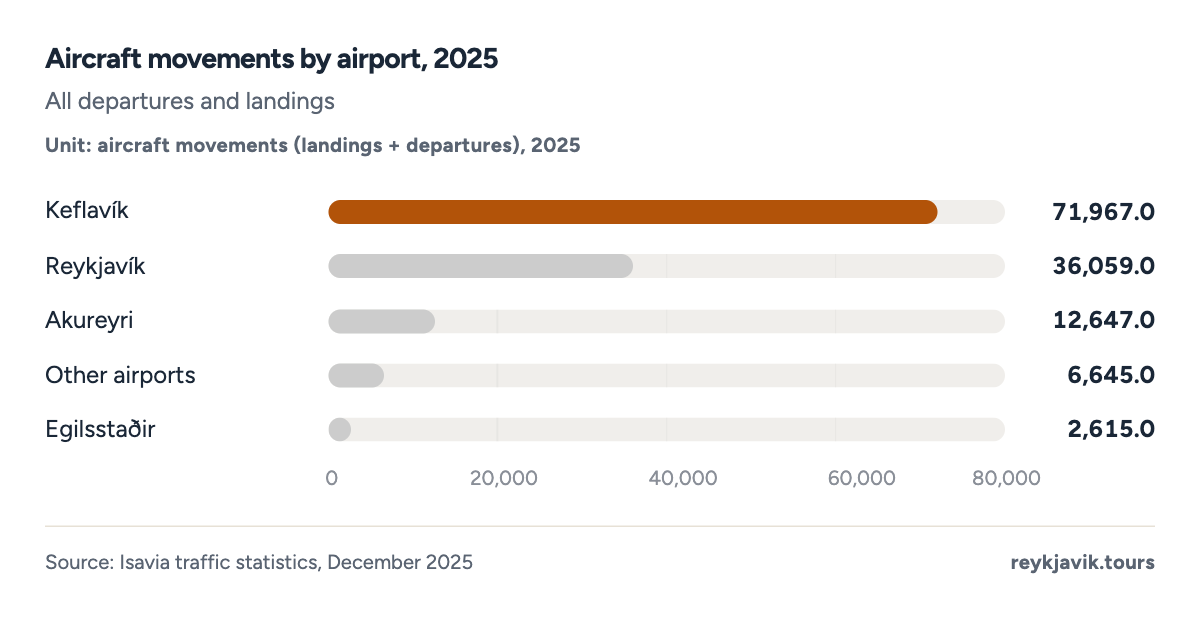
- Keflavík recorded 71,967 movements in 2025.
- Reykjavík's 36,059 movements reflect its role as the domestic hub.
- General aviation keeps the small fields alive: 6,645 movements across the other public airports.
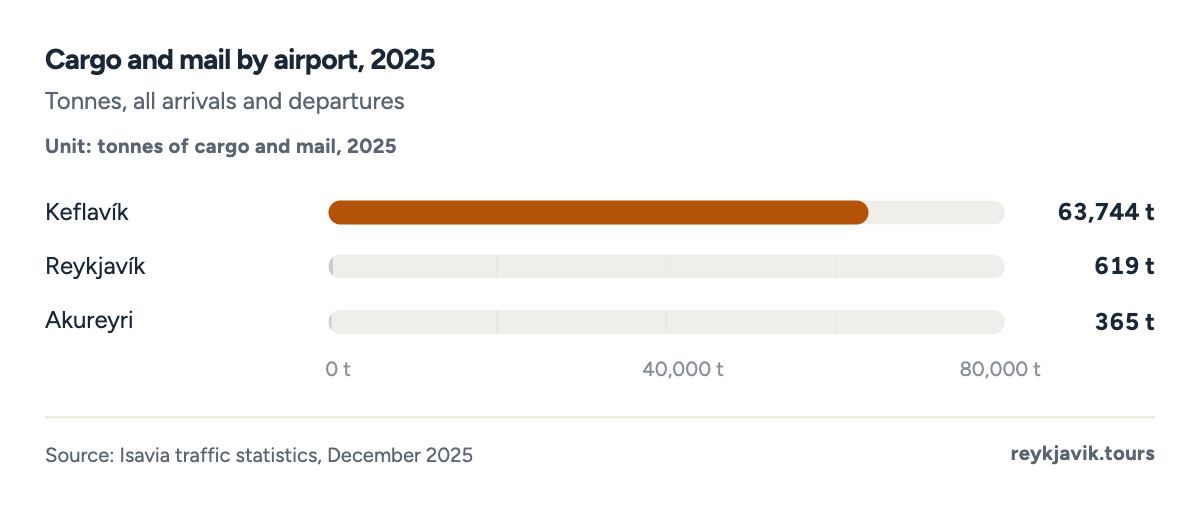
- Keflavík carries essentially all of Iceland's air cargo: 63,744 tonnes in 2025.
- Akureyri's 365 tonnes serve the north; everything else is marginal.
Conclusions
- Iceland has 33 registered airports, but the functioning system is a hub-and-spoke around two fields: Keflavík for the world (92.2% of passengers) and Reykjavík for the country3.
- The runway map is a history lesson: long military-built strips at Keflavík, Akureyri and Egilsstaðir anchor the network, while dozens of sub-1,200 m strips exist because mid-century Iceland could not always be crossed by road1.
- Per capita, Iceland is one of the most airport-dense countries on Earth - one field per ~11,800 residents - yet the average resident is far outnumbered at their own main airport, where three of four passengers are foreigners7.
- The traffic curve is a tourism curve: the 8× growth since 1995, the 2018 peak, the pandemic collapse and the recovery all trace visitors, not residents6.
- Seasonality is extreme - July carries four times February's arrivals - which means the same runways, gates and aircraft fleet must serve a demand that quadruples between winter and summer6.
Methodology
- Airport counts and runway data: current registers (2026)
- Passengers, movements, cargo: January–December 2025 (Isavia)
- Keflavík arrivals: 1995–2023 (Statistics Iceland)
- Passengers by citizenship: 2015–2019 (Statistics Iceland)
Definition. An 'airport' here means a registered aerodrome with an ICAO indicator (BI..). A public certified aerodrome appears in the Icelandic eAIP with published procedures. Scheduled service means regular commercial passenger flights at the time of the register snapshot.
Data sources. ICAO aerodrome list compiled on Wikipedia (cross-checked against the Icelandic eAIP, 17 public fields); Isavia monthly traffic statistics (December 2025 workbook); Statistics Iceland tables FER90001 (Keflavík arrivals by month) and SAM02000 (passengers by citizenship); Wikipedia's Keflavík International Airport article for terminal and gate counts (secondary, labelled).
Calculations. Passenger shares divide Isavia airport totals by the national total. Foreign share divides foreign-citizen passengers by all passengers (SAM02000). Monthly averages are computed over 2015–2024. Airport density divides the population (389,444, 1 January 2025) by 33 airports. The projection is an ordinary least-squares trend with a 95% prediction interval, computed by the renderer.
Limitations. Runway lengths are unavailable for 16 of the 33 registered fields; the runway charts cover the 17 with published data. Isavia's 'Other airports' line aggregates the smaller fields and is shown as one category. FER90001 counts arriving passengers only, which is why the 1995–2023 series runs below Isavia's total passenger figures for overlapping years. Gate and terminal counts come from a secondary source and change as the airport is rebuilt.
Sources
- Wikipedia. “List of airports in Iceland (ICAO aerodrome list).” Wikipedia, 2026. en.wikipedia.org. Accessed 2026-09-17. Back to text
- Statistics Iceland. “Population key figures, 1703–2026 (MAN00000).” Statistics Iceland, 2026. hagstofa.is. Accessed 2026-09-17. Back to text
- Isavia. “Monthly report traffic statistics, December 2025 (flugtolur).” Isavia (airport operator), 2026-01. isavia.is. Accessed 2026-09-17. Back to text
- Icelandic Transport Authority / Isavia. “Iceland eAIP - aerodromes (AD 2).” ICA (Samgöngustofa) eAIP, 2026. eaip.isavia.is. Accessed 2026-09-17. Back to text
- Wikipedia. “Keflavík International Airport - terminal and gates.” Wikipedia, 2026. en.wikipedia.org. Accessed 2026-09-17. Back to text
- Statistics Iceland. “Passengers arriving at Keflavík Airport by month, 1995–2023 (FER90001).” Statistics Iceland, 2024. hagstofa.is. Accessed 2026-09-17. Back to text
- Statistics Iceland. “Passengers by citizenship at Keflavík Airport, monthly (SAM02000).” Statistics Iceland, 2026. hagstofa.is. Accessed 2026-09-17. Back to text
About the author
Laufey turns public statistics on tourism and travel into research people can check and cite.
Every figure on this page links to its source. How we research
Related research
More data on Iceland's weather and travel from Reykjavik Tours.
- TravelHow Much Is a Trip to Iceland? (2026 Data)$1,766 average a visitor spends in IcelandRead the research →
- Travel costsHow Much Are Hotels in Iceland? (2026 Data)$196 a night for a typical hotel roomRead the research →
- TravelHow Many Days in Iceland? (2026 Data)7.1 nights average stay of foreign visitorsRead the research →
- NatureHow Many Waterfalls in Iceland? (2026 Data)1,624 named waterfalls in IcelandRead the research →
- HousingAverage Rent in Iceland (2026 Data)ISK 269k average monthly rent in IcelandRead the research →
- HousingHow Much Is a House in Iceland? (2026 Data)$467k-779k typical capital-region apartmentRead the research →