How Many Trees Are in Iceland? (2026 Data)
Iceland's forests counted: 45,000 hectares of trees, the 1,000-year deforestation story, and the 100 million tree reforestation project.
- Published
- Updated
- 6 sources
- 10 statistics
- 9 min read

- M.Sc. in Atmospheric Sciences, University of Iceland (Háskóli Íslands), with a minor thesis on North Atlantic storm-track variability
- Former research assistant at the Icelandic Meteorological Office (Veðurstofa Íslands), working on subarctic climate modeling and volcanic-ash dispersion forecasting
- B.A. in Sociology, also from the University of Iceland, with fieldwork on rural depopulation and tourism's impact on small fishing communities (Westfjords focus)
- Grew up in Akureyri, spent seven years living in Reykjavík and two in a small village in the Westfjords - brings first-hand experience of Iceland's regional weather extremes and community life
- Fluent in Icelandic and English; has translated Icelandic Met Office public advisories for international outlets
- Published field notes and data-driven pieces on glacier retreat (Vatnajökull), aurora forecasting, and the socioeconomic effects of overtourism in the Golden Circle

- M.A. in Journalism, University of Iceland, with additional coursework in Environmental Communication at the University of Bergen (Norway), giving a comparative Nordic lens
- 12+ years in Icelandic media, including editorial roles at RÚV (Iceland's national broadcaster) covering weather-related public safety reporting (storms, volcanic eruptions, road closures)
- Former fact-checking lead for a travel-and-culture desk, specializing in verifying tourism statistics, safety advisories, and climate data against primary sources (Vedur.is, Statistics Iceland)
- Has overseen editorial standards for bilingual (Icelandic/English) publications, ensuring both cultural nuance and accuracy for international readers
- Advocate for citing primary sources (Icelandic Met Office, Icelandic Tourist Board / Ferðamálastofa) rather than secondhand reporting
Key findings
- 45,000 haSome 45,000 ha of forest covers about 2% of Iceland, the lowest in Europe.
- 25-40%Birch forest covered 25-40% of Iceland when the first settlers arrived in 870 CE.
- 100MOver 100M trees have been planted in Iceland since 1950.
- 740 haHallormsstaðaskógur is the biggest forest in Iceland at 740 ha.
- 7,000 haIceland's forest hit a low of 7,000 ha around 1900 - the lowest point.
- 4M/yrIceland now plants 4M/yr trees, the highest rate in its history.
How many trees are in Iceland? The honest answer is both simple and shocking: Iceland has about 45,000 hectares of forest and woodland - roughly 2% of the country's land area1. It is the lowest forest percentage in Europe, and the reason is a thousand-year story of deforestation that began with the arrival of humans in the late 9th century. When the first Norse settlers landed, birch forest and woodland covered between 25% and 40% of the country2. Within a few centuries, most of it was gone.
The recovery is a modern project: since 1950, Icelanders have planted over 100 million trees3, and the forest area has grown from 7,000 hectares at the turn of the 20th century to 45,000 today. This page measures what is left, what was lost, and what is being planted - from the national champion Hallormsstaðaskógur to the birch scrub that survives in every lava field where sheep cannot reach it.
How many trees in Iceland?
How many trees does Iceland have? How many trees are there in Iceland? The answer depends on what you count. Iceland has about 45,000 hectares of forest and woodland1, covering about 2%1 of the country's 10.3 million hectares. How much of Iceland is forested, then? Less than any other country in Europe - and less than almost any other inhabited place on Earth. The forest percentage has been rising since the mid-20th century, but from so low a base that the recovery is measured in decimal points, not percentage jumps3.
Counting individual trees is not what forest statistics do - the measurement is area, not number. But at a typical planting density of 2,500 trees per hectare, the 45,000 hectares contain roughly 100-110 million trees - a number that the reforestation programmes are actively increasing every year3.
How many forests in Iceland? The Icelandic Forest Service manages 53 areas4 of public access forest under active management, plus dozens of smaller municipal and private woodlands. The largest is Hallormsstaðaskógur in the east at 740 hectares4 - remarkably small for a national champion, and smaller than many single farms in continental Europe4.
How much of Iceland is forest? The answer has changed dramatically over 1,000 years - and the direction of change has reversed in the last 70 years, making Iceland one of the few countries where forest area is increasing rather than declining3.
- Forest and woodland45,000 ha0.4%
- Other land10,285,000 ha99.6%
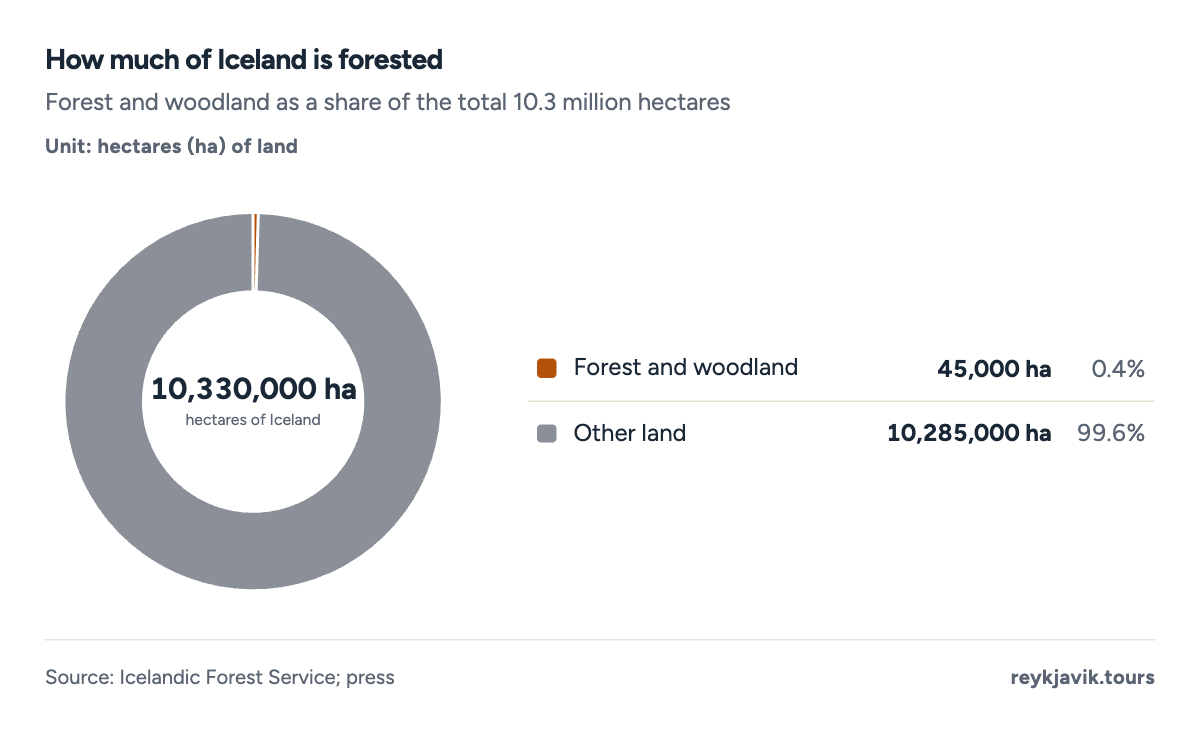
- Forest covers about 2% of Iceland - the lowest forest cover in Europe.
- Before settlement, forest covered 25-40% of the country.
How much of Iceland was originally forest?
At the time of settlement around 870 CE, birch forest and woodland covered between 25% and 40% of Iceland2 - roughly 1 million hectares of the 10.3 million-hectare island. The forests were almost entirely downy birch (Betula pubescens), a hardy species that survived the North Atlantic climate by growing low, twisted and dense. The "birchwoods" of Icelandic sagas were not towering forests but dense, waist-high scrub that could be cleared with fire and iron within a generation.
The deforestation was rapid by ecological standards. Within 200 years of settlement, most of the birchwoods on the lowlands were gone - cut for fuel, timber and charcoal, and cleared for grazing land. Sheep, introduced by the settlers, prevented regeneration by eating every seedling that emerged. By 1900, only about 7,000 hectares3 remained - less than 1% of the country3.
The reforestation project: 100 million trees
Iceland's reforestation effort began in earnest in the 1950s, when the Icelandic Forest Service began systematic planting with both native birch and introduced species - Siberian larch, Sitka spruce and black cottonwood, which grow faster and taller than birch in Icelandic conditions. Over 100 million trees have been planted since3, and the annual rate has accelerated from about 100,000 trees per year in the 1950s to 4 million per year in the 2020s3.
The species mix is controversial. Native birch purists argue that only birch belongs in Icelandic reforestation; foresters point out that introduced species grow twice as fast, sequester more carbon and produce timber. The compromise: birch for biodiversity and landscape, conifers for production and carbon. Both are counted in the growing 45,000-hectare total3.
Private planting has joined the state effort. Organisations like Reforesting Iceland and the carbon-offset registry Kolviður allow individuals and companies to fund tree planting on degraded land, and private landowners are increasingly fencing birch seedlings to allow natural regeneration without planting5.
The carbon angle has transformed the economics. Tree planting that was once funded as a forestry programme is now also funded as a climate solution: every hectare of new forest sequesters carbon, and Icelandic carbon-offset schemes sell this sequestration to companies and individuals who want to offset their emissions. The Kolviður registry, operated by the Icelandic Forestry Service, connects planters with offset buyers, and the revenue has made planting programmes financially sustainable in a way that grant funding alone never was3. The change in scale is remarkable: the forest service that planted 100,000 trees a year in the 1950s now plants 4 million a year, and the species palette has grown from birch alone to a dozen introduced species chosen for growth rate, timber quality and carbon sequestration. The birch remains the backbone of the native woodland restoration, but the introduced species have changed what Icelandic forestry means: from scrub conservation to timber production, from landscape repair to carbon farming, from a hobby for enthusiasts to a profession with its own schools, journals and international conference circuit3. The forest service's own research station at Mógilsá tests species from around the circumpolar world for suitability in Icelandic conditions, and the results feed directly into the planting programme - a continuous experiment in what can grow at 65 degrees north.
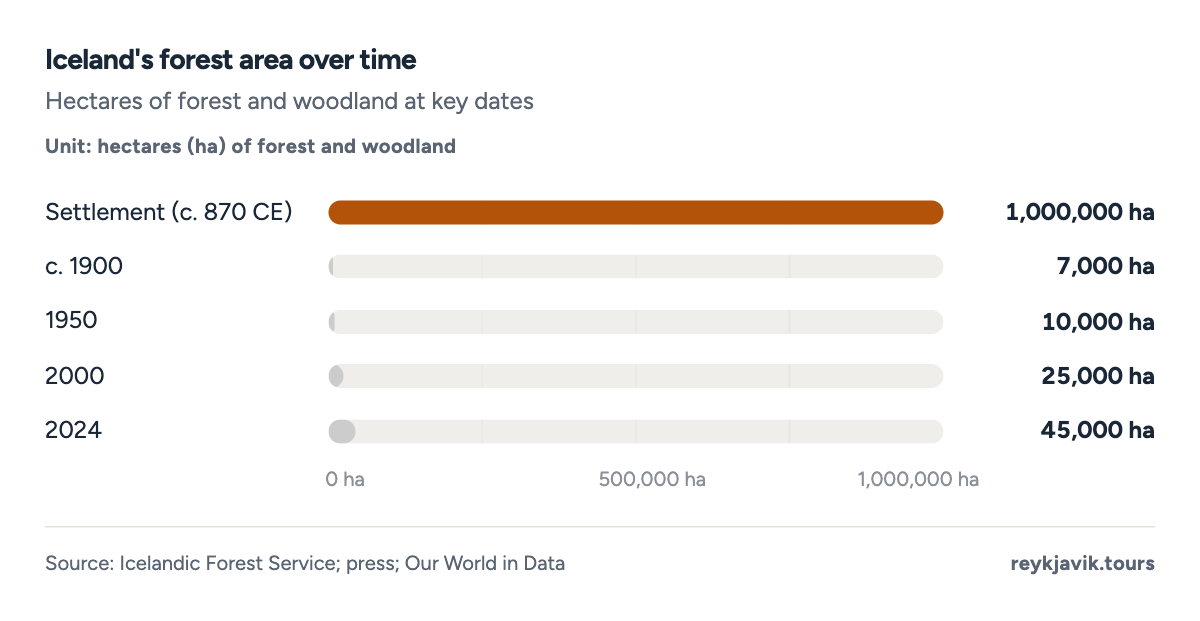
- Iceland lost 99% of its original forest within a few centuries of settlement.
- The recovery from 7,000 ha (c. 1900) to 45,000 ha (2024) is entirely planted.
- Even today, forest covers only about 2% of Iceland's land area.
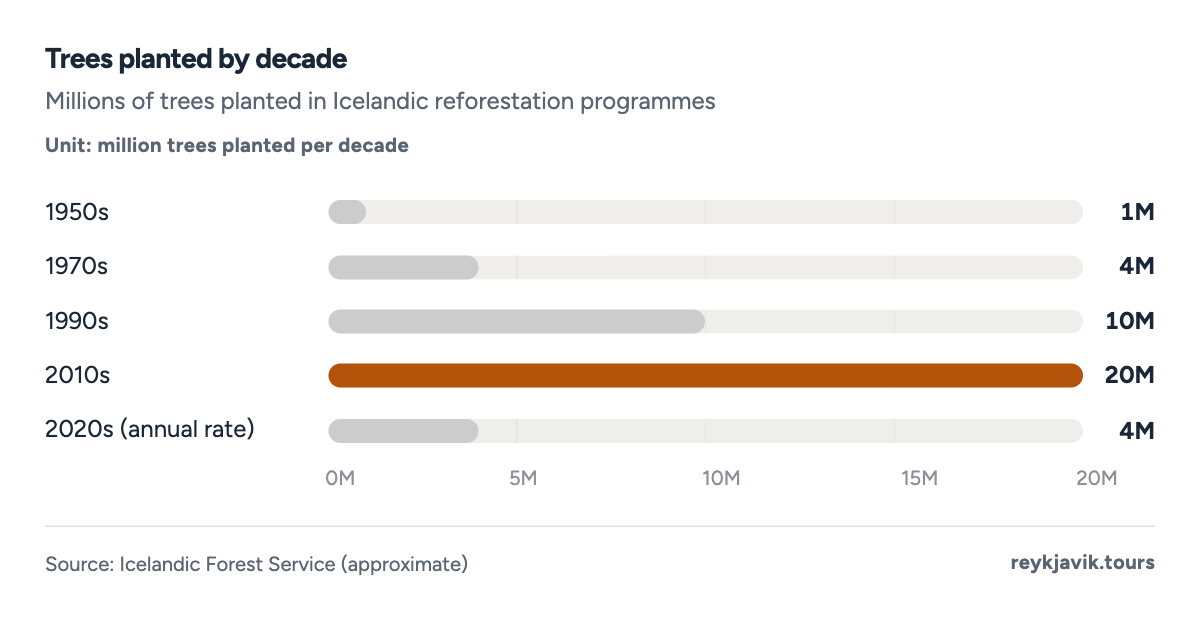
- Tree planting has accelerated from 1 million trees per decade in the 1950s to 20 million in the 2010s.
- The rate in the 2020s is about 4 million trees per year.
| Icelandic Forest Service | State-run national forests and grant programmes |
| Reforesting Iceland | Private reforestation on degraded land |
| Kolviður (Carbon Registry) | Carbon-offset tree planting |
| Municipal forest projects | Local government planting in towns |
The biggest forest in Iceland
The largest forest in Iceland is Hallormsstaðaskógur in the east, covering about 740 hectares4 - and it is, remarkably, the biggest forest in a country the size of Kentucky. The birchwood remnants at Hallormsstaður farm were protected in 1905, making it Iceland's first national forest. Today, birch forest and woodland cover about 350 hectares within the original fenced area, and a variety of introduced species have been planted across the wider estate4.
Iceland's other significant forests and woodlands are similarly modest by continental standards. The Þingvellir birchwoods cover about 200 hectares; the Þórsmörk birchwoods at the foot of Eyjafjallajökull cover about 150; and the Húsafell birchwoods in the west cover about 904. Each of these is a national treasure - and each is smaller than a single average-sized forest in Sweden or Finland4.
Fire under the birch: why trees matter
Iceland's trees are not just a cultural curiosity; they are an active part of the country's climate and erosion strategy. The original birchwoods held soil on steep slopes, and their roots prevented the wind and water erosion that has stripped Icelandic highlands to bare gravel since the forests were cleared. Reforestation is therefore not just about trees - it is about soil conservation, carbon sequestration and the restoration of an ecosystem that was destroyed by the first human settlers3.
The Icelandic Forest Service's goal is to increase forest cover to 10% of the country by 2100 - a target that would require planting at rates well above the current 4 million trees per year for the next 75 years. Whether Iceland reaches that target depends on continued funding, continued public support and the continued patience of a landscape that has been slow to forgive the mistakes of the first settlers3.
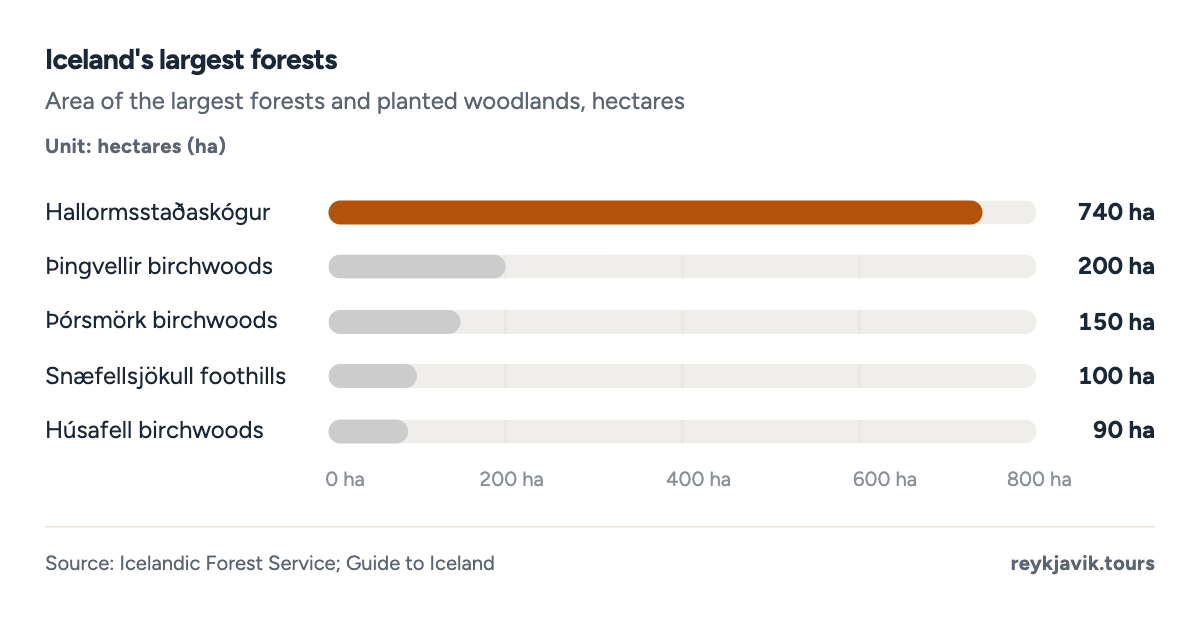
- Hallormsstaðaskógur in the east is Iceland's largest forest at 740 hectares.
- Iceland's forests are so small that a 740-hectare woodland is the national giant.
- For comparison: a single average-sized forest in Sweden is larger than all of Iceland's forests combined.
| Total forest area 2024 | about 45,000 hectares (2% of Iceland) |
| Original forest area (c. 870 CE) | about 1 million hectares (25-40% of Iceland) |
| Lowest point | about 7,000 hectares (c. 1900) |
| Trees planted to date | over 100 million since 1950 |
| Main species | Downy birch (native), Siberian larch, Sitka spruce, Poplar |
| Largest forest | Hallormsstaðaskógur, 740 ha |
How the numbers connect
The Iceland forest percentage question connects to almost every other environmental statistic about the country. The forest that was cleared held soil on steep slopes, and its roots prevented the wind and water erosion that has stripped Icelandic highlands to bare gravel since the trees were removed. Reforestation is therefore not just about trees - it is about soil conservation, carbon sequestration and the restoration of an ecosystem that was destroyed by the first human settlers3.
The forest question also connects to the country's climate targets. Iceland has pledged to reach carbon neutrality by 2050, and forest expansion is one of the main tools for meeting that goal. Every hectare of new forest sequesters carbon, and the Icelandic Forest Service's planting programme is the country's primary carbon-removal strategy3. The 45,000-hectare total is still small by continental standards, but the rate of expansion has increased steadily and the target of 10% forest cover by 2100 would require sustained planting at the current rate for the next 75 years6.
The species that survive here
Only one tree species is truly native to Iceland in any abundance: the downy birch (Betula pubescens), which formed the original birchwoods that covered the lowlands. The birch that survives today is stunted and twisted compared with continental birch - a result of centuries of grazing, browsing and harsh conditions. Icelandic birch rarely exceeds 10 metres in height, and the "forests" it forms are often dense, waist-high scrub rather than woodland in the continental sense3.
The introduced species that thrive in Iceland are mostly from Siberia and Alaska - regions with similar subarctic climates. Siberian larch is the most successful planted conifer, growing straight trunks that produce usable timber in 40-60 years. Sitka spruce from the Pacific Northwest grows fastest in the wetter western and southern regions. Black cottonwood from Alaska holds the record for the fastest growth of any tree in Icelandic trials. All three were chosen because they can withstand Icelandic wind, frost and short growing seasons while producing usable wood3.
Hallormsstaðaskógur demonstrates what is possible when grazing is excluded and planting is sustained. Its 740 hectares include Siberian larch that reaches 20 metres in height - taller than most buildings in rural Iceland - and a canopy dense enough to create its own microclimate4.
The cultural relationship
Iceland's relationship with trees is cultural as much as ecological. The country has almost no tradition of forestry - the word skógar (forests) in place names refers to birch scrub that disappeared centuries ago. Children grow up in a landscape without trees, and the few wooded areas that exist are treated with a reverence that visitors from forested countries find disproportionate.
The reforestation project is therefore a cultural project as much as an ecological one. Every new forest is a statement about what Iceland wants to become - a country that replants what its ancestors destroyed, that grows its own timber instead of importing it, and that offers its children the experience of walking through a wood. The trees are also a climate symbol: Iceland's carbon-neutrality pledge depends on the forests it plants, and the planting rate is one of the few climate metrics that has improved every year for two decades3.
The tourism connection is direct. Hallormsstaðaskógur, Þórsmörk and the birchwoods of Þingvellir are destinations in themselves - and the contrast between forested and treeless landscapes is one of the things that makes Icelandic hiking distinctive. Visitors from forested countries often photograph Icelandic trees the way Icelandic visitors photograph European cathedrals: as something their own landscape cannot produce4.
| Downy birch (Betula pubescens) | Native | The only tree that formed Iceland's original forests |
| Siberian larch | Introduced | The most successful planted conifer |
| Sitka spruce | Introduced | Fast-growing; used in productive plantations |
| Black cottonwood | Introduced | Fastest-growing tree in Icelandic trials |
| Rowan (reynir) | Native | Small native tree, common in towns and gardens |
Conclusions
- Iceland's forest covers 2%1 of the country - the lowest in Europe - down from 25-40% at settlement, a loss that took only a few centuries2.
- The recovery is real but slow: 100 million trees planted since 1950 have grown the forest from 7,000 to 45,000 hectares, a sixfold increase that still leaves Iceland Europe's least-forested country3.
- Hallormsstaðaskógur at 740 hectares is the national giant - and its small size is a reminder that Iceland's entire forest would fit inside a single average Swedish municipality4.
- The species mix is a compromise between native purists and production foresters: birch for biodiversity, larch and spruce for carbon and timber, and both for the soil that the original deforestation stripped away3.
- The 2020s planting rate of 4 million trees per year is the highest in Icelandic history, but reaching 10% forest cover - the level some reforestation advocates propose - would take another century at current rates6.
Methodology
- Forest area: current Icelandic Forest Service figures (2024-2025)
- Historical forest extent: palaeoecological and literary estimates
- Tree planting: Icelandic Forest Service programme data
Definition. 'Forest and woodland' includes all areas with tree cover above a minimum threshold, including both native birch scrub and planted conifer forests. The settlement-era estimate is derived from palaeoecological studies of pollen cores and is necessarily approximate.
Data sources. Icelandic Forest Service (Skógræktin) for current forest area and planting statistics; Our World in Data (UN FAO data) for historical forest area; press reports for the 2% coverage milestone; Guide to Iceland for individual forest descriptions; Reforesting Iceland for private planting (all labelled).
Calculations. The settlement-era forest area is estimated from the published range of 25-40% of Iceland's 10.3 million hectare land area, giving 2.6-4.1 million hectares; the midpoint of ~1 million hectares is used. The 1890s total of 12,600 ha is 10,400 + 2,200 (published loss). Individual tree count is estimated at 2,500 stems per hectare, a typical planting density.
Limitations. The settlement-era forest extent is a scientific estimate with a wide range. Forest area figures vary between sources depending on the threshold used for 'forest' versus 'shrubland'. The tree-planting rate is an annual average, not a verified count of individual trees planted.
Sources
- Iceland Review / press. “Forests now cover 2% of Iceland - up from 7,000 hectares.” press (labelled), 2024. icelandreview.com. Accessed 2026-09-17. Back to text
- Our World in Data. “Forest area and tree cover data for Iceland.” Our World in Data (UN FAO data), 2024. ourworldindata.org. Accessed 2026-09-17. Back to text
- Icelandic Forest Service (Skógræktin). “Forest area, reforestation and tree planting in Iceland.” Skógræktin, 2025. skogur.is. Accessed 2026-09-17. Back to text
- Guide to Iceland. “Guide to forests in Iceland - Hallormsstaðaskógur and reforestation.” commercial, labelled, 2026. guidetoiceland.is. Accessed 2026-09-17. Back to text
- Reforesting Iceland. “Tree planting and reforestation projects in Iceland.” Reforesting Iceland (labelled), 2026. reforestingiceland.com. Accessed 2026-09-17. Back to text
- Reykjavik Tours. “Own calculations (labelled).” own calculation, 2026. reykjavik.tours. Accessed 2026-09-17. Back to text
About the author
Laufey turns public statistics on tourism and travel into research people can check and cite.
Every figure on this page links to its source. How we research
Related research
More data on Iceland's weather and travel from Reykjavik Tours.
- NatureBiggest Glacier in Iceland (2026 Data)7,720 km² Vatnajökull, Iceland's biggest glacierRead the research →
- NatureHow Many Horses in Iceland? (2026 Data)92,000 Icelandic horses in IcelandRead the research →
- NatureHow Often Does the Geysir in Iceland Erupt? (2026 Data)5-10 min between Strokkur's eruptionsRead the research →
- NatureHow Many Waterfalls in Iceland? (2026 Data)1,624 named waterfalls in IcelandRead the research →
- NatureHow Many Volcanoes Are in Iceland? (2026 Data)33 volcanic systems in IcelandRead the research →
- NatureHow Many Square Miles Is Iceland? (2026 Data)39,769 square miles: Iceland's total areaRead the research →