How Often Does the Geysir in Iceland Erupt? (2026 Data)
The Great Geysir is dormant - Strokkur erupts every 5-10 minutes. Iceland's geysers, hot springs, pools and lagoons counted and explained.
- Published
- Updated
- 5 sources
- 15 statistics
- 9 min read

- M.Sc. in Atmospheric Sciences, University of Iceland (Háskóli Íslands), with a minor thesis on North Atlantic storm-track variability
- Former research assistant at the Icelandic Meteorological Office (Veðurstofa Íslands), working on subarctic climate modeling and volcanic-ash dispersion forecasting
- B.A. in Sociology, also from the University of Iceland, with fieldwork on rural depopulation and tourism's impact on small fishing communities (Westfjords focus)
- Grew up in Akureyri, spent seven years living in Reykjavík and two in a small village in the Westfjords - brings first-hand experience of Iceland's regional weather extremes and community life
- Fluent in Icelandic and English; has translated Icelandic Met Office public advisories for international outlets
- Published field notes and data-driven pieces on glacier retreat (Vatnajökull), aurora forecasting, and the socioeconomic effects of overtourism in the Golden Circle

- M.A. in Journalism, University of Iceland, with additional coursework in Environmental Communication at the University of Bergen (Norway), giving a comparative Nordic lens
- 12+ years in Icelandic media, including editorial roles at RÚV (Iceland's national broadcaster) covering weather-related public safety reporting (storms, volcanic eruptions, road closures)
- Former fact-checking lead for a travel-and-culture desk, specializing in verifying tourism statistics, safety advisories, and climate data against primary sources (Vedur.is, Statistics Iceland)
- Has overseen editorial standards for bilingual (Icelandic/English) publications, ensuring both cultural nuance and accuracy for international readers
- Advocate for citing primary sources (Icelandic Met Office, Icelandic Tourist Board / Ferðamálastofa) rather than secondhand reporting
Key findings
- 5-10 minStrokkur erupts every 5-10 minutes; the original Geysir has been dormant since 1916.
- 15-20 mStrokkur's eruptions usually reach 15-20 m, with a 40 m maximum.
- 25Iceland has about 25 active geysers; the English word comes from Geysir itself.
- 45+Iceland counts 45+ named hot springs and 120+ geothermal swimming pools.
- 122 mGeysir's 2000 earthquake-forced eruption reached a record 122 m.
- 11About 11 major lagoons operate in Iceland, from the Blue Lagoon to Sky Lagoon.
How often does the Geysir in Iceland erupt? The honest answer has two parts. The Great Geysir - the original whose name the world borrowed for every geyser on Earth - has been dormant since 1916, apart from brief forced revivals, most famously in 20001. What erupts instead, every 5-10 minutes, is its neighbour Strokkur, which throws boiling water 15-20 metres into the air and has been doing so on schedule for as long as anyone has timed it2.
The two geysers sit 100 metres apart in the Haukadalur valley on the Golden Circle, an hour from Reykjavík. This page answers the whole question family: how often both erupt, how many geysers and hot springs Iceland has, where the lagoons fit, and why the country that named the phenomenon rarely performs it.
How often does Strokkur erupt?
Strokkur erupts every 5-10 minutes, with an average near six minutes - roughly ten eruptions an hour, all day, every day2. The burst lasts a few seconds: a turquoise dome swells at the surface, bursts into a column that usually reaches 15-20 m2, and in strong shows climbs toward 40 m2. Visitors standing at the rope line see 6-9 eruptions in a typical one-hour visit - the best hit rate of any famous geyser on Earth3.
The first written record of Strokkur erupting dates to 17892, though it likely spouted long before. Its punctuality is partly maintained: the water channel below the vent was cleared in the 20th century after blockages slowed it, and the pool is occasionally re-deepened to keep the cycle short2.
The interval is the headline, but the reliability is the story. Geysers are famous worldwide precisely because most of them are unreliable: Yellowstone's Steamboat goes years between major shows, and half the world's geysers erupt on schedules measured in days or seasons. Strokkur's five-to-ten-minute loop, running continuously since the 1960s, is what turns a geological rarity into a fixed stop on a bus route. Tour operators schedule Golden Circle stops at Haukadalur for 25-30 minutes precisely because the odds of catching two eruptions in that window approach certainty4.
Why does Haukadalur produce geysers at all? The field sits where the Mid-Atlantic Rift crosses the South Icelandic Seismic Zone - rock fractured in two directions, groundwater percolating down to meet basalt that a shallow magma body keeps at boiling-point. Water sinks, superheats past 100 degrees under pressure, and rises again through narrow channels until the pressure balance breaks and the whole column flashes upward. A geyser is a self-refilling steam cannon, and Haukadalur's geology reloads it every few minutes2.
Each eruption follows the same three-act script. The pool pulses, filling and overflowing for a minute or two; then the water domes upward into a turquoise lens that bulges above the rim; then it detonates - a single cannon shot that throws the dome's contents skyward in under a second. The whole show runs on superheated water flashing to steam a few metres below the surface, which is why the spray arrives hot enough to demand the rope line visitors routinely ignore2.
For photographers the arithmetic is generous: at six-minute intervals, a 30-minute wait guarantees four to five eruptions, and digital memory makes the misses free. The only skill the show demands is pointing downwind - the spray drifts, and it is genuinely boiling. Visitors who time the pool instead of the sky get the better photographs: the turquoise dome in the final seconds before burst is the shot the postcards sell, and it arrives on schedule several times during any single wait4.
The show is also free. Haukadalur charges no entry, the car park is metres from the field, and the viewing area runs along the vent's downwind side. The gift shops and hotels around the field employ more people than the geyser they market. Compared with the operated lagoons, where entry starts around the cost of a restaurant meal, Strokkur is the best free show per minute in the country - which is why every Golden Circle bus, private jeep and self-driving hire car converges here between Geysir's gift shops, three restaurants and the Flosagja gorge4.
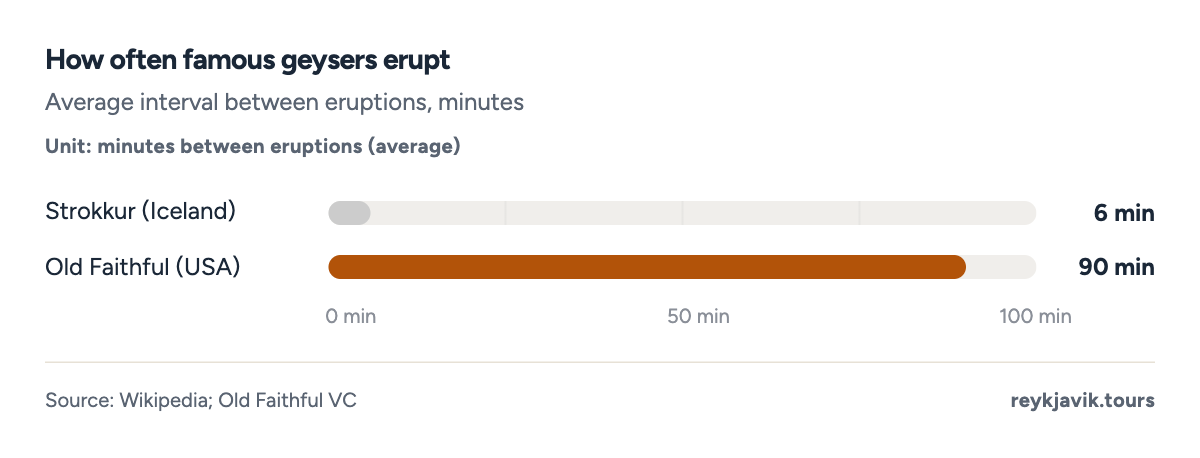
- Strokkur erupts roughly every 6 minutes - about 10 times an hour.
- Old Faithful's 90-minute interval makes Strokkur the world's most punctual big show.
| Eruption interval | every 5-10 minutes (occasionally up to 15) |
| Usual height | 15-20 m |
| Maximum height | about 40 m |
| First recorded eruption | 1789 |
| Location | Haukadalur valley, Golden Circle, ~100 km from Reykjavík |
| Show duration | a few seconds, one main burst |
Geysir Iceland: how often does it erupt?
The original Great Geysir - dormant since 1916 - is the reason the question "Geysir Iceland how often erupt" has a disappointing answer: rarely, and only when the ground decides.
The Great Geysir began forming around 1150 CE1 and appears in written accounts from the 13th century. In its prime it threw water to 60-70 m1 - higher than any active geyser in the world reaches today except Yellowstone's Steamboat. In 1630 the eruptions were reportedly violent enough to shake the surrounding ground1.
Then, in 1916, it stopped - and the biggest geyser in Iceland became a silent spring. Earthquakes had shifted its plumbing before; this dormancy held. The only interruptions were man-made: a brief 1935 reactivation after operators cut a channel to lower the water level, and the 20001 revival, when earthquakes on the anniversary of Iceland's settlement forced eruptions reaching a reported 122 m1 - the tallest in its recorded history. Since then, silence. Chalk deposits at the vent and the steam wisps are all that show the giant is warm underneath - the field's other springs keep bubbling, and on cold mornings the steam column over Geysir's basin is visible from the road while the geyser itself stays still1.
Why did it stop? The honest answer is that geyser plumbing is a delicate underground chemistry of pressure, heat and narrow channels, and Geysir's channels silted or collapsed - nobody drilled deep enough to know exactly. The 1916 stoppage came in the middle of a seismic period in the southwest, and the same earthquakes that silenced Geysir appear in the records of neighbouring hot springs changing behaviour in the same years. A geyser is a self-sealing machine: every eruption deposits a little silica in the channels that feed it, and a channel narrow enough to build pressure is narrow enough to lose. Geysir may simply have completed its own plumbing repair1. What is documented is the human meddling: in 1935, locals cleared the outlet channel and Geysir erupted again for a few years, on command for film crews and delegations at rates of one show per day or better. When the channel silted over once more, the giant went quiet and has stayed quiet1. On anniversaries of Iceland's settlement some operators have ceremonially added soap - a surfactant that lowers the water's boiling point - but soap-fed eruptions are now banned as damaging to the geyser1.
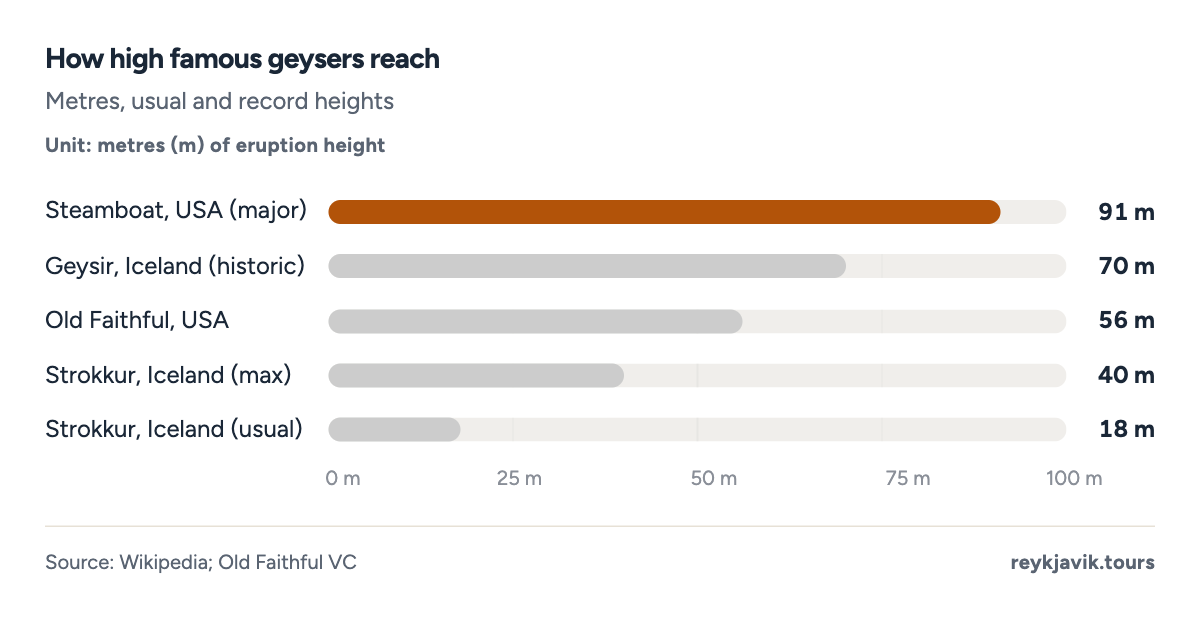
- Strokkur's usual 15-20 m triples to a 40 m maximum in strong eruptions.
- Geysir's pre-1916 bursts reached about 70 m - taller than Hallgrímskirkja's tower.
- Yellowstone's Steamboat holds the world record at 91 m.
| 13th c. | First written accounts of eruptions at Haukadalur |
| 1630 | Eruptions reportedly shake the ground around the field |
| 1910-1916 | Geysir erupts frequently, to ~60-70 m |
| 1916 | Geysir ceases regular eruptions - dormant begins |
| 1935 | Brief reactivation after operators reduce the water channel |
| 2000 | Earthquake anniversaries force a brief revival; eruptions to ~122 m |
| 2010s- | Dormant; Strokkur carries the show every 5-10 minutes |
How many geysers in Iceland?
Iceland has roughly 25 active geysers5 - counts run from 20 to 29 depending on whether intermittent spouters are included, and to about 50 if perpetual spouters count too5. Almost all sit in the southwest's Haukadalur field, the Hengill area, and the northern fields at Hveravellir and Krafla4.
The world context makes Iceland's family remarkable: Yellowstone holds perhaps 5005 of the world's thousand-odd geysers, and Iceland is one of only a handful of countries with more than a dozen. But the word itself is Iceland's export: "geyser" comes from Geysir, from the Icelandic *geysa*, to gush - every hot water column on Earth is named after this one field in Haukadalur5.
The name travelled through English in the 17th century, when accounts of the "Great Geysir" reached scientists who had no word for a gusher that repeated on schedule. Today the family tree has curious branches: American geysers bear Icelandic-derived names in guidebooks, geyser enthusiasts chart "Geysir's cousins" on every continent, and the Haukadalur field remains the pilgrimage site for geyser tourists - the birthplace of the word, if no longer of the show5.
The counts behind those branches tell Iceland's story in miniature. A country of 390,000 people holds a double-digit share of the world's geysers, almost all of its usable geothermal bathing capacity per capita, and an energy system where the same volcanism that annoys the drillers heats every swimming pool for free. The inventory chart above - geysers, springs, pools, lagoons - is really a map of how one geological feature became four different industries: tourism, bathing, heating and greenhouse agriculture all drink from the same aquifer4. And the inventory keeps moving: lagoons open and expand, pools are rebuilt, and the geyser count itself is a soft number that changes with every earthquake swarm - which is why this page pins the counts to their sources and dates rather than presenting them as permanent constants4.
- Yellowstone, USA50050%
- Rest of world (Russia, NZ, Chile …)47547.5%
- Iceland252.5%
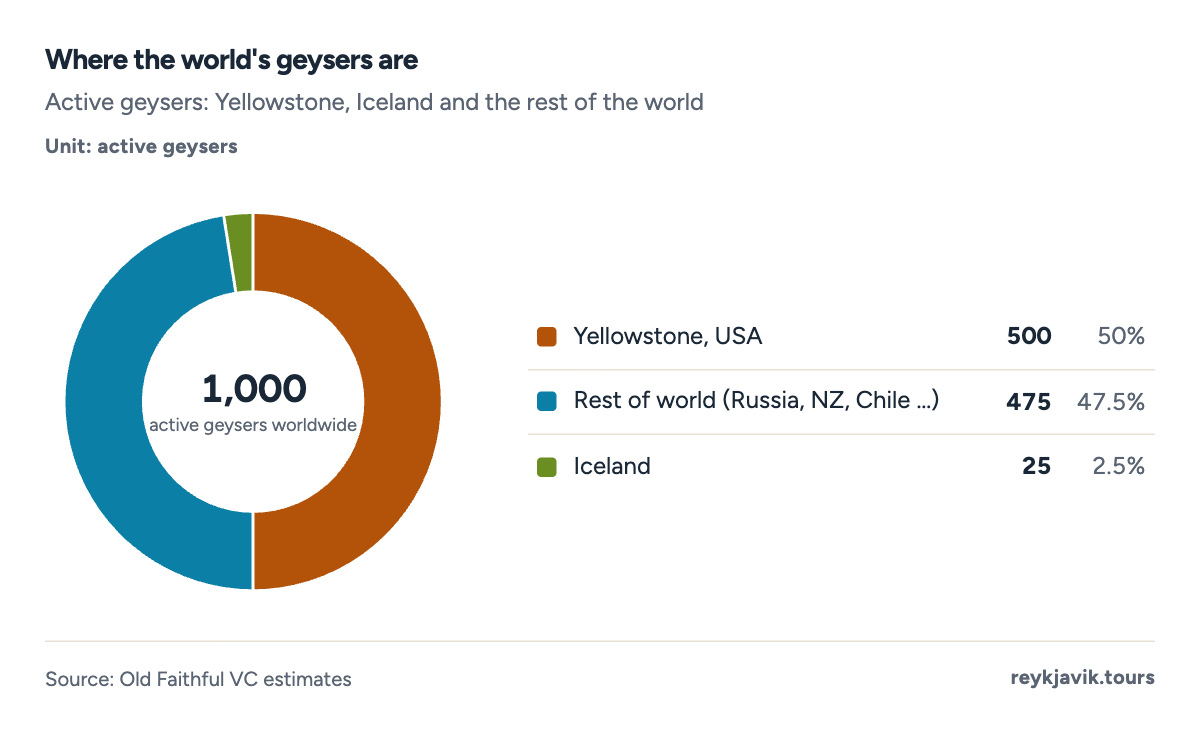
- Yellowstone holds roughly half of the world's active geysers.
- Iceland's 25 make it one of only a handful of geyser countries.
- The word 'geyser' itself comes from Geysir - the original named the phenomenon.
How many hot springs are in Iceland?
The count of named, soakable springs is the number bathers want; the count of geothermal pools is the number locals live with; and the lagoons are the spa industry built on top of both. How many lagoons are there in Iceland? About eleven operated ones - and how many Blue Lagoons are there in Iceland? Exactly one: everything milky and blue since 1987 is a competitor, not a branch.
How many hot springs in Iceland are worth the detour? Guides list 45+ named hot springs worth visiting and more than 120 geothermal pools4 - the man-made swimming pools fed by geothermal water that Icelanders treat as ordinary municipal infrastructure4. On top of those sit about 11 major lagoons - the operated spa destinations from the Blue Lagoon to Sky Lagoon, Mývatn Nature Baths and the Forest Lagoon - a category that barely existed before 1987 and is now one of Iceland's defining industries4.
Behind the bathable features, the geothermal resource is enormous: Iceland sits on the Mid-Atlantic Ridge, and its ~30 volcanic systems and hundreds of smaller hot-spring fields heat everything from greenhouses to sidewalks. Deildartunguhver in the west is the extreme example - Europe's highest-flow hot spring, pushing 180 litres per second4 at near boiling4.
The lagoon boom is the newest layer. The Blue Lagoon opened in 1987 on runoff from the Svartsengi power station - an accident of geothermal energy production that became Iceland's most-visited attraction. Its success spawned a genre: Sky Lagoon's oceanside infinity edge, the Forest Lagoon's Akureyri woods, Mývatn's mineral baths, and lagoons announced in regions that had never sold a ticket before. Each is man-made plumbing into water the volcanoes heat for free - the operated lagoon count of eleven grows almost yearly4.
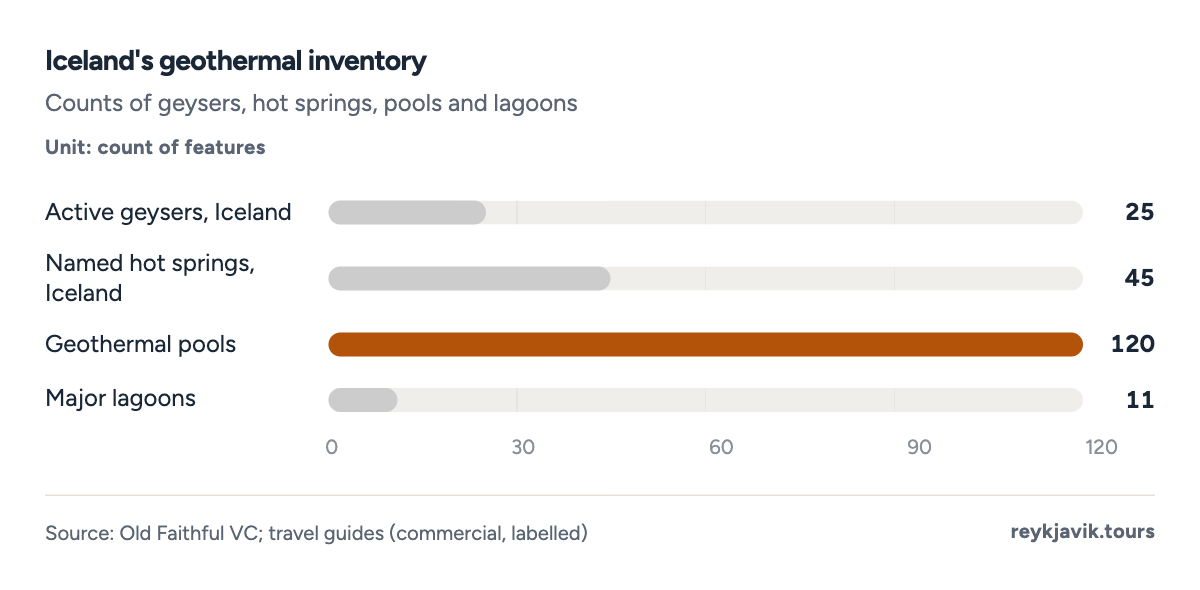
- About 25 active geysers work in Iceland today.
- Dozens of named hot springs and 120+ geothermal pools serve bathers.
- Around 11 major lagoons now operate as spa destinations.
| Haukadalur (Geysir & Strokkur) | South | the Golden Circle geyser field |
| Hveravellir | North (highlands) | fumaroles, hot pots, bathing pool |
| Krafla / Námaskarð | North | mud pools, steam vents, the Viti crater |
| Gunnuhver | Southwest (Reykjanes) | Iceland's largest mud pool |
| Deildartunguhver | West | Europe's highest-flow hot spring (180 l/s at ~100 °C) |
| How many geysers in Iceland? | about 25 active (up to ~50 counting perpetual spouters) |
| How many hot springs? | 45+ named; 120+ geothermal pools |
| How many lagoons? | about 11 major operated lagoons, incl. Blue Lagoon and Sky Lagoon |
| How often does Strokkur erupt? | every 5-10 minutes |
| How often does Geysir erupt? | it is dormant; last eruption 2000 |
Conclusions
- The geyser that gave the phenomenon its name, Great Geysir, has been dormant since 1916 - its last eruption, in 2000, was earthquake-forced and reached a record 122 m1.
- Strokkur fills the show: every 5-10 minutes, 15-20 m usual, up to 40 m - the most predictable big geyser display on Earth, and the reason the Golden Circle works as a day tour2. The eruption is a pressure cycle anyone can understand: groundwater percolates down to superheated rock, flashes to steam, and blows the column skyward through a channel barely wide enough to swim through. No two bursts are identical - the pool chooses its own power level each time2.
- Iceland counts about 25 active geysers5 - remarkable globally, and only a fraction of Yellowstone's 500, though the English word for all of them is Icelandic5.
- The bathing industry dwarfs the geyser-watching: 45+ named hot springs, 120+ geothermal pools and about 11 major lagoons turn geothermal water into the country's signature leisure product - one aquifer feeding four industries4. The same hot water that Strokkur throws skyward warms greenhouses, sidewalks and swimming pools across the country without burning a gram of fossil fuel - a geothermal dividend no other Western country collects at this scale.
- For a visitor the planning answer is simple: no timing needed - drive to Haukadalur, wait ten minutes, watch a 20-metre eruption; then repeat until satisfied2.
- The naming is the deepest fact: the English word "geyser" is literally Geysir - Iceland named the phenomenon for the field that now mostly sleeps, while its neighbour performs nightly on schedule5.
Methodology
- Strokkur interval and heights: current Wikipedia figures, stable for years
- Geysir history: 13th century to 2000 (Wikipedia, Old Faithful VC)
- Counts: geyser, hot spring, pool and lagoon totals from compiled sources
Definition. An 'active geyser' erupts periodically on its own; a 'perpetual spouter' jets continuously; a 'hot spring' is any thermally fed pool. Intervals are averages - Strokkur occasionally stretches to 15 minutes, and earthquakes can reset both geysers' plumbing overnight.
Data sources. Wikipedia's Strokkur and Geysir articles (with the underlying scientific and historical references); the Old Faithful Virtual Visitor Education Centre for world geyser counts and comparisons; Guide to Iceland and Visit South Iceland for hot-spring, pool and lagoon counts (commercial, labelled).
Calculations. Eruptions per hour for Strokkur derive from the interval midpoint (6 min → ~10/hour; per-visit sightings assume a 60-minute stay). The activity timeline encodes qualitative history into three levels (dormant / revival / frequent) - clearly labelled as our encoding, since eruption frequency was never measured in modern units before the 20th century.
Limitations. Geyser counts vary by definition and change with seismic events; the 20-29 range and the ~500 Yellowstone figure are estimates from geyser-study sources. Strokkur's interval occasionally stretches to 15 minutes. Historic Geysir heights predate instruments and rest on period accounts. Lagoon and pool counts reflect operated facilities and change with openings and closures.
Sources
- Wikipedia. “Geysir (Great Geysir) - history, dormancy, 2000 reactivation.” Wikipedia, 2026. en.wikipedia.org. Accessed 2026-09-17. Back to text
- Wikipedia. “Strokkur - eruption interval and heights.” Wikipedia, 2026. en.wikipedia.org. Accessed 2026-09-17. Back to text
- Reykjavik Tours. “Own compilations and midpoints (labelled).” own calculation, 2026. reykjavik.tours. Accessed 2026-09-17. Back to text
- Guide to Iceland / Visit South Iceland. “Hot spring, pool and lagoon counts; Strokkur visitor figures (commercial, labelled).” travel portals, 2026. guidetoiceland.is. Accessed 2026-09-17. Back to text
- Old Faithful Virtual Visitor Education Centre. “Global context - world geyser counts and famous geysers.” Yellowstone educational site, 2024. geyserstudy.org. Accessed 2026-09-17. Back to text
About the author
Laufey turns public statistics on tourism and travel into research people can check and cite.
Every figure on this page links to its source. How we research
Related research
More data on Iceland's weather and travel from Reykjavik Tours.
- NatureBiggest Glacier in Iceland (2026 Data)7,720 km² Vatnajökull, Iceland's biggest glacierRead the research →
- NatureHow Many Waterfalls in Iceland? (2026 Data)1,624 named waterfalls in IcelandRead the research →
- NatureHow Many Volcanoes Are in Iceland? (2026 Data)33 volcanic systems in IcelandRead the research →
- NatureHow Many Square Miles Is Iceland? (2026 Data)39,769 square miles: Iceland's total areaRead the research →
- EnergyIceland Renewable Energy Percentage (2026 Data)90% of Iceland's energy is renewableRead the research →