How Many Horses in Iceland? (2026 Data)
Iceland's animals counted: 92,000 horses, 800,000 sheep, millions of puffins, zero mosquitoes - every animal number sourced and explained.
- Published
- Updated
- 6 sources
- 11 statistics
- 9 min read

- M.Sc. in Atmospheric Sciences, University of Iceland (Háskóli Íslands), with a minor thesis on North Atlantic storm-track variability
- Former research assistant at the Icelandic Meteorological Office (Veðurstofa Íslands), working on subarctic climate modeling and volcanic-ash dispersion forecasting
- B.A. in Sociology, also from the University of Iceland, with fieldwork on rural depopulation and tourism's impact on small fishing communities (Westfjords focus)
- Grew up in Akureyri, spent seven years living in Reykjavík and two in a small village in the Westfjords - brings first-hand experience of Iceland's regional weather extremes and community life
- Fluent in Icelandic and English; has translated Icelandic Met Office public advisories for international outlets
- Published field notes and data-driven pieces on glacier retreat (Vatnajökull), aurora forecasting, and the socioeconomic effects of overtourism in the Golden Circle

- M.A. in Journalism, University of Iceland, with additional coursework in Environmental Communication at the University of Bergen (Norway), giving a comparative Nordic lens
- 12+ years in Icelandic media, including editorial roles at RÚV (Iceland's national broadcaster) covering weather-related public safety reporting (storms, volcanic eruptions, road closures)
- Former fact-checking lead for a travel-and-culture desk, specializing in verifying tourism statistics, safety advisories, and climate data against primary sources (Vedur.is, Statistics Iceland)
- Has overseen editorial standards for bilingual (Icelandic/English) publications, ensuring both cultural nuance and accuracy for international readers
- Advocate for citing primary sources (Icelandic Met Office, Icelandic Tourist Board / Ferðamálastofa) rather than secondhand reporting
Key findings
- 92,000Iceland has about 92,000 Icelandic horses - roughly one per 4 people.
- 800,000Sheep outnumber people two to one, with about 800,000 in summer.
- 2-3MIceland hosts 2-3M pairs of Atlantic puffins, 60% of the world total.
- 0Iceland has 0 mosquitoes, 0 reptiles and 0 amphibians.
- 3,000-6,000Some 3,000-6,000 reindeer roam East Iceland, introduced in 1771.
- 0Iceland caught zero whales in 2024 - commercial whaling has ended.
Iceland has about 92,000 Icelandic horses1 - roughly one horse for every four people, the highest per-capita horse ownership in the world by a wide margin, a statistic that surprises every visitor and defines the relationship between Icelanders and their most famous domestic animal. But the horse is just the beginning of Iceland's animal story: the country has 800,000 sheep2, 2-3 million puffins3, zero mosquitoes4, and the only Arctic fox population in Europe outside Scandinavia.
The animal kingdom in Iceland is small in species but large in individuals - and some of the numbers are famous: no mosquitoes, no reptiles, no amphibians, no polar bears (despite the name). This page counts every animal people ask about, from the 92,000 horses to the zero snakes.
How many horses are in Iceland?
Iceland has about 92,000 horses1 - the registered Icelandic horse population as of 2024, according to the international WorldFengur registry1. That number has grown steadily since 1990, when the registered population was about 60,000. The Icelandic horse is a pure breed: an import ban dating from 982 CE means that no horse that leaves Iceland can ever return, keeping the bloodline isolated for over a thousand years4.
The horses per capita ratio is extraordinary and unique among nations: roughly one horse per four people1, compared with one per 60 in the United Kingdom. About 100,000 additional Icelandic horses live abroad, mostly in Germany and Scandinavia, where the breed's unique tölt gait has made it a recreational riding favourite, and the Iceland horses per capita ratio is the highest of any nation1.
Number of horses in Iceland by use
The 92,000 horses divide between riding and leisure horses (the majority), breeding mares, and competition horses. The breed's five-gaited ability - including the smooth tölt that replaces the trot - is what makes it valuable internationally, and Icelandic horse breeding is a significant export industry: horses sell for ISK 500,000 to several million depending on training and pedigree1.
The breed's purity is legally protected: the import ban means no horse that leaves Iceland can return, and no horse from outside can enter. Even equipment used with foreign horses must be disinfected before import. This isolation has preserved a breed that is genetically distinct from every other horse population on Earth, with DNA studies tracing Icelandic horses directly to the horses the Norse settlers brought from Norway and the British Isles more than a thousand years ago1.
Horse riding is a significant part of Icelandic tourism: commercial riding tours operate from every major town, from one-hour beach rides to multi-day highland expeditions. The annual Landsmót - the national Icelandic horse competition - draws thousands of spectators and entries every summer, and the breeding show season runs from June to September with horses judged on conformation and all five gaits1.
Projection: linear trend of 1990–2024 per-decade values, 95% prediction range. Our calculation, not a forecast.
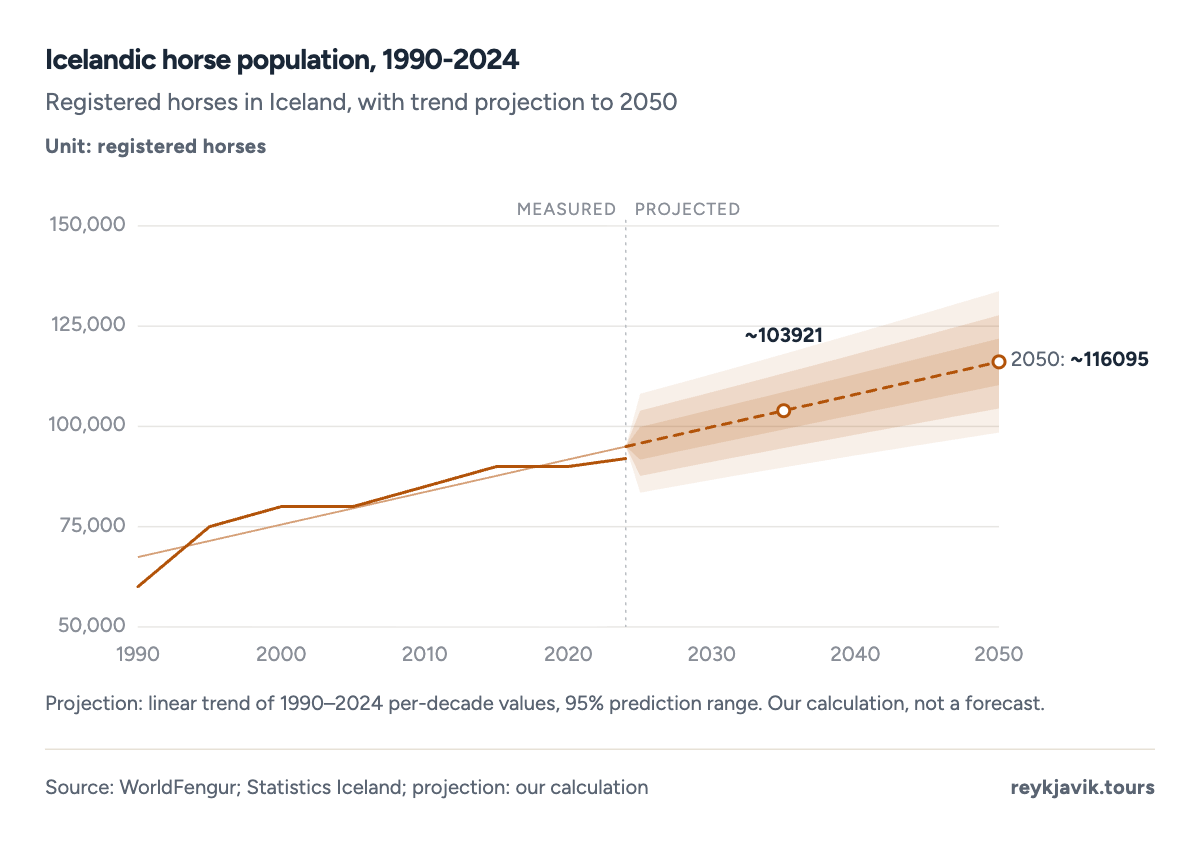
- The horse population grew from 60,000 in 1990 to 92,000 in 2024.
- The growth reflects the international popularity of the Icelandic breed.
- The projection is our calculation, not a forecast.
How many sheep in Iceland?
Iceland has about 800,000 sheep2 in summer - the number drops to about 450,000 after the autumn slaughter, when lambs are taken in and the breeding flock is counted2. Sheep farming has been central to Icelandic agriculture since settlement, and the annual réttir (roundup) - where farmers on horseback gather sheep from the highlands - is a cultural event broadcast live on national television. The autumn réttir in Þórsmörk and Landmannalaugar draws hundreds of riders and spectators, and the spectacle of hundreds of sheep stampeding down a mountain towards the sorting pen is one of the most photographed events in the Icelandic calendar2.
The wool industry connected to sheep farming is also significant: Icelandic wool (lópi) is a distinctive dual-coat fleece that produces the lopapeysa, the iconic Icelandic sweater hand-knitted in patterns that identify the wearer's region and family. Every sheep produces about 1.5 kg of wool per year, and the total clip of 800,000 sheep generates over a million kilograms of raw wool annually2.
The sheep population has declined from its mid-20th-century peak of over 900,000, as agriculture diversified and wool prices fell. But sheep still outnumber people two to one, and their presence defines the landscape: almost every lowland meadow and hillside is grazed in summer, and the absence of trees in many areas is partly a sheep story2.
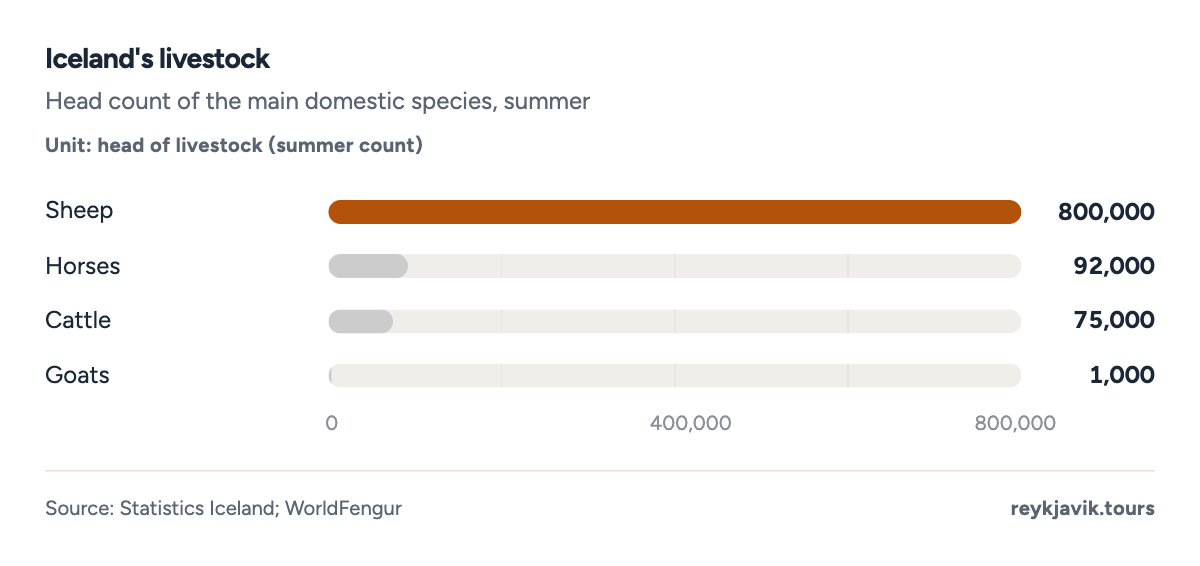
- Sheep are the most numerous livestock at about 800,000 in summer.
- Horses outnumber cattle at 92,000 head.
- Goats are critically rare at about 1,000 animals.
| Sheep | 800,000 |
| Horses | 92,000 |
| Cattle | 75,000 |
| Goats | 1,000 |
Wild mammals: reindeer, Arctic foxes and the polar bear question
Iceland has almost no native terrestrial mammals. The only species that was here before humans is the Arctic fox (about 3,000 animals)3, which crossed the sea ice at the end of the last ice age. Everything else was introduced - deliberately or accidentally.
How many reindeer are in Iceland? Reindeer were introduced in 1771 and now number about 3,000-6,0003, confined almost entirely to East Iceland. They roam freely in the highlands and are hunted under quota. The population fluctuates with weather and food availability, and the hunting quota adjusts annually3.
How many polar bears in Iceland? Polar bears do not live in Iceland as residents. The country has no resident polar bear population, but individual bears occasionally arrive on drift ice from Greenland - the most recent was in 2016. Every visitor is typically shot, since capturing and returning a polar bear is not practical. The number of polar bear visits in recorded history is fewer than 600[^wiki]5.
American mink, escaped from fur farms in the 1930s, are now widespread and considered invasive. They prey on ground-nesting birds and have no natural predator in Iceland3.
- Sheep (summer)800,00084.1%
- Horses92,0009.7%
- Dogs50,0005.3%
- Reindeer + Arctic foxes9,0000.9%
- Other species5000.1%
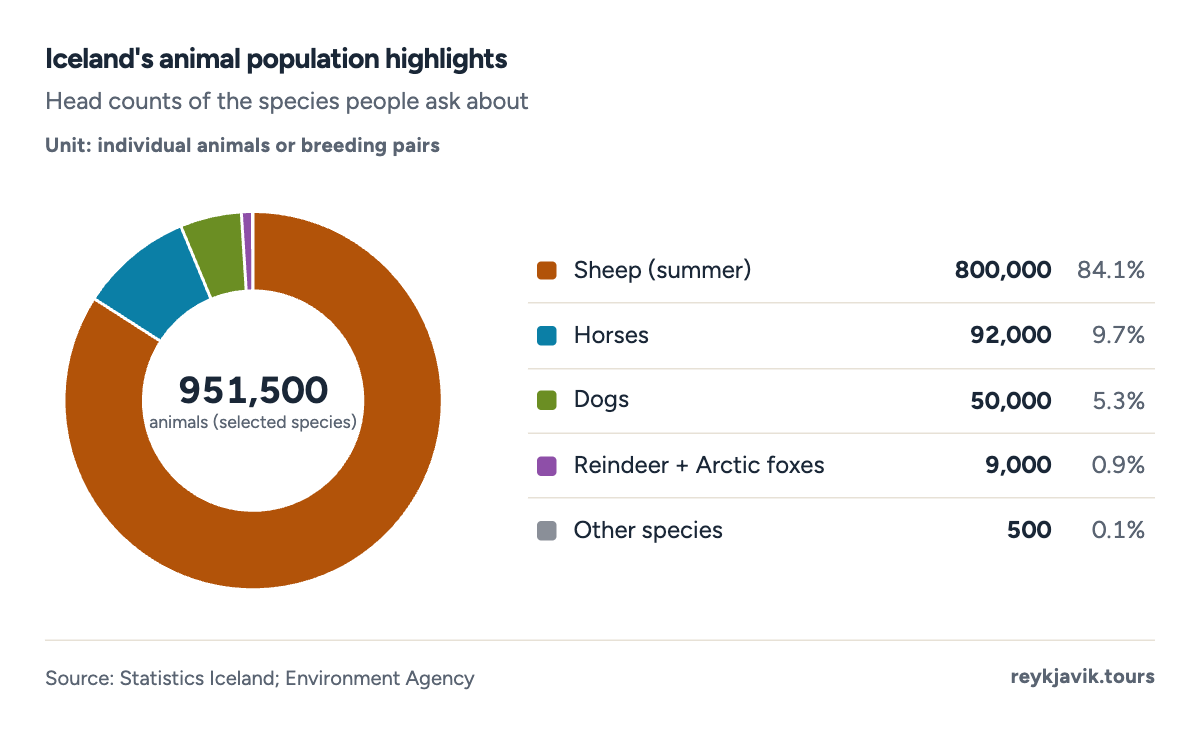
- Sheep outnumber every other domestic animal by far.
- Reindeer and Arctic foxes are the only large wild terrestrial mammals.
| Reindeer | 3,000-6,000 | Introduced 1771; East Iceland only |
| Arctic fox | about 3,000 | Only native terrestrial mammal |
| American mink | unknown (thousands) | Introduced (escaped fur farms); invasive |
| Polar bear | 0 resident | Occasional drift-ice visitors from Greenland |
| Mouse (wood mouse) | common | Introduced; only terrestrial rodent |
| Mosquitoes | 0 | Iceland famously has no mosquitoes |
Birds and marine life
Iceland is one of the world's great bird-watching destinations. About 330 bird species3 occur regularly, and around 85 species3 breed here. How many puffins in Iceland? The Atlantic puffin is the icon: Iceland hosts 2-3 million pairs3 - about 60% of the world's Atlantic puffin population - with the largest colonies at Látrabjarg, the Westman Islands and Grímsey3.
The number of species of amphibians in Iceland is zero - no frogs, toads or newts exist. In the waters around Iceland, the marine mammals outnumber the terrestrial ones: blue whales, fin whales, humpback whales, orcas, dolphins and seals all feed in Icelandic waters. The blue whale - the biggest animal in Iceland and the biggest animal that has ever lived on Earth - reaches 30 metres and 200 tonnes4.
How many whales does Iceland kill each year? The answer in 2024 is zero. Whaling is Iceland's most controversial animal policy. Iceland stopped commercial whaling in 2024, and no whales have been caught since 20236. The annual catch had already declined from a peak of over 400 whales in the 2000s to single figures by 2021, as demand for whale meat collapsed and international pressure grew6.
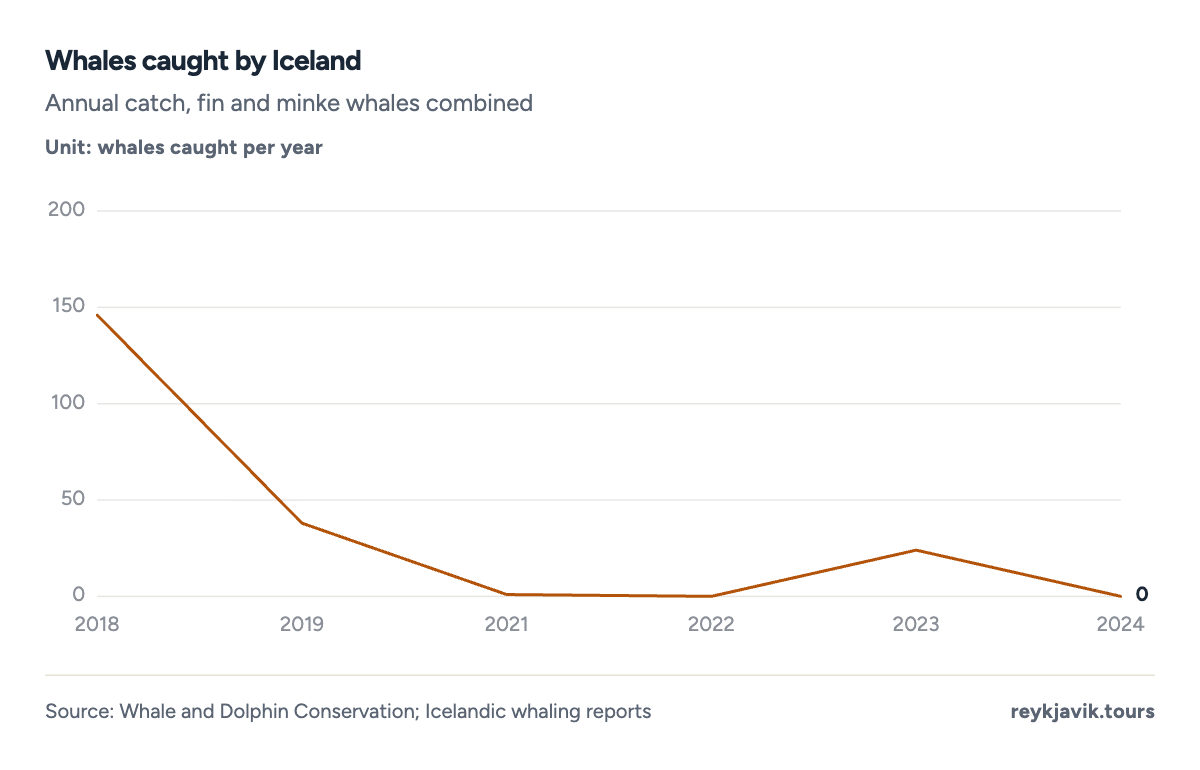
- Iceland caught no whales in 2024 - the minke whaling company closed and fin whaling paused.
- The 2018 catch of 146 whales was the highest in recent years.
| 2018 | 142 | 4 | 146 |
| 2019 | 0 | 38 | 38 |
| 2021 | 0 | 1 | 1 |
| 2022 | 0 | 0 | 0 |
| 2023 | 24 | 0 | 24 |
| 2024 | 0 | 0 | 0 |
The zero list: what Iceland doesn't have
How many animals are in Iceland? The answer depends on what counts: about 92,000 horses, 800,000 sheep, 75,000 cattle, 50,000 dogs, 3,000-6,000 reindeer, 3,000 Arctic foxes, 2-3 million pairs of puffins and 330 bird species. Iceland's most famous animal statistics are the absences. How many mosquitoes in Iceland? Zero. - one of the only inhabited places on Earth where they don't live, for reasons that entomologists don't fully understand but that relate to Iceland's volatile weather and volcanic soil chemistry4.
There are also no reptiles and no amphibians - no snakes, no lizards, no frogs, no toads, no newts. The only terrestrial reptiles in Iceland are in the zoo. The absence is pre-human: these groups never reached Iceland before the Atlantic separated them from the continents, and no species has crossed since4. The absence of mosquitoes is particularly famous: Iceland sits at the perfect latitude for them, has the standing water they need, and hosts millions of biting midges - but not a single mosquito has ever established a population. The reason is unknown; theories include volatile volcanic soil chemistry, unpredictable temperature swings that disrupt larval development, and the simple fact that whatever mosquito species might arrive cannot survive the Icelandic winter in any life stage4.
Polar bears are not residents, and penguins live only in the Southern Hemisphere - the puffins that tourists sometimes mistake for penguins are a completely different bird family entirely4.
| Mosquitoes | 0 - Iceland is one of the only inhabited places on Earth with none |
| Reptiles | 0 native species |
| Amphibians | 0 native species |
| Polar bears | 0 resident - occasional drift-ice visitors only |
| Snakes | 0 native species |
Birds and plants: the species counts
How many species of birds are in Iceland? The number of bird species in Iceland stands at about 330 regularly occurring species, with 85 breeding here during the short subarctic summer. The number of plant species in Iceland is about 500 native vascular plants - remarkably few for a European country, reflecting the island's isolation and young geology. The flora is dominated by mosses, lichens and sedges rather than flowering plants, and the tree line is so low that "forest" and "scrub" overlap entirely in most of the country4.
The species counts connect to the larger biodiversity picture: Iceland has no ants, no bats, no freshwater fish beyond a handful of species, and no native land mammals other than the Arctic fox. Every terrestrial mammal except the fox was introduced by humans - reindeer in 1771, mink by escape in the 1930s, mice and rats by ship since settlement. The bird population is the richest part of the terrestrial fauna, and the marine environment adds whales, seals and countless fish species that never appear in terrestrial counts4.
Dogs and other pets
How many dogs in Iceland? The registered dog population is about 50,0002 - one dog for every eight people. Dog ownership has grown steadily, and Icelandic dog culture is distinctive: the native Icelandic Sheepdog is one of the oldest breeds in the world, brought by the Vikings. Cats are equally popular, and the Icelandic cat population is estimated at a similar level to dogs2.
The horse culture: why the numbers matter
The Icelandic horse is not just an animal count; it is a cultural institution. The breed's isolation has produced a genetic uniqueness that makes it a living archaeological artefact - a direct link to the horses the Vikings brought to the North Atlantic. The breed's five gaits, including the smooth tölt that can carry a rider at speed without bouncing, are genetic traits that no other breed shares in the same combination.
The horse economy supports riding schools, breeding farms, export agents, farriers, veterinarians and tourism operators across rural Iceland. Horse riding tourism is a year-round industry, and the annual Landsmót competition is a national event that fills exhibition halls in Reykjavík or Akureyri. The breed's international market has been growing for decades: German, Scandinavian and North American buyers import Icelandic horses at prices that range from a few thousand dollars for a recreational horse to hundreds of thousands for a competition or breeding champion1.
The per-capita ratio of one horse per four people tells the story of a country where the horse is not a luxury but a partner in work and sport, and where the breed itself is a national symbol that appears on stamps, coins and the coats of arms of Icelandic farms. The ratio has been stable for decades because the horse population grows with the human population - and because the export market for Icelandic horses absorbs the surplus that the domestic market cannot absorb1.
Conclusions
- Iceland has about 92,000 horses - one per four people, the highest per-capita ratio in the world, and a pure breed protected by an import ban older than any other in the world1.
- 800,000 sheep outnumber people two to one in summer, and their annual réttir roundup is a national event2.
- The wild mammal population is tiny: Arctic foxes, reindeer and mice are the only terrestrial species, and polar bears are visitors, not residents3.
- Zero mosquitoes, zero reptiles, zero amphibians - absences that are as much a part of Iceland's identity as the animals it does have4.
- The bird life is rich despite the isolation: 330 species, including 2-3 million pairs of puffins - 60% of the world's population3.
- The absences define the list: no mosquitoes, no reptiles, no amphibians, no polar bears - and no whales killed in 2024, the first year since 2017 that the catch was zero6.
Methodology
- Horse population: 2024 (WorldFengur)
- Livestock: summer counts, 2024 (Statistics Iceland)
- Wildlife: Environment Agency of Iceland monitoring
- Whaling: annual catch reports to 2024
Definition. Horse population counts registered Icelandic horses in Iceland. Livestock summer counts include all animals grazing in July. Breeding pairs of puffins are estimated from burrow counts. 'Native' means present before human settlement.
Data sources. WorldFengur international registry for horse numbers; Statistics Iceland livestock statistics; Environment Agency of Iceland for wildlife monitoring; Whale and Dolphin Conservation for whaling data; Wikipedia for species descriptions.
Calculations. Per-capita ratios divide species populations by the human population (390,000, 1 January 2025). Livestock summer counts are the July-August figures, before autumn slaughter.
Limitations. Wildlife populations are estimates: reindeer and Arctic fox numbers fluctuate annually with weather and food. Puffin population estimates vary between 2 and 3 million pairs depending on the survey method and year. Dog and cat numbers are estimates from registration data, which undercounts unregistered animals.
Sources
- WorldFengur. “Icelandic horse population, 2024 (92,000 in Iceland, 215,000 globally).” WorldFengur (international registry), 2024. worldfengur.com. Accessed 2026-09-17. Back to text
- Statistics Iceland. “Livestock statistics - sheep, cattle, horses.” Statistics Iceland, 2025. hagstofa.is. Accessed 2026-09-17. Back to text
- Environment Agency of Iceland. “Wildlife populations - reindeer, Arctic fox, puffin.” UST, 2025. ust.is. Accessed 2026-09-17. Back to text
- Wikipedia. “Icelandic horse; Atlantic puffin; Wildlife of Iceland.” Wikipedia, 2026. en.wikipedia.org. Accessed 2026-09-17. Back to text
- Reykjavik Tours. “Own compilations (labelled).” own calculation, 2026. reykjavik.tours. Accessed 2026-09-17. Back to text
- Whale and Dolphin Conservation. “Whaling in Iceland - catches and quotas.” WDC (labelled), 2025. uk.whales.org. Accessed 2026-09-17. Back to text
About the author
Laufey turns public statistics on tourism and travel into research people can check and cite.
Every figure on this page links to its source. How we research
Related research
More data on Iceland's weather and travel from Reykjavik Tours.
- NatureBiggest Glacier in Iceland (2026 Data)7,720 km² Vatnajökull, Iceland's biggest glacierRead the research →
- NatureHow Often Does the Geysir in Iceland Erupt? (2026 Data)5-10 min between Strokkur's eruptionsRead the research →
- NatureHow Many Trees Are in Iceland? (2026 Data)2% of Iceland is forestRead the research →
- NatureHow Many Waterfalls in Iceland? (2026 Data)1,624 named waterfalls in IcelandRead the research →
- NatureHow Many Volcanoes Are in Iceland? (2026 Data)33 volcanic systems in IcelandRead the research →
- NatureHow Many Square Miles Is Iceland? (2026 Data)39,769 square miles: Iceland's total areaRead the research →