How Many Schools Are in Iceland? (2026 Data)
Every school in Iceland counted: preschools, compulsory schools, upper secondary, universities - plus tuition costs, literacy rates and the Hjalli model.
- Published
- Updated
- 6 sources
- 11 statistics
- 9 min read

- M.Sc. in Atmospheric Sciences, University of Iceland (Háskóli Íslands), with a minor thesis on North Atlantic storm-track variability
- Former research assistant at the Icelandic Meteorological Office (Veðurstofa Íslands), working on subarctic climate modeling and volcanic-ash dispersion forecasting
- B.A. in Sociology, also from the University of Iceland, with fieldwork on rural depopulation and tourism's impact on small fishing communities (Westfjords focus)
- Grew up in Akureyri, spent seven years living in Reykjavík and two in a small village in the Westfjords - brings first-hand experience of Iceland's regional weather extremes and community life
- Fluent in Icelandic and English; has translated Icelandic Met Office public advisories for international outlets
- Published field notes and data-driven pieces on glacier retreat (Vatnajökull), aurora forecasting, and the socioeconomic effects of overtourism in the Golden Circle

- M.A. in Journalism, University of Iceland, with additional coursework in Environmental Communication at the University of Bergen (Norway), giving a comparative Nordic lens
- 12+ years in Icelandic media, including editorial roles at RÚV (Iceland's national broadcaster) covering weather-related public safety reporting (storms, volcanic eruptions, road closures)
- Former fact-checking lead for a travel-and-culture desk, specializing in verifying tourism statistics, safety advisories, and climate data against primary sources (Vedur.is, Statistics Iceland)
- Has overseen editorial standards for bilingual (Icelandic/English) publications, ensuring both cultural nuance and accuracy for international readers
- Advocate for citing primary sources (Icelandic Met Office, Icelandic Tourist Board / Ferðamálastofa) rather than secondhand reporting
Key findings
- 250Iceland has about 250 preschools, 150 compulsory schools and 7 universities.
- FreePublic university tuition is Free at every level - only a $780 registration fee applies.
- 99%Iceland's literacy rate is 99%, among the highest in the world.
- 10:1The primary student-teacher ratio is 10:1 - about half the OECD average.
- 14,000The University of Iceland enrols about 14,000 students, the largest in the country.
- 10-15About 10-15 preschools follow the Hjalli model's gender-separate pedagogy.
Iceland has about 250 preschools, 150 compulsory schools, 30 upper secondary schools and 7 universities1 - a small system by international standards, serving a population of 390,000. What the system lacks in scale it makes up for in generosity: public education is tuition-free from preschool through university, and the student-teacher ratio of 10:12 in primary schools is roughly half the OECD average2.
The Iceland school system follows the Nordic model: municipal preschools and compulsory schools, state-run upper secondary schools, and a university sector where public tuition is free - students pay only a registration fee of about ISK 100,000 ($780) a year3. This page counts every level of the system, from the Hjalli model's gender-separate preschools to the University of Iceland's 14,000 students.
How many schools in Iceland?
How many schools are in Iceland? The education system has four levels, each with a different institutional count:
- Preschools (ages 1-5): about 250 institutions, run by municipalities1
- Compulsory schools (ages 6-15): about 150 schools covering grades 1-101
- Upper secondary schools (ages 16-19): about 30 schools, run by the central government4
- Universities: 7 institutions - 5 public and 2 private4. The number of preschools in Iceland total has remained stable at about 250 for several years, while the Iceland number of preschools per capita is among the highest in the OECD1
The counts are a moving target: preschools close and merge as rural populations shrink, while new compulsory schools open in growing Reykjavík suburbs. The compulsory school count includes both separate primary and lower-secondary schools and combined "grunnskóli" institutions that cover the full ten-year compulsory programme1.
The 250 preschools serve about 26,000 children aged 1-5, with attendance rates above 95% - among the highest in the OECD. The preschool system's coverage is a policy achievement: Iceland was one of the first countries to guarantee a preschool place to every child, and the municipal responsibility for preschools means every town and village has at least one. The rural schools are small - some with fewer than ten children - but the municipality must operate them regardless, which means no Icelandic child faces a daily commute to preschool longer than the distance to the nearest village1.
The 150 compulsory schools show a similar geographic distribution. Reykjavík and its suburbs account for about 40 schools serving the capital's 230,000 residents, while the remaining 110 schools serve towns and villages around the coast. The smallest compulsory schools - those with fewer than 20 students - are found in the Westfjords and the east fjords, where a single teacher may cover multiple grade levels in a single classroom. These schools are expensive per student but culturally essential: they keep villages viable by guaranteeing that families with children can stay1.
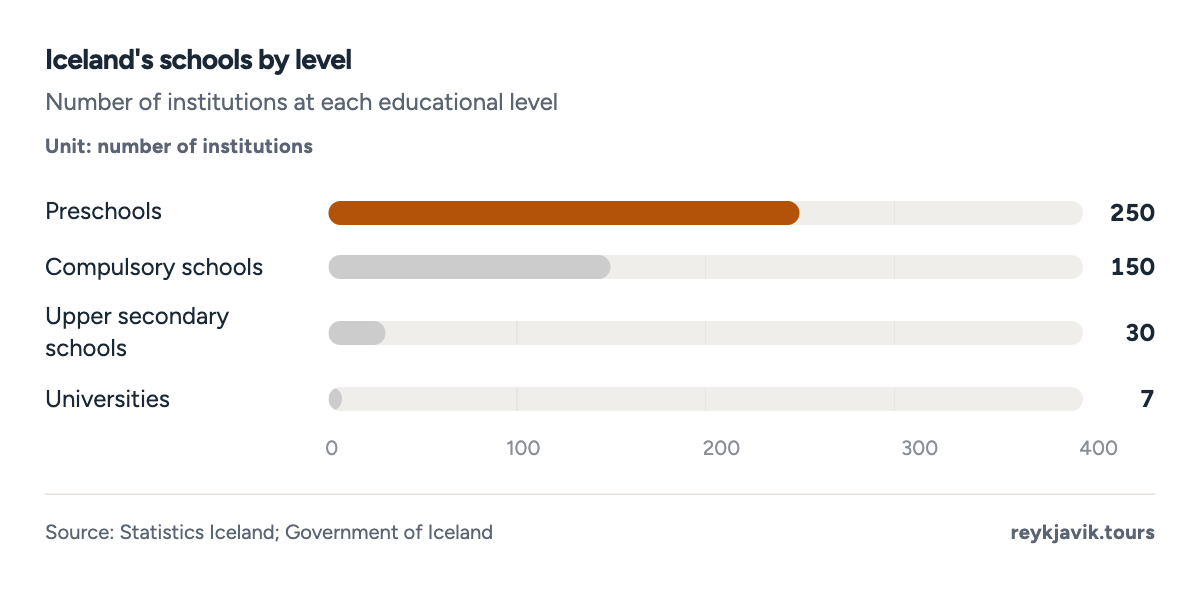
- Preschools are the most numerous at about 250 institutions.
- Seven universities serve the entire country - five public and two private.
- The 150 compulsory schools cover ages 6-16 across all municipalities.
| Preschool | 1-5 | 250 | Municipalities |
| Compulsory school | 6-15 | 150 | Municipalities |
| Upper secondary | 16-19 | 30 | Central government |
| Universities | 20+ | 7 | Central government / private |
Preschools and the Hjalli model
Preschool is where Iceland's education system is most distinctive. Attendance is not compulsory but is nearly universal, with about 250 institutions serving children from 12 months to age 6. Most are municipally run; a growing minority are private with public funding1.
The Hjalli model
The Hjalli model is Iceland's most famous pedagogical export. Founded by Margrét Pála Ólafsdóttir in 1989, The hjalli model Iceland number of preschools stands at about 10-15 institutions that separate boys and girls for most activities and apply a compensatory gender-aware curriculum - training boys in empathy and girls in physical confidence5. The model has been featured in international media and debated in academic journals, but its core insight - that gender stereotypes form before age three - has influenced Icelandic preschool education well beyond the Hjalli network itself5.
Iceland's preschool system also gained attention for another reason: the country was the first in the world to require preschools to register children by gender in official statistics, which made the Hjalli model's impact measurable. The number of Hjalli preschools has remained stable at about 10-15, with waiting lists in most locations5.
| Number of preschools | about 10-15 across Iceland |
| Model | gender-separate groups with gender-aware pedagogy |
| Founder | Margrét Pála Ólafsdóttir, 1989 |
| Approach | compensatory training to counter gender stereotypes |
| Reception | widely discussed; cited in international media |
Compulsory and upper secondary education
Compulsory education in Iceland runs from age 6 to 16 - a ten-year programme called grunnskóli that combines primary and lower secondary in a single school. About 150 schools deliver this programme across the country, from large suburban schools with 500+ students to rural schools with fewer than 101.
Upper secondary education (framhaldsskóli) is not compulsory but is attended by virtually all 16-19-year-olds. About 30 schools offer academic, vocational or mixed programmes, leading to the stúdentspróf matriculation exam that qualifies for university entry4. How many colleges are in Iceland? The answer depends on the definition: the 7 universities include several that would be called "colleges" in the US system, and Iceland also has vocational and arts colleges that don't grant degrees. But the conventional answer - counting degree-granting higher education institutions - is 74. The largest - Menntaskólinn í Reykjavík (MR) - is also the oldest, founded in 1846.
Class sizes are among the smallest in the OECD: an average of 18 students2 per primary class, compared with an OECD average of 212. The student-teacher ratio of 10:12 in primary schools is about half the EU average, reflecting Iceland's commitment to small learning groups over economy of scale2.
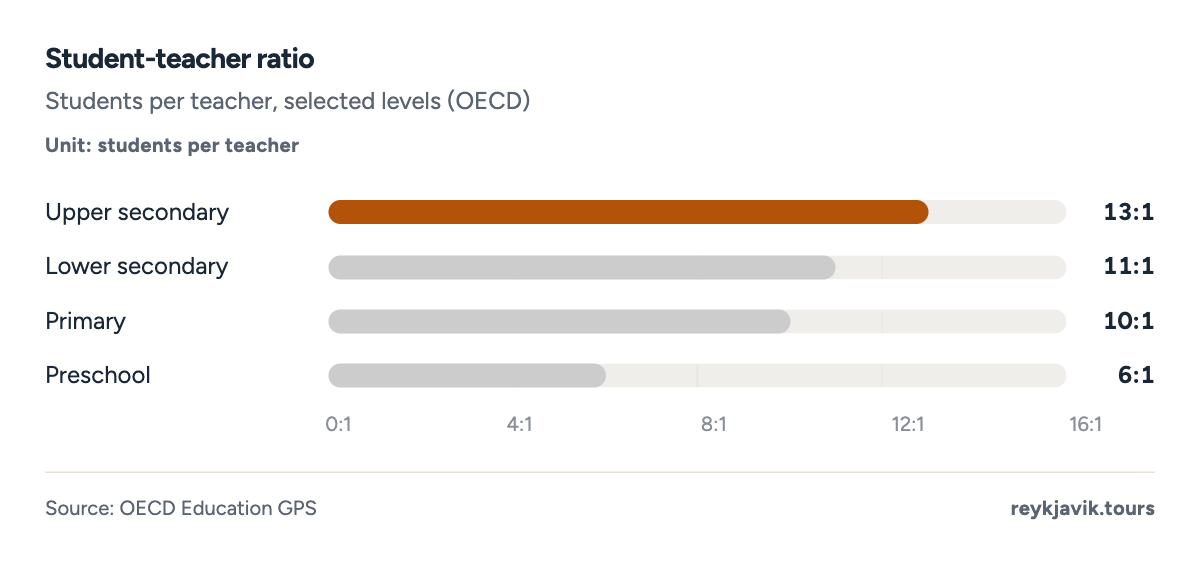
- Iceland's student-teacher ratios are among the lowest in the OECD.
- The 10:1 primary ratio is about half the OECD average of 15:1.
How many universities are in Iceland?
How many universities are there in Iceland? Iceland has 7 universities: five public and two private. The University of Iceland, founded in 1911, is the largest with about 14,000 students3, followed by Reykjavík University (a private institution founded in 1998) with about 3,5003. The remaining five - Akureyri, Agricultural University, Bifröst, Iceland Academy of the Arts and Hólar - together enrol fewer than 4,000 students3. The university of Iceland number of students by faculty shows the largest cohorts in social sciences, education and engineering, with the medical school and law school among the most competitive to enter3.
How much does university cost in Iceland?
How much is university in Iceland? Public university tuition is free for all nationalities3. Students pay only a registration fee of about ISK 100,000 per year (roughly $780), which covers student services rather than instruction. Private institutions - Reykjavík University and the Iceland Academy of the Arts - charge full tuition of about ISK 2.2 million ($17,100) per year3.
This makes Iceland one of the few countries where a degree from a public university costs nothing beyond living expenses - a policy that applies to international students as well as Icelanders, though most undergraduate programmes are taught in Icelandic3.
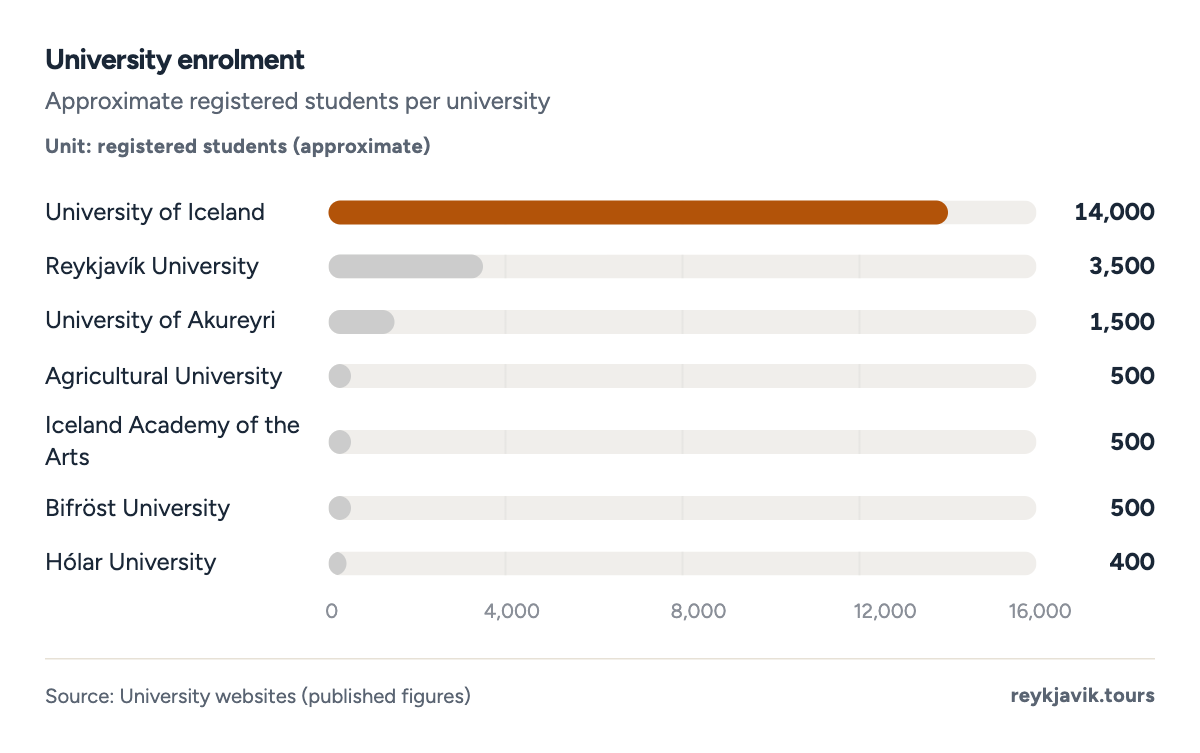
- The University of Iceland is the largest at about 14,000 students.
- Reykjavík University is the second largest and the main private institution.
- The university of Iceland number of students across all faculties and distance-learning programmes makes it one of the largest employers in the capital region as well as its largest educational institution.
- The five smaller universities together enrol fewer than 4,000 students.
| University of Iceland | Free | 100,000 |
| Reykjavík University | Private tuition | 0 |
| University of Akureyri | Free | 100,000 |
| Iceland Academy of the Arts | Private tuition | 0 |
Literacy and years of schooling
The literacy rate of Iceland is 99%2 - among the highest in the world, and equal to its Nordic neighbours. The average years of schooling in Iceland is approximately 12.5 years2, and about 45%1 of the adult population holds a tertiary (university-level) qualification, one of the highest rates in the OECD2.
The combination of free education from preschool to university, small class sizes, and a highly educated population creates a system where the question is not how many schools Iceland has, but how a country of 390,000 sustains seven universities and a 10:1 student-teacher ratio. The answer is the same one that sustains 250 preschools for 26,000 children: a national commitment to education as a public good, funded by taxes and delivered without tuition at every level[^gov]6.
Iceland's education system is not without its challenges. Teacher shortages have been reported in both preschools and compulsory schools, with an increasing share of unlicensed teachers filling positions that require certification. The rural school network is expensive to maintain, and debates about consolidation surface in every municipal election. And the university sector's seven institutions for 390,000 people raises questions about duplication and research efficiency - debates that play out in every budget cycle4.
But the system's achievements are equally real: a 99% literacy rate, one of the world's highest tertiary-education participation rates, and a student-teacher ratio that gives Icelandic children more individual attention than almost any other country provides. The question of how many schools Iceland has is really a question of what kind of society Iceland wants to be - and the answer, consistently, is one that builds a school in every village and charges nothing to walk through the door
The scale is worth restating: 437 institutions, 390,000 people, 103,000 square kilometres. Every number in this system is small by world standards, and every one of them matters to the community it serves.1.
The system's cost is measured not just in money but in the choices it forces. Every rural school kept open is a school that cannot benefit from economies of scale; every small class is a teacher who could teach twice as many students in a larger school; every university in a regional town is a department that might be stronger if consolidated in the capital. These trade-offs are visible in the numbers on this page - and Iceland has consistently chosen the version that costs more and serves fewer people per institution, because the alternative is a country that empties out beyond its capital1.
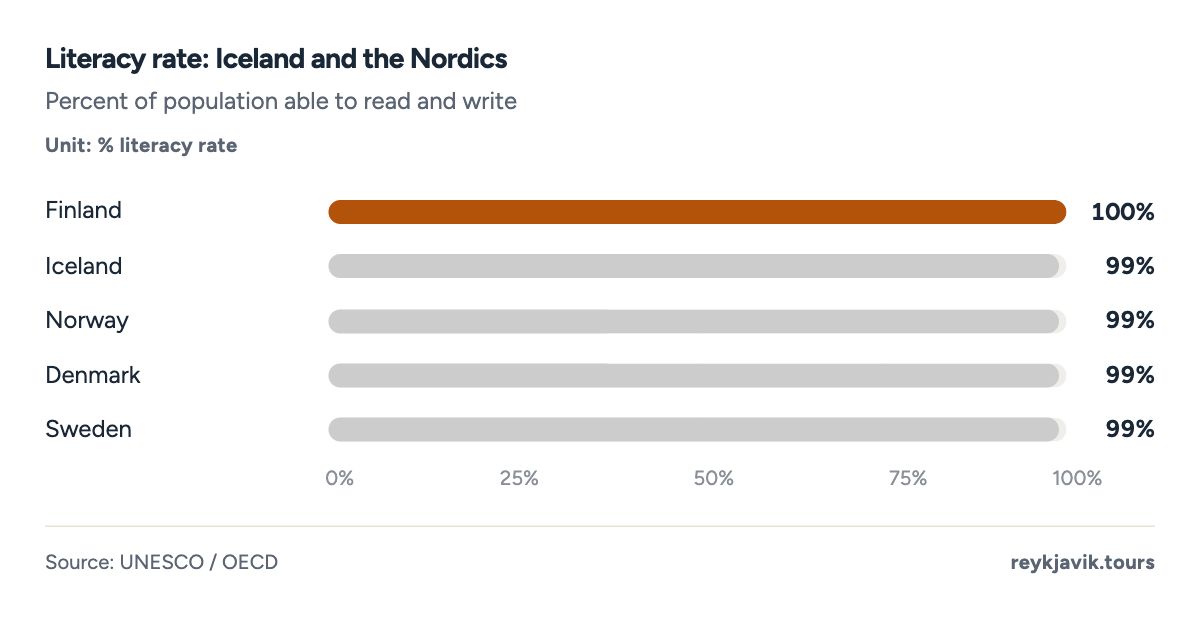
- Iceland's 99% literacy rate matches its Nordic neighbours.
- Finland reports 100% - the highest literacy rate ever recorded.
| Literacy rate | 99% |
| Average years of schooling | approximately 12.5 years |
| Population with upper secondary education or higher | about 78% |
| Population with tertiary education | about 45% |
| Literacy rate | 99% | 99-100% |
| Public university tuition | Free | Free or minimal |
| Student-teacher ratio (primary) | 10:1 | 10-13:1 |
| Compulsory education ages | 6-16 | 6-16/17 |
The Hjalli model in detail
The Hjalli model is Iceland's most internationally discussed pedagogical approach. Founded in 1989 by Margrét Pála Ólafsdóttir, who developed the method while working as a preschool teacher, the model operates on a simple but controversial premise: children as young as two are separated by gender for parts of the day, and each group receives targeted training to counteract the gender stereotypes that research shows form in the first years of life5.
Boys practice negotiation, empathy and verbal expression - skills the model identifies as underdeveloped in boys raised traditionally. Girls practice physical confidence, risk-taking and assertiveness. The separation is not total: children share meals, outdoor play and mixed activities, and the goal is explicitly to prepare them for a gender-equal society rather than to isolate them5.
The model attracted international attention when it was profiled in documentaries and news features, and its preschools have waiting lists despite the controversy. The exact number of Hjalli-model preschools in Iceland varies between 10 and 15 depending on how many follow the model fully versus partially, and the organisation also operates a school for older children and a summer programme5.
Free education: how it works
Iceland's public education system is tuition-free at every level, from preschool through university. Preschools charge small meal fees; compulsory schools charge nothing; upper secondary schools charge nothing; and public universities charge only a registration fee of about ISK 100,000 per year (roughly $780)3.
The free-tuition policy applies to all nationalities, not just Icelanders - which has made Iceland an attractive destination for international students, particularly from other EEA countries. Private universities charge full tuition, but the two private institutions (Reykjavík University and the Iceland Academy of the Arts) are smaller than the public universities and serve a more specialised student body3.
The cost to the state is substantial: education is one of the largest line items in the Icelandic budget, and the per-student cost of running small rural schools with 10:1 student-teacher ratios is far above what a market system would bear. But the political consensus across all parties has been to maintain the system - a reflection of the value Icelandic society places on equal access to education regardless of geography or income4.
Conclusions
- Iceland has about 250 preschools, 150 compulsory schools, 30 upper secondary schools and 7 universities - a total of roughly 437 educational institutions serving 390,000 people across the country's inhabited coastal strip1.
- Public education is tuition-free at every level, including university - students pay only a registration fee of about $780 a year3.
- The Hjalli model's gender-separate preschools are a uniquely Icelandic pedagogical experiment, operating in about 10-15 institutions since 19895.
- The 10:1 primary student-teacher ratio is roughly half the OECD average, reflecting a commitment to small learning groups over economy of scale2.
- The 99% literacy rate and 12.5 years of average schooling place Iceland among the most educated populations on Earth - and the free-tuition policy makes higher education accessible to every resident regardless of income3.
Methodology
- School counts: 2025-2026 academic year (Statistics Iceland, Government of Iceland)
- University enrolment: current academic year (university websites)
- Student-teacher ratios: OECD Education GPS 2024
- Literacy and years of schooling: UNESCO / OECD
Definition. Preschools (leikskóli) serve children aged 1-5. Compulsory schools (grunnskóli) cover grades 1-10 (ages 6-15). Upper secondary schools (framhaldsskóli) cover grades 11-14. Universities include all accredited higher-education institutions.
Data sources. Statistics Iceland education statistics; Government of Iceland education portal; OECD Education GPS; Study in Iceland portal; Hjallastefnan (the Hjalli model's own organisation, commercial, labelled); university websites for enrolment figures.
Calculations. Student-teacher ratios divide enrolled students by full-time-equivalent teaching staff as reported to the OECD. University enrolment figures are approximate registered-student counts from institutional websites. The registration fee conversion uses the 2025 average ISK/USD rate of 128.37.
Limitations. School counts change annually as institutions merge, close and open. University enrolment figures are approximate and include part-time and distance students. The Hjalli preschool count depends on how franchise and model-following schools are counted. Private university tuition varies by programme.
Sources
- Statistics Iceland. “Education statistics - pre-primary, compulsory, upper secondary, universities.” Statistics Iceland, 2026. hagstofa.is. Accessed 2026-09-17. Back to text
- OECD Education GPS. “Iceland: student-teacher ratios, instruction time, literacy.” OECD, 2024. gpseducation.oecd.org. Accessed 2026-09-17. Back to text
- Study in Iceland. “University tuition fees and registration costs.” official study portal, 2026. studyiniceland.is. Accessed 2026-09-17. Back to text
- Government of Iceland. “The Icelandic educational system brochure 2025.” Government Offices of Iceland, 2025. government.is. Accessed 2026-09-17. Back to text
- Hjallastefnan. “The Hjalli model - gender-separate preschools in Iceland.” Hjallastefnan (commercial, labelled), 2026. hjalli.is. Accessed 2026-09-17. Back to text
- Reykjavik Tours. “Own compilations from published sources (labelled).” own calculation, 2026. reykjavik.tours. Accessed 2026-09-17. Back to text
About the author
Laufey turns public statistics on tourism and travel into research people can check and cite.
Every figure on this page links to its source. How we research
Related research
More data on Iceland's weather and travel from Reykjavik Tours.
- HealthHow Many Hospitals in Iceland? (2026 Data)1 main university hospital serves all of IcelandRead the research →
- SocietyIceland Religion Percentage (2026 Data)56.3% belong to the national churchRead the research →
- SocietyWhat Is the Biggest City in Iceland? (2026 Data)140,470 residents of Reykjavík, Iceland's biggest cityRead the research →
- SocietyIceland Average Height for Men and Women (2026 Data)5 ft 11 in average height of young Icelandic menRead the research →
- SocietyIceland Ethnic Composition Percentage (2026 Data)70.9% of Iceland's residents have no foreign backgroundRead the research →
- SocietyHow Many People Live in Iceland? (2026 Data)396,500 people living in IcelandRead the research →