Iceland Religion Percentage (2026 Data)
Iceland's religions in percentages: the national church's fall from 90%, the rise of no-religion, Catholics, Muslims, the pagan revival - and the elf question.
- Published
- Updated
- 3 sources
- 17 statistics
- 9 min read

- M.Sc. in Atmospheric Sciences, University of Iceland (Háskóli Íslands), with a minor thesis on North Atlantic storm-track variability
- Former research assistant at the Icelandic Meteorological Office (Veðurstofa Íslands), working on subarctic climate modeling and volcanic-ash dispersion forecasting
- B.A. in Sociology, also from the University of Iceland, with fieldwork on rural depopulation and tourism's impact on small fishing communities (Westfjords focus)
- Grew up in Akureyri, spent seven years living in Reykjavík and two in a small village in the Westfjords - brings first-hand experience of Iceland's regional weather extremes and community life
- Fluent in Icelandic and English; has translated Icelandic Met Office public advisories for international outlets
- Published field notes and data-driven pieces on glacier retreat (Vatnajökull), aurora forecasting, and the socioeconomic effects of overtourism in the Golden Circle

- M.A. in Journalism, University of Iceland, with additional coursework in Environmental Communication at the University of Bergen (Norway), giving a comparative Nordic lens
- 12+ years in Icelandic media, including editorial roles at RÚV (Iceland's national broadcaster) covering weather-related public safety reporting (storms, volcanic eruptions, road closures)
- Former fact-checking lead for a travel-and-culture desk, specializing in verifying tourism statistics, safety advisories, and climate data against primary sources (Vedur.is, Statistics Iceland)
- Has overseen editorial standards for bilingual (Icelandic/English) publications, ensuring both cultural nuance and accuracy for international readers
- Advocate for citing primary sources (Icelandic Met Office, Icelandic Tourist Board / Ferðamálastofa) rather than secondhand reporting
Key findings
- 56.3%Some 56.3% of Icelanders belong to the national Lutheran church, down from 90% in 1998.
- 7.7%Icelanders registered with no religious organisation now total 7.7% of the population.
- 3.9%Catholics are Iceland's largest religious minority at 3.9% of the population.
- 64Iceland's state register lists 64 religious and life-stance organisations.
- 6,000+The pagan Ásatrúarfélagið has grown to over 6,000+ members from about 100 in 1998.
- ~50%About ~50% of Icelanders do not rule out the existence of elves and hidden folk.
Iceland is becoming less Lutheran at a measured, generational pace - and the register that tracks it is one of the most detailed in the world. Every resident is automatically registered with a religious or life-stance organisation at birth, and can opt out or switch with a simple form. The result is a 28-year official series that shows the Iceland religion percentage shift precisely: the national Lutheran church has fallen from 89.9% of the population in 1998 to 56.3% in 20261, while the no-religation group has quadrupled and the Catholic church has grown with immigration.
This page walks through the full register - every major group, the minorities people search for (Muslims, Jews, Buddhists), the pagan revival, and the famous question of how many Icelanders believe in elves. The data comes from the national register itself, not from opinion polls, which makes it uniquely reliable as a measure of belonging - and uniquely misleading as a measure of belief. The two must be read together to understand what the religion figures actually mean.
Iceland religion percentage: the 2026 numbers
The religion in Iceland percentage question has a precise answer because every resident is on a register. What percentage of Iceland is Christian? Adding every Christian group gives about 62%1. The biggest religion in Iceland is the Evangelical Lutheran Church - but Iceland christianity percentage is falling, and the percentage of Christians in Iceland as a whole is falling with it. What is the biggest religion in Iceland after Christianity? The answer depends on whether you count the no-religion group.
As of 1 January 2026, the register shows a country still majority-Lutheran but no longer overwhelmingly so:
- Evangelical Lutheran Church of Iceland: 56.3%1** (222,012 members)
- Roman Catholic Church: 3.9%1** (15,558)
- No religious organisation: 7.7%1** (30,257)
- Ásatrúarfélagið (pagan): 1.6%1** (6,158)
- Ethical Humanist Association: 1.6%1** (6,387)
- Muslim Association: 5691** members (0.1%)
- Jewish Community: 761** registered members
How many churches in Iceland? The state register lists 64 organisations, and the national church alone operates several hundred congregations and chapels across the country2.
The register's 64 organisations span every branch of Christianity, every major world religion, and a growing list of life-stance groups that reject the supernatural entirely. The largest single shift in the register's history is not a conversion story but an administrative one: in 2013, Iceland removed the Lutheran church's formal state status, making all 64 organisations legally equal and the registration choice genuinely voluntary for the first time. The deregistration curve steepened immediately after1.
The most important caveat on the whole page: the register counts *memberships*, not beliefs. A majority of registered Lutherans tell surveys they do not believe church doctrine, and many Muslims never join the registered association - so both the church's decline and the Muslim count are statements about registration, not faith1.
- National Lutheran Church222,01282.9%
- Roman Catholic Church15,5585.8%
- No religious organisation30,25711.3%
- Other and unspecified00%
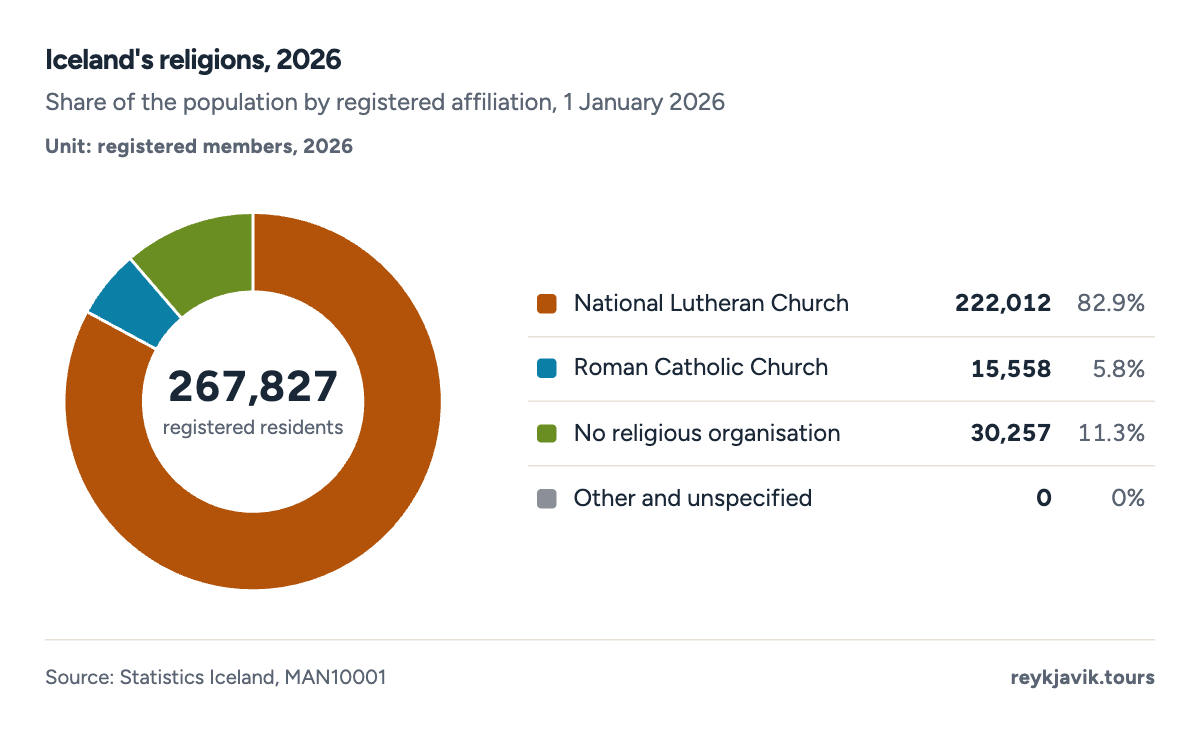
- The national Lutheran church remains the single largest religious body.
- One in thirteen Icelanders registers with no religious organisation.
| The Evangelical Lutheran Church of Iceland | 222,012 | 56.3 |
| Roman Catholic Church | 15,558 | 3.9 |
| No religious organisation | 30,257 | 7.7 |
| Ásatrúarfélagið (pagan) | 6,158 | 1.6 |
| Ethical Humanist Association | 6,387 | 1.6 |
| Muslim Association | 569 | 0.1 |
| Jewish Community | 76 | 0.0 |
| Total registered | 394,324 | 100.0 |
The fall of the national church
The Iceland christian percentage has fallen by roughly half a percentage point per year since 2000 - from 89.9% in 1998 to 56.3%1 in 20261. The decline is driven by deregistrations: Icelanders born into the church actively opt out, typically in their twenties. The projection extends the trend to 2050, passing the 50% mark in the mid-2030s - our calculation, not a forecast.
The church keeps two privileges that soften the fall: it collects its membership fee through the tax system, and it remains the state's partner for weddings, funerals and the worldwide recognition of its ministers. How many christians in Iceland? Adding every Christian organisation in the register - Lutheran, Catholic, Pentecostal, Orthodox and independent - gives about 62%1 of the population. Iceland has no formal state religion since 2013, but the national church's infrastructure - several hundred congregations - remains the country's default ceremonial provider1.
Projection: linear trend of 1998–2026 yearly values, 95% prediction range. Our calculation, not a forecast.
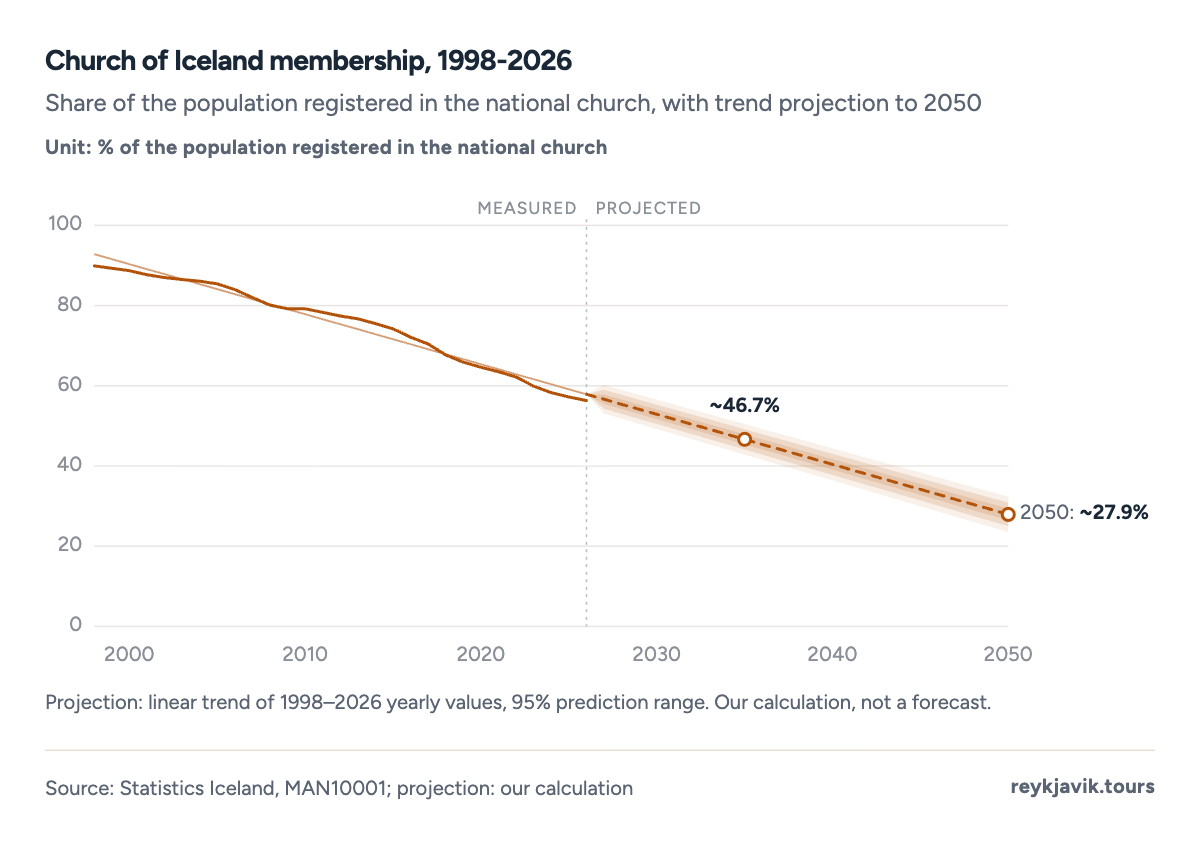
- The national church's share fell from 89.9% in 1998 to 56.3% in 2026.
- The projection passes 50% around 2035 - our calculation, not a forecast.
- Deregistration, not mortality, drives the decline: Icelanders actively opt out.
The minorities: Catholics, Muslims and Jews
How many catholics in Iceland? The Roman Catholic Church is Iceland's largest minority at 15,5581 registered members (3.9%) - built almost entirely from Polish immigration since the 1990s, and the one group whose registry count tracks reality closely, because Catholic registration is tied to baptism1. How many catholic churches in Iceland? About a dozen serve the Catholic community2.
How many muslim in Iceland? How many muslims in Iceland? The Muslim Association of Iceland counts 5691 registered members - but press and community estimates put the true Muslim population at 1,500-3,0002, since many Muslims register with no organisation. The number of mosques in Iceland is zero purpose-built; Reykjavík's Muslim community has prayed in converted spaces for decades, and a mosque building plan has been approved and stalled repeatedly since 20082. The Iceland muslim percentage of the population is therefore about 0.4%1 by registry - or closer to 0.8%2 by community estimates.
How many jews in Iceland? The Jewish Community of Iceland registers 761 members - a community that has grown with international arrivals but remains one of Europe's smallest organised Jewish communities. The number of jews in Iceland by any wider estimate is a few hundred, as the registry counts only those who formally joined the organisation1.
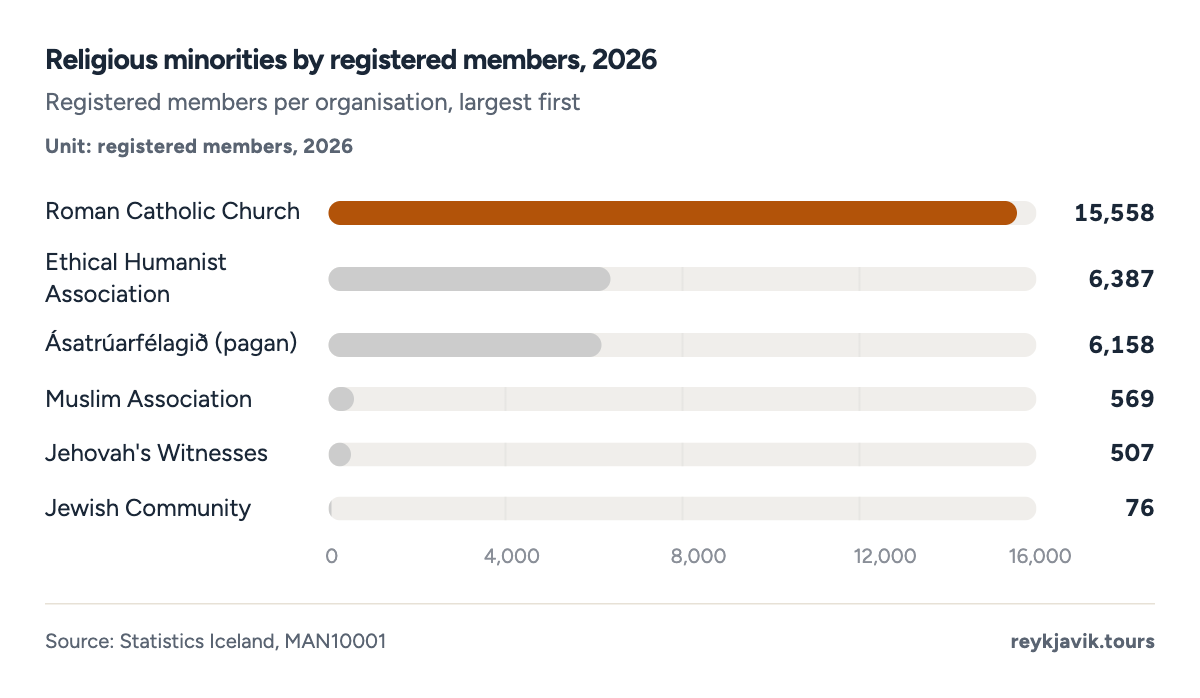
- The Roman Catholic Church is Iceland's largest religious minority.
- Ásatrúarfélagið - the revived old Norse faith - is now larger than most Protestant free churches.
| Muslims | 569 | 1,500-3,000 (many Muslims register elsewhere or in no organisation) |
| Jews | 76 | a few hundred (registry counts only the registered community) |
| Catholics | 15,558 | close to the registry - baptism-linked registration |
| Buddhists | 1,281 | three organisations in the register |
The pagan revival and the elves
What percentage of Iceland is atheist? The register counts 7.7%1 as having no religious organisation - the closest official proxy for atheism, though surveys suggest the percentage of atheists in Iceland who actively disbelieve is lower, since many no-organisation Icelanders hold private spiritual beliefs. Iceland's fastest-growing registered religion is also its oldest: Ásatrúarfélagið, the association reviving the pre-Christian Norse faith, grew from about 1001 members in 1998 to over 6,0001 in 2026 - proportionally the register's steepest line1. Its membership is partly belief, partly cultural identity: members cite heritage, environmental values and opposition to church tax as reasons for joining.
Then the question the internet always asks: do Icelanders believe in elves? The honest answer is that Icelanders famously refuse to deny it. Surveys have repeatedly found that around half of Icelanders do not rule out the existence of huldufólk - the hidden folk - and a smaller group believes outright3. Roads have been rerouted around claimed elf habitats, most famously in Kópavogur, and the stories are treated with a national wink rather than a national dismissal3. How much of Iceland believes in elves? And how many people in Iceland believe in elves? Around half3 do not rule it out - and how many people in Iceland believe in trolls follows the same pattern: a folklore tradition so embedded that denial, not belief, is the unusual position3.
The elf-stone debates are not folklore tourism but real planning disputes. Construction projects that would move or drill into rocks classified as elf habitats have triggered protests, court cases and at least one government intervention. Whether the campaigners believe literally or are using folklore as environmental protection is often deliberately ambiguous - and that ambiguity is itself a deeply Icelandic trait, a refusal to dismiss what cannot be proven either way3.
Projection: linear trend of 1998–2026 yearly values, 95% prediction range. Our calculation, not a forecast.
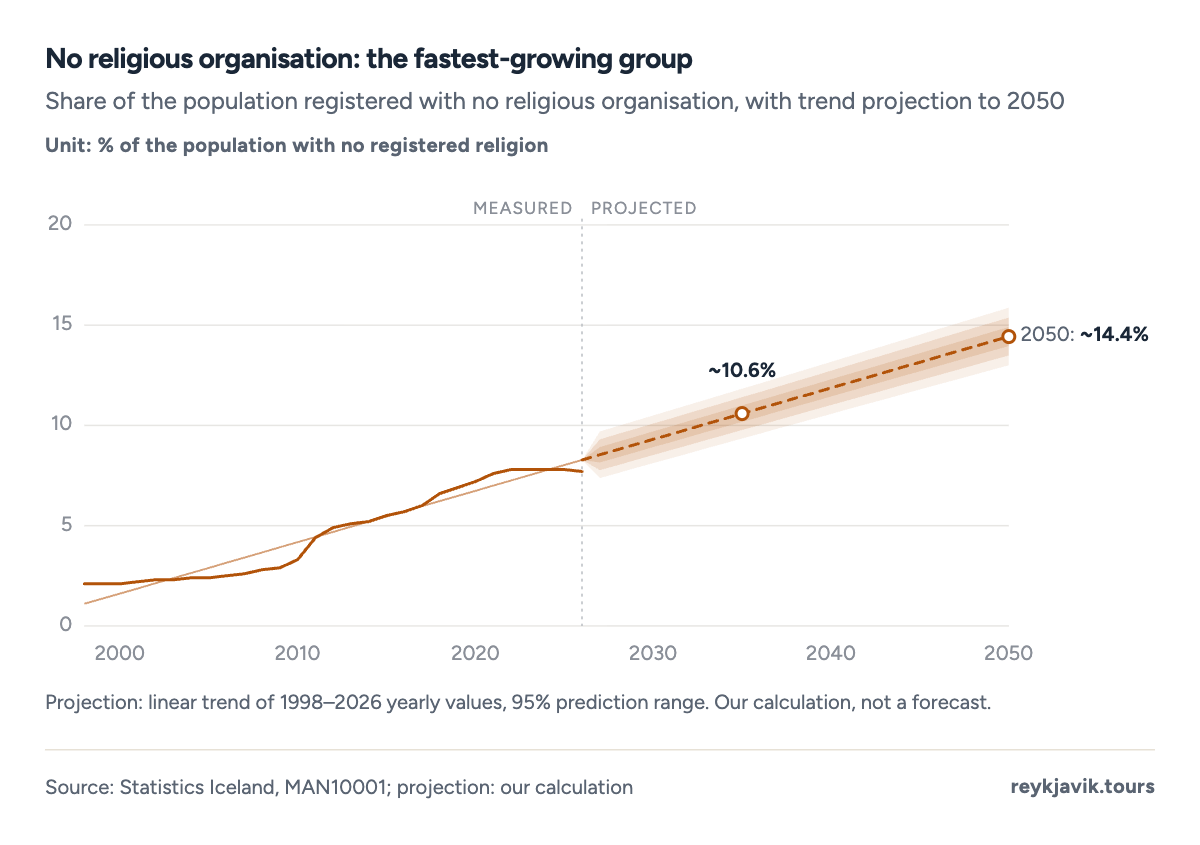
- The no-religion share grew from 1.7% in 1998 to 7.7% in 2026.
- It is the fastest-growing 'affiliation' in the register - growth by leaving, not joining.
Projection: linear trend of 1998–2026 yearly values, 95% prediction range. Our calculation, not a forecast.
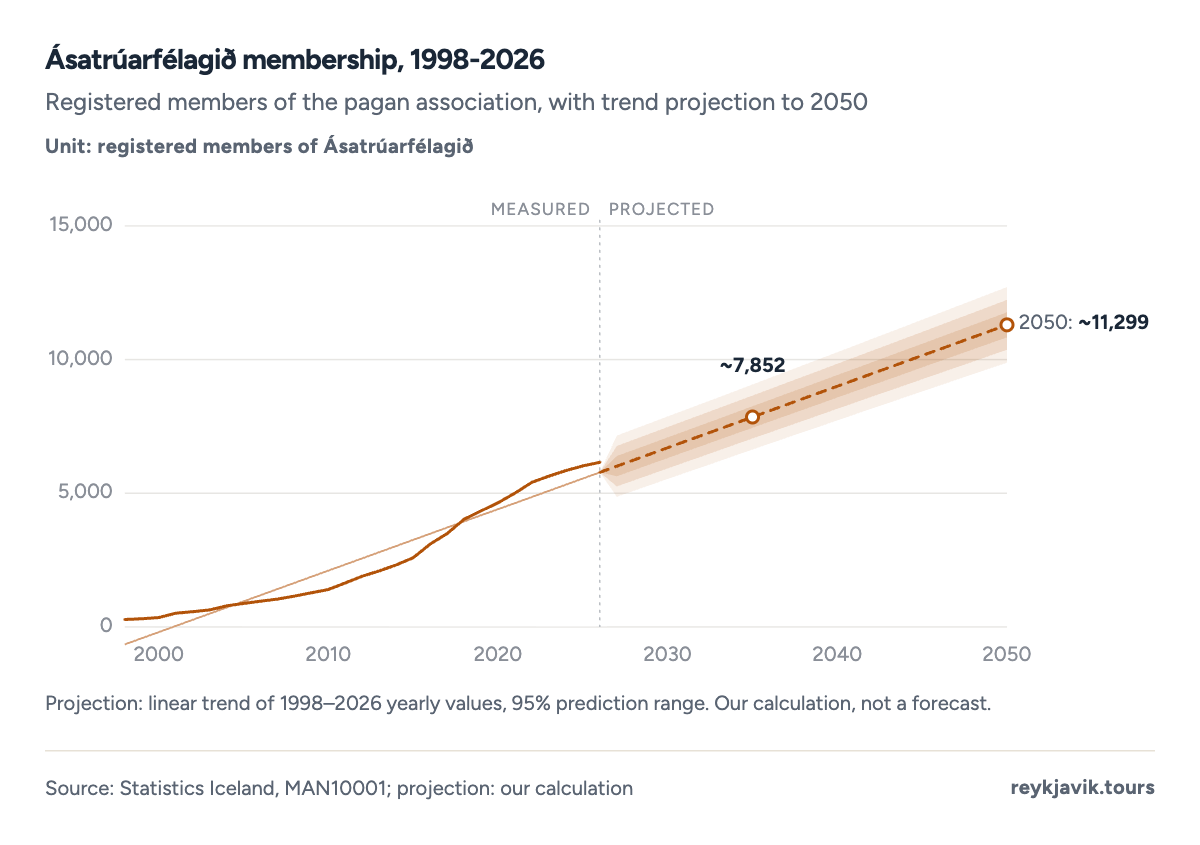
- The pagan association grew from about 100 members in 1998 to over 6,000 in 2026.
- It is proportionally the fastest-growing religion in the register.
| Around half of Icelanders do not rule out the existence of huldufólk (hidden people) and elves |
| Surveys question belief directly - most respondents answer 'hást' (possible) rather than yes |
| Road projects have been rerouted around elf habitats, with media coverage worldwide |
| Registered religious and life-stance organisations | 64 in the state register |
| Lutheran churches | several hundred congregations and chapels nationwide |
| Purpose-built mosques | 0 - Muslim prayer halls operate in rented spaces in Reykjavík |
| Catholic churches | a dozen parishes and missions |
The Nordic comparison
Iceland's religious shift is not happening in isolation. Every Nordic country has seen its national church decline, but the pace varies dramatically. Denmark's folk church still holds about 72% of the population; Norway's church dropped below 70% in 2020; Sweden's Church of Sweden fell below 60% in 2019. Iceland at 56.3% is the fastest decliner, but from the highest starting point - and the same pattern holds across all of them: the decline is generational, driven by deregistration among young adults rather than by conversion to other faiths1.
What distinguishes Iceland from its neighbours is the growth of the pagan and humanist alternatives. Ásatrúarfélagið's 6,158 members and the Ethical Humanist Association's 6,387 give Iceland a higher per-capita membership in non-Christian life-stance organisations than any other Nordic country. The Siðer (ethical humanism) movement in Norway and Sweden is comparable but smaller per capita. The Icelandic pagan revival's visibility - the temple at Öskjuhlíð, the weddings and naming ceremonies it performs - has made it a cultural marker beyond its membership numbers1.
The immigration-driven growth of the Catholic and Muslim communities is also part of the Nordic pattern, but Iceland's per-capita Catholic growth is the fastest, driven by the Polish community that now numbers over 20,000 people. The Catholic church's growth has made it the second-largest religious body and the fastest-building: new churches have opened in Reykjavík, Akureyri and Reykjanesbær within the past decade1.
The infrastructure: what the numbers mean on the ground
The 64 registered religious organisations share a funding model unique to Iceland: the state collects their membership fees through the tax system and redistributes them. A member's registration automatically directs a monthly fee to their chosen organisation - or, for the no-religion group, to the University of Iceland instead (since 2013). This means every deregistration directly reduces a church's funding, and every switch to Ásatrúarfélagið redirects money from the Lutheran church to the pagan association1.
The physical infrastructure reflects the membership: the national church maintains several hundred buildings, many of them historic turf churches or concrete modernist designs from the mid-century building boom. The Catholic church has built three new churches in the past decade to serve its growing Polish and international congregation. The Muslim community operates prayer halls in converted office spaces. Ásatrúarfélagið opened its first purpose-built temple at Öskjuhlíð in Reykjavík in 2023 - a circular stone building that took over a decade to fund and construct2.
The temple: what the numbers built
The most visible product of Iceland's religious shift is a building. Ásatrúarfélagið's temple at Öskjuhlíð - a circular stone structure dug into a hillside overlooking Reykjavík - opened in 2023 after more than a decade of fundraising. It is the first purpose-built pagan temple in Iceland in a thousand years, and its construction was paid for entirely by the membership fees collected through the state tax system - the same mechanism that funds the national church's cathedrals1.
The temple's opening was a cultural event as much as a religious one. It signaled that the non-Lutheran religious landscape of Iceland had grown enough to sustain architecture, not just administration. The building hosts naming ceremonies, weddings and the major seasonal blót festivals, and its design - dug into the earth, open to the sky through a central oculus - embodies the relationship between the Icelandic landscape and the supernatural that the huldufólk tradition also expresses1.
For the national church, the temple is a visible reminder that its privileged position is historical rather than permanent. For Ásatrúarfélagið, it is proof that a religious organisation which did not exist in 1972 can build its own sacred space using the same state funding mechanism the Lutheran church has used for centuries. The symbolic weight of that comparison is not lost on either side1.
Conclusions
The register data tells a story that opinion polls cannot: every entry and exit is dated, every switch is recorded, and every year's snapshot is comparable with the last. No other Nordic country tracks religious belonging with this precision, and the story the data tells is one of accelerating, generational change rather than sudden crisis. The numbers point to a country that has not abandoned belief but has abandoned institutional belonging - and the pace of that abandonment is the clearest signal in the data.
- The national church has lost a third of the population's registration in a generation - 89.9% in 1998 to 56.3% in 2026 - with the projection crossing 50% in the 2030s1.
- The register measures membership, not belief: the no-religion group's quadrupling and the church's decline both track deregistration, not conversion1.
- Immigration drives the fastest real growth: the Catholic church's Polish-born expansion and the Muslim association's growth track immigration waves, not conversions1.
- The pagan revival is Iceland's most distinctive religious trend - Ásatrúarfélagið's growth from 100 to 6,000 members has no parallel among the registered churches1.
- The elves question is real cultural history rather than belief statistics: the huldufólk surveys measure a national reluctance to dismiss folklore, not a religious position3.
Methodology
- Religious membership: 1998-2026, all registered organisations (MAN10001)
- Belief surveys: 2006-2007 University of Iceland studies (qualitative)
Definition. Membership means registration with a recognised religious or life-stance organisation in Statistics Iceland's population register. 'No religious organisation' means registered with none. Shares divide members by the total population of the same date.
Data sources. Statistics Iceland table MAN10001 (population by religious and life-stance groups, 1998-2026); University of Iceland belief surveys for the huldufólk question (labelled academic); Icelandic press for church and mosque counts (labelled).
Calculations. Shares divide each group's registered members by the total population on the same date. Projections are ordinary least-squares trends with a 95% prediction interval, computed by the renderer.
Limitations. Registry membership is administrative: it changes when people file forms, not when beliefs change. Registered counts understate Muslims and Jews, whose communities include many unregistered members. Belief-survey figures are academic estimates, not official statistics.
Sources
- Statistics Iceland. “Population by religious and life-stance groups, 1998-2026 (MAN10001).” Statistics Iceland, 2026. hagstofa.is. Accessed 2026-09-17. Back to text
- Icelandic press / Guide to Iceland. “Church and mosque counts in Iceland (commercial, labelled).” commercial, labelled, 2026. guidetoiceland.is. Accessed 2026-09-17. Back to text
- University of Iceland / University of Fróðskaparsetur surveys (widely quoted). “Belief in huldufólk (hidden folk) and elves among Icelanders.” academic surveys (labelled), 2007. hi.is. Accessed 2026-09-17. Back to text
About the author
Laufey turns public statistics on tourism and travel into research people can check and cite.
Every figure on this page links to its source. How we research
Related research
More data on Iceland's weather and travel from Reykjavik Tours.
- SocietyIceland Ethnic Composition Percentage (2026 Data)70.9% of Iceland's residents have no foreign backgroundRead the research →
- SocietyWhat Is the Biggest City in Iceland? (2026 Data)140,470 residents of Reykjavík, Iceland's biggest cityRead the research →
- SocietyIceland Average Height for Men and Women (2026 Data)5 ft 11 in average height of young Icelandic menRead the research →
- SocietyHow Many People Live in Iceland? (2026 Data)396,500 people living in IcelandRead the research →
- HealthHow Many Hospitals in Iceland? (2026 Data)1 main university hospital serves all of IcelandRead the research →
- EducationHow Many Schools Are in Iceland? (2026 Data)437 educational institutions in IcelandRead the research →