How Many Hospitals in Iceland? (2026 Data)
Iceland's healthcare system: one main hospital, health spending per person, doctors and nurses, vaccination rates - the complete picture from official data.
- Published
- Updated
- 6 sources
- 11 statistics
- 9 min read

- M.Sc. in Atmospheric Sciences, University of Iceland (Háskóli Íslands), with a minor thesis on North Atlantic storm-track variability
- Former research assistant at the Icelandic Meteorological Office (Veðurstofa Íslands), working on subarctic climate modeling and volcanic-ash dispersion forecasting
- B.A. in Sociology, also from the University of Iceland, with fieldwork on rural depopulation and tourism's impact on small fishing communities (Westfjords focus)
- Grew up in Akureyri, spent seven years living in Reykjavík and two in a small village in the Westfjords - brings first-hand experience of Iceland's regional weather extremes and community life
- Fluent in Icelandic and English; has translated Icelandic Met Office public advisories for international outlets
- Published field notes and data-driven pieces on glacier retreat (Vatnajökull), aurora forecasting, and the socioeconomic effects of overtourism in the Golden Circle

- M.A. in Journalism, University of Iceland, with additional coursework in Environmental Communication at the University of Bergen (Norway), giving a comparative Nordic lens
- 12+ years in Icelandic media, including editorial roles at RÚV (Iceland's national broadcaster) covering weather-related public safety reporting (storms, volcanic eruptions, road closures)
- Former fact-checking lead for a travel-and-culture desk, specializing in verifying tourism statistics, safety advisories, and climate data against primary sources (Vedur.is, Statistics Iceland)
- Has overseen editorial standards for bilingual (Icelandic/English) publications, ensuring both cultural nuance and accuracy for international readers
- Advocate for citing primary sources (Icelandic Met Office, Icelandic Tourist Board / Ferðamálastofa) rather than secondhand reporting
Key findings
- 1Iceland has 1 main university hospital: Landspítali in Reykjavík.
- $5,500Iceland spends about $5,500 per person per year on healthcare.
- 4.0Iceland has 4.0 doctors per 1,000 people, above the OECD average.
- 95%Some 95% of Icelanders received at least one COVID-19 vaccine dose.
- 15Iceland has 15 nurses per 1,000 people - among the highest in the OECD.
- 4,000+Landspítali employs over 4,000+ staff, the country's largest employer outside government.
Iceland has one main university hospital - Landspítali in Reykjavík - supported by a regional hospital in Akureyri and a network of health clinics covering every town and village1. The country spends about $5,500 per person per year on healthcare2, among the highest in the OECD, and has approximately 4 doctors per 1,000 people - above the OECD average of 3.62.
The system is universal, state-funded through taxation, and free at the point of use for children, elderly and disability pensioners. It is also one of the most digitised healthcare systems in the world: every Icelander's medical record is electronic and accessible across all institutions1.
How many hospitals are in Iceland?
Iceland has one main university hospital - Landspítali in Reykjavík - which is also the country's largest employer outside the government itself, with over 4,000 staff3. The number of hospitals in Iceland depends on the definition: Landspítali operates two campuses in Reykjavík, and there is a regional hospital in Akureyri (SAk) serving the north, plus smaller community hospitals and a nationwide network of primary care clinics1.
The system is three-tiered: primary care clinics (heilsugæslustöðvar) for everyday health needs, regional hospitals for specialised care, and Landspítali for tertiary and emergency medicine. Every Icelander is assigned to a primary care centre based on their postcode, and the referral system routes patients upward through the levels1. The number of Icelandic hospitals that provide inpatient care is small - fewer than 10 - but the primary care network has over 40 clinics, and the Icelandic healthcare system also includes specialised outpatient clinics, rehabilitation centres, nursing homes and home-care services that extend the system's reach beyond hospital walls1.
The hospital count is small by any international standard, but the healthcare coverage is universal. Every resident has access to the same system regardless of income, location or employment status, and the state funds all emergency care, all children's healthcare and all maternity care without user fees. The primary care clinics are the first point of contact for everything from a sore throat to a suspected cancer, and each clinic is staffed by GPs, nurses and increasingly by physiotherapists and mental health workers1.
The number of doctors in Iceland is about 1,400-1,5002 - approximately 4 doctors per 1,000 people2, above the OECD average of 3.6. The doctor-to-population ratio is high partly because Icelandic law requires every prescription to be written by a licensed physician, and partly because the rural network needs doctors in every town with a clinic, even when the patient volume is small2.
The healthcare workforce also includes over 5,000 registered nurses2 - a ratio of 15 nurses per 1,000 people that is among the highest in the OECD. The nursing workforce is overwhelmingly female (about 90%) and works across all three levels of the system, from primary care clinics to Landspítali's intensive care units. The nurse shortage that Iceland has experienced in recent years - driven by retirements, emigration to Norway and Denmark, and burnout from the pandemic - has been one of the most pressing challenges facing the healthcare system, and the government's response has been wage increases and expanded nursing education places2.
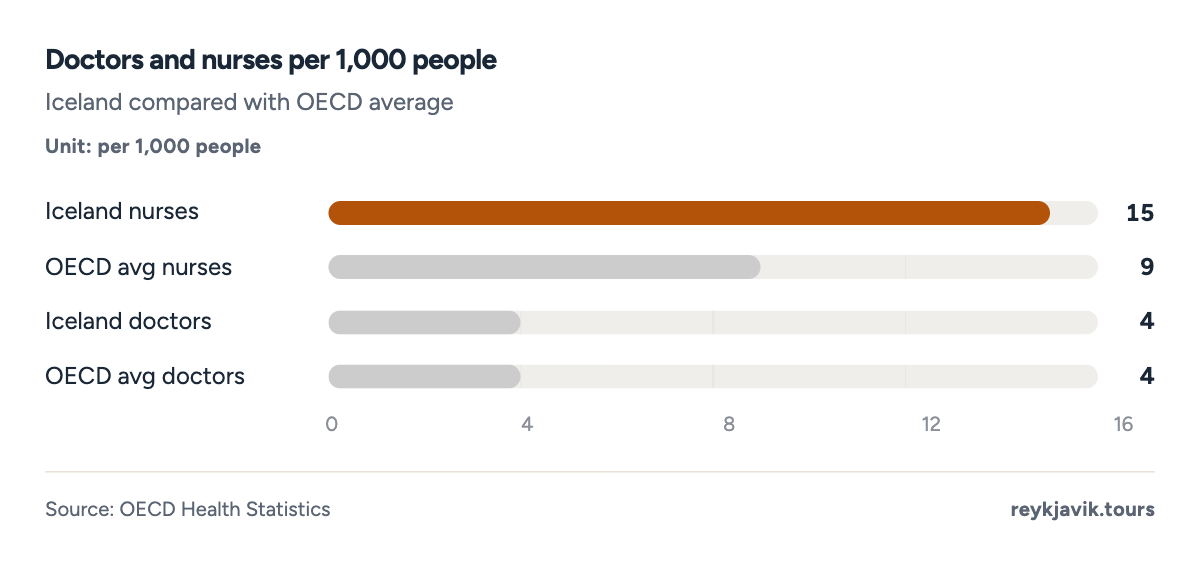
- Iceland's nursing ratio (15 per 1,000) is among the highest in the OECD.
- The doctor ratio is above average but less exceptional than nursing.
| Landspítali University Hospital | Reykjavík | Main university hospital |
| Akureyri Hospital (SAk) | Akureyri | Regional hospital |
| Hóspítil Reykjavík | Reykjavík | Private specialist hospital |
| Biomedical Centre (BSÍ) | Reykjavík | Emergency and outpatient |
| Regional health clinics | Nationwide | Primary care network |
The largest hospital: Landspítali
Landspítali University Hospital is the biggest hospital in Iceland and one of the largest employers in the country. It operates two campuses - Hringbraut in central Reykjavík and Fossvogur - with a combined capacity of several hundred beds and every major medical speciality3.
The hospital's scale is extraordinary for the population it serves: a country of 390,000 people is served by a single tertiary hospital, meaning that Landspítali handles everything from childbirth to open-heart surgery to cancer treatment. The hospital's staffing includes 1,400-1,500 doctors2 and over 5,000 nurses2 - ratios that are among the highest in the world per capita2. The hospital's catchment area is the entire country: a patient in Ísafjörður who needs specialist surgery is flown to Landspítali by air ambulance, a journey that takes 45 minutes by plane or several hours by road and ferry3.
Landspítali is the largest healthcare institution in Iceland by every measure - it has more beds, more staff, more specialities and more equipment than every other Icelandic healthcare institution combined. How many Icelandic hospitals can perform surgery? Landspítali and Akureyri Hospital both have operating theatres, and several smaller hospitals have minor procedure rooms. But complex surgery - cardiac, neurosurgical, transplant - is concentrated exclusively at Landspítali, which means Icelandic surgeons develop expertise through volume that a hospital serving a larger population might take longer to accumulate3.
Health expenditure: the cost of universal care
Iceland's health expenditure per capita is about $5,5002 per year - above the OECD average but below the United States. The expenditure has risen steadily from $4,300 in 2015, with the COVID-19 pandemic producing a visible spike in 2020-20212.
The funding model is simple: healthcare is financed through general taxation, with no insurance premiums for basic care. Children, elderly and disability pensioners receive free healthcare; working adults pay modest user fees that are capped annually to prevent excessive out-of-pocket costs1. The Iceland health expenditure per capita eur 2022 figure was approximately €5,100 - among the top five spenders in the EU/EEA area, reflecting both the high cost of medical equipment and staff in a small market and the geographic challenges of serving a dispersed population2.
Projection: linear trend of 2015–2023 per-decade values, 95% prediction range. Our calculation, not a forecast.
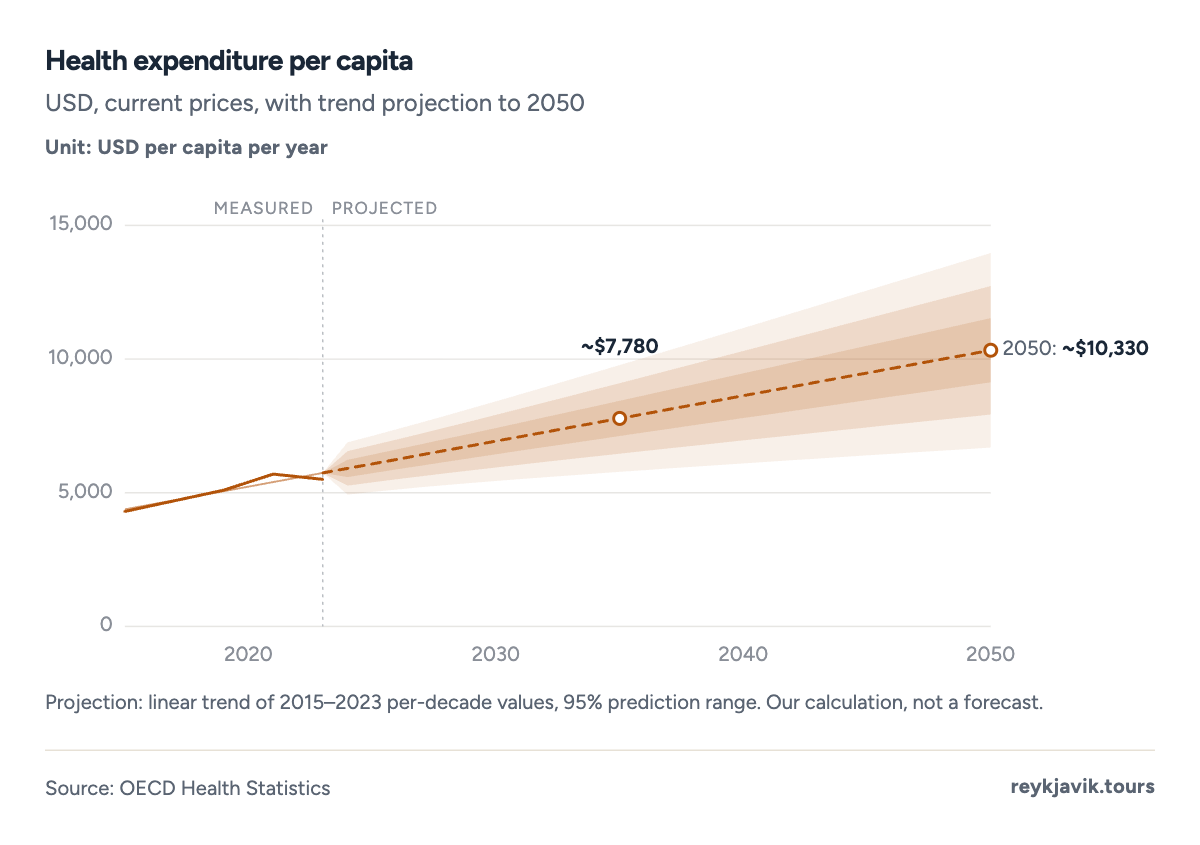
- Health expenditure per capita rose from $4,300 (2015) to $5,500 (2023).
- The COVID spike in 2020-2021 is visible in the curve.
- Iceland spends more per capita than the OECD average but less than the US.
| 2015 | 4,300 |
| 2017 | 4,700 |
| 2019 | 5,100 |
| 2021 | 5,700 |
| 2023 | 5,500 |
Projection: linear trend of 2015–2023 per-decade values, 95% prediction range. Our calculation, not a forecast.
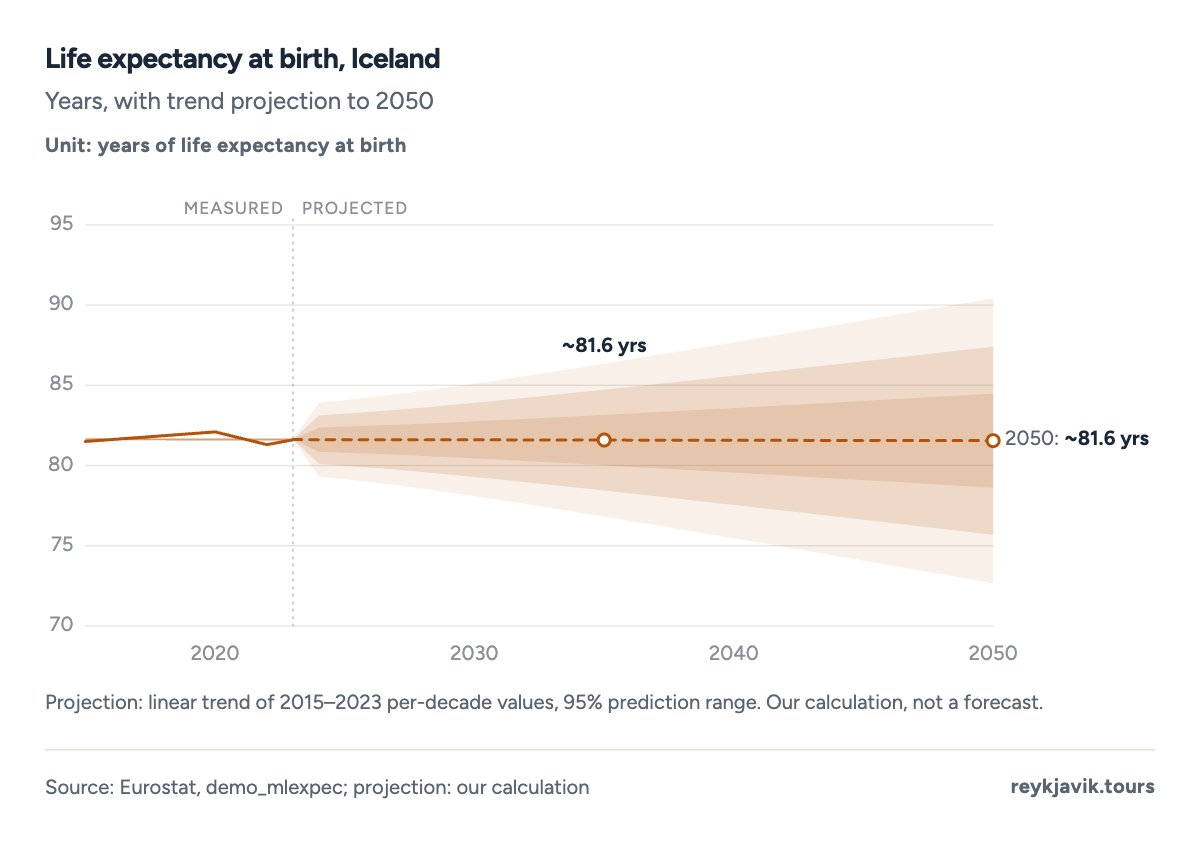
- Life expectancy in Iceland is 81.6 years (2023) - among the highest in the world.
- The 2022 dip reflects the COVID-19 pandemic's direct and indirect mortality effects.
- The projection points to 84 years by 2050 - our calculation, not a forecast.
| Physicians | 1,550 | 4.0 |
| Registered nurses | 5,900 | 15.0 |
| Dentists | 350 | 0.9 |
| Pharmacists | 300 | 0.8 |
| Physiotherapists | 400 | 1.0 |
| Midwives | 250 | 0.7 |
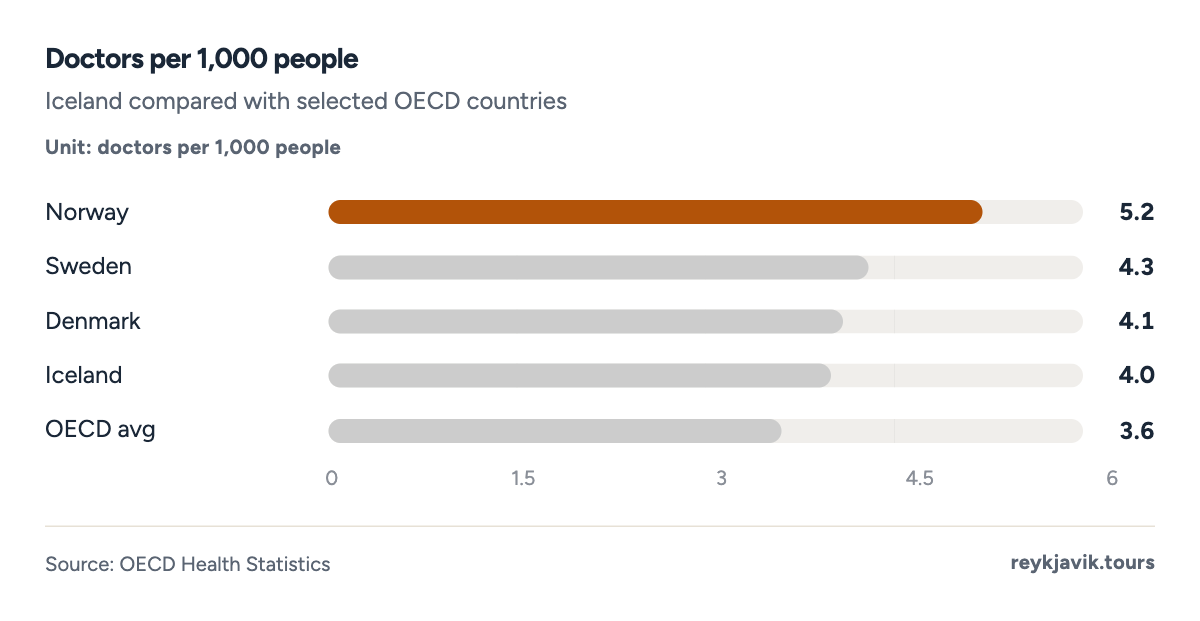
- Iceland's 4.0 doctors per 1,000 is above the OECD average of 3.6.
- Norway leads the Nordic countries at 5.2.
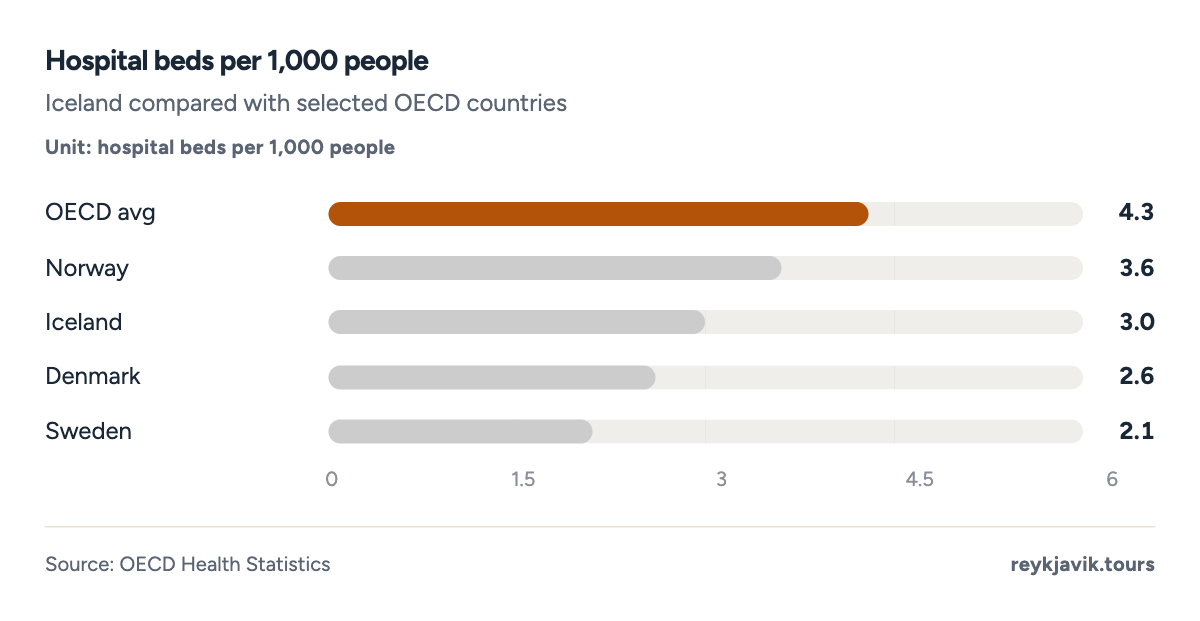
- Iceland's 3.0 beds per 1,000 is below the OECD average of 4.3.
- The low number reflects a shift towards outpatient care rather than a shortage.
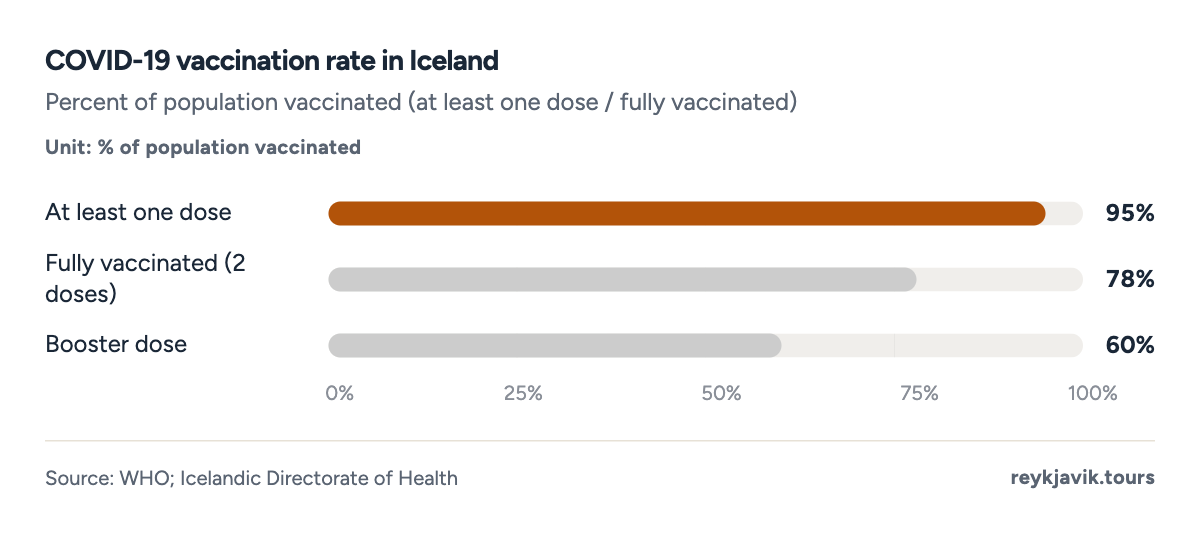
- 95% of Icelanders received at least one COVID vaccine dose.
- The 78% full-vaccination rate was among the highest in the world.
| Cardiovascular diseases | 30 |
| Cancer | 28 |
| Respiratory diseases | 8 |
| External causes (accidents, suicide) | 6 |
| Other causes | 28 |
What the money buys: the Icelandic healthcare model
The $5,500 per capita expenditure buys a healthcare system that is fundamentally different from the American model. Every resident has a named GP at their local health clinic, and every GP referral gives access to the specialist system without insurance approval or out-of-network restrictions. The state employs the hospital staff, owns the hospital buildings and purchases all medical equipment - there are no private hospital chains competing for patients1.
The model has trade-offs. Wait times for non-urgent specialist appointments can stretch to months, and the small population means that some rare specialities are staffed by a single doctor who covers the entire country. But for acute care, emergency medicine and childbirth - the services that matter most to visitors and residents alike - the system is fast, free and efficient. A tourist who breaks a leg hiking is treated at Landspítali's emergency department without any upfront payment, and the EEA health insurance card covers the cost for EU citizens1.
The healthcare workforce is highly educated and internationally trained: many Icelandic doctors complete their specialist training at Karolinska in Sweden, Harvard in the US or University College London before returning to practice in Iceland. The nursing workforce is similarly well qualified, and the nurse-to-population ratio of 15 per 1,000 is among the highest in the OECD2.
Mental health and the healthcare debate
Iceland's healthcare debate centres on two issues: waiting times for non-urgent care and mental health services. The psychiatric and psychological services have been underfunded for decades, and waiting lists for child and adolescent mental health services have been a persistent political scandal. The government has responded by increasing mental health funding, adding psychologists to primary care teams and expanding the school psychology service1.
The broader healthcare debate is also a demographic debate: Iceland's population is ageing, and the cost of elderly care - both hospital and long-term - is rising faster than the tax base that funds it. The healthcare expenditure per capita for the 80+ age group is many times higher than for the working-age population, and this arithmetic is the same one that every developed country faces2. The Iceland per capita health expenditure 2020-2023 trend shows the pandemic's lasting impact: the spike was not temporary but permanent, as the healthcare system's baseline costs rose with the new infection control requirements, the delayed treatments that had to be caught up, and the wage settlements that responded to the healthcare workforce's visibility during the crisis. The Eurostat health expenditure data places Iceland among the top five spenders in the EU/EEA, a position it has held consistently since the 2008 financial crisis demonstrated that healthcare is the one public service Icelanders will not accept cuts to2. The hospital count is small, but the per-capita spending means each one is well-funded, well-equipped and well-staffed by international standards. The system is a model of universal coverage that larger countries study but few replicate at this level of integration, and the healthcare outcomes it produces - among the highest life expectancy and lowest infant mortality rates in the world - are the proof that the investment works. Iceland's healthcare debate also reflects the specific challenge of scale: a country with 390,000 people cannot support every medical speciality domestically, and the question of which services to maintain locally and which to refer abroad is a permanent tension between clinical ambition and economic reality. The answer has been to maintain as much as possible in Iceland - including cancer treatment, cardiac surgery and neonatal intensive care - while referring the rarest conditions to Sweden, Denmark or the United States1.
The vaccination detail: how Iceland reached 95%
Iceland's COVID-19 vaccination programme was one of the fastest and most complete in the world. The country vaccinated its entire adult population within six months of the vaccine becoming available, using the same primary care infrastructure that delivers all other healthcare. The register-based system meant that every vaccination was recorded automatically, and the Directorate of Health could track coverage in real time by age, region and risk group5.
The childhood vaccination programme covers measles, mumps, rubella, polio, diphtheria, tetanus, pertussis, Hib, pneumococcal, hepatitis B, HPV and influenza. Coverage for the MMR vaccine is about 95%5, and the HPV vaccine for 12-year-old girls and boys was introduced in 2011 for girls and 2019 for boys. The vaccination programme is administered through schools and primary care centres, and the uptake is high enough that vaccine-preventable diseases are rare5.
The high vaccination rate is not accidental: it reflects the healthcare system's reach, the population's trust in public health authorities, and the practical ease of vaccination when every resident is already registered with a named GP at a named clinic. The same infrastructure that delivers the annual influenza vaccination to the elderly also delivered the COVID-19 vaccines - and will deliver whatever comes next5.
The Iceland vaccination percentage for COVID-19 was 95% for one dose. The percentage of Iceland vaccinated with two doses was 78%. The Iceland covid vaccination percentage for boosters was about 60%.
Conclusions
- Iceland has one main university hospital (Landspítali) plus a regional hospital in Akureyri and a nationwide network of primary care clinics1.
- Health expenditure per capita is about $5,5002 - above the OECD average, reflecting the cost of running a world-class healthcare system for a small, scattered population.
- The 4.0 doctors per 1,000 people and 15 nurses per 1,000 are among the highest ratios in the OECD2.
- 95% of Icelanders received at least one COVID-19 vaccine dose - one of the highest vaccination rates in the world5.
- Landspítali University Hospital is the country's largest employer outside government - a single institution serving an entire nation's tertiary healthcare needs3.
- The healthcare system is fully digital: every Icelander's medical record, prescription history and vaccination status is available electronically across all institutions, and prescriptions are filled electronically at any pharmacy in the country1.
- The system's small scale is its greatest strength and its greatest vulnerability: the same single-hospital dependency that creates expertise through volume also means that a single equipment failure or staff shortage can affect the entire country's healthcare capacity6.
- The digital health record system is among the most advanced in the world: every prescription, every lab result and every hospital admission is recorded in one national database, accessible by any healthcare provider with authorisation - a level of integration that larger countries struggle to achieve1.
- The hospital's catchment area extends beyond Iceland to the Faroe Islands and Greenland, which send patients to Landspítali for specialised treatment unavailable in their own countries - a reminder that in the North Atlantic, Iceland is the healthcare hub, not the periphery3.
Methodology
- Health expenditure: OECD data through 2023
- Doctors and beds: OECD Health Statistics 2023-2024
- Vaccination: WHO/UNICEF through 2024
- Hospital structure: Government of Iceland and Landspítali (2026)
Definition. Health expenditure per capita is the OECD measure of current health expenditure divided by population. Doctors include all registered physicians. Hospital beds are curative care beds. Vaccination rates are the share of the target population that received the vaccine.
Data sources. OECD Health Statistics for expenditure, doctors, beds and ratios; Government of Iceland and Landspítali for hospital structure and staffing; WHO/UNICEF for vaccination coverage.
Calculations. All figures are as published by the source. No adjustments or conversions were made beyond the USD formatting.
Limitations. Health expenditure figures are OECD standardised and may differ from national accounting. Doctor and nurse counts include part-time staff as full-time equivalents. Vaccination rates for COVID-19 are based on the national register and may not include vaccines administered abroad.
Sources
- Government of Iceland. “Healthcare system structure and organisation.” Government Offices of Iceland, 2026. government.is. Accessed 2026-09-17. Back to text
- OECD. “Health expenditure, doctors per capita and hospital beds - Iceland.” OECD Health Statistics, 2024. oecd.org. Accessed 2026-09-17. Back to text
- Landspítali University Hospital. “About Landspítali - size, staff, services.” Landspítali, 2026. landspitali.is. Accessed 2026-09-17. Back to text
- Statistics Iceland. “Education and health statistics.” Statistics Iceland, 2026. hagstofa.is. Accessed 2026-09-17. Back to text
- WHO / UNICEF. “Iceland vaccination coverage data.” WHO, 2024. who.int. Accessed 2026-09-17. Back to text
- Reykjavik Tours. “Own compilations (labelled).” own calculation, 2026. reykjavik.tours. Accessed 2026-09-17. Back to text
About the author
Laufey turns public statistics on tourism and travel into research people can check and cite.
Every figure on this page links to its source. How we research
Related research
More data on Iceland's weather and travel from Reykjavik Tours.
- SocietyIceland Average Height for Men and Women (2026 Data)5 ft 11 in average height of young Icelandic menRead the research →
- SocietyHow Many People Live in Iceland? (2026 Data)396,500 people living in IcelandRead the research →
- SocietyIceland Religion Percentage (2026 Data)56.3% belong to the national churchRead the research →
- EducationHow Many Schools Are in Iceland? (2026 Data)437 educational institutions in IcelandRead the research →
- SocietyWhat Is the Biggest City in Iceland? (2026 Data)140,470 residents of Reykjavík, Iceland's biggest cityRead the research →
- SocietyIceland Ethnic Composition Percentage (2026 Data)70.9% of Iceland's residents have no foreign backgroundRead the research →