How Often Can You See the Northern Lights in Iceland? (2026 Data)
The real odds of seeing the northern lights in Iceland: darkness by month, per-night success rates, stay-length maths, tour prices from $78 and the solar-cycle window.
- Published
- Updated
- 5 sources
- 21 statistics
- 9 min read

- M.Sc. in Atmospheric Sciences, University of Iceland (Háskóli Íslands), with a minor thesis on North Atlantic storm-track variability
- Former research assistant at the Icelandic Meteorological Office (Veðurstofa Íslands), working on subarctic climate modeling and volcanic-ash dispersion forecasting
- B.A. in Sociology, also from the University of Iceland, with fieldwork on rural depopulation and tourism's impact on small fishing communities (Westfjords focus)
- Grew up in Akureyri, spent seven years living in Reykjavík and two in a small village in the Westfjords - brings first-hand experience of Iceland's regional weather extremes and community life
- Fluent in Icelandic and English; has translated Icelandic Met Office public advisories for international outlets
- Published field notes and data-driven pieces on glacier retreat (Vatnajökull), aurora forecasting, and the socioeconomic effects of overtourism in the Golden Circle

- M.A. in Journalism, University of Iceland, with additional coursework in Environmental Communication at the University of Bergen (Norway), giving a comparative Nordic lens
- 12+ years in Icelandic media, including editorial roles at RÚV (Iceland's national broadcaster) covering weather-related public safety reporting (storms, volcanic eruptions, road closures)
- Former fact-checking lead for a travel-and-culture desk, specializing in verifying tourism statistics, safety advisories, and climate data against primary sources (Vedur.is, Statistics Iceland)
- Has overseen editorial standards for bilingual (Icelandic/English) publications, ensuring both cultural nuance and accuracy for international readers
- Advocate for citing primary sources (Icelandic Met Office, Icelandic Tourist Board / Ferðamálastofa) rather than secondhand reporting
Key findings
- ~50%On a dark-season night, tours see the northern lights about ~50% of the time.
- 92%A 4-night stay gives about a 92% chance of at least one northern lights sighting.
- 230The aurora season runs about 230 nights, from early September to mid-April.
- $78The classic northern lights coach tour starts at about $78 per person.
- 18.4 hJanuary nights average 18.4 hours of darkness - the raw aurora window is huge.
- 20 yrsSolar Cycle 25 brought the strongest aurora activity in 20 yrs, peaking 2024-25.
The honest answer to how often can you see the northern lights in Iceland is a fraction that surprises people: on any dark night between September and mid-April, tours succeed about half the time - operators publicly quote 40-55% per-night success rates1. The lights themselves are overhead far more often than that; what limits sightings is Iceland's other famous resident, cloud. Give the sky four chances and the odds of at least one aurora pass 90%1 - which is why the standard advice is a minimum 4-night stay1.
Iceland is also the easiest place on Earth to attempt it: it sits directly under the auroral oval, so even modest solar activity produces displays overhead, and the season - early September to mid-April - overlaps everything else people come for. This page quantifies the whole hunt: darkness hours by month, the cold you'll stand in, the odds night by night, and what tours cost.
How often are the northern lights visible in Iceland?
The northern lights are *happening* above Iceland almost every night of the year - the auroral oval sits roughly over the country, and any KP-1+ activity puts a display on the northern horizon. What decides "visible" is two gates: darkness and cloud2.
- Darkness rules out late spring and summer entirely: from about the second week of May to the first week of August, Reykjavík's nights never get darker than twilight.
- Cloud is the season-killer within it: Iceland's skies are overcast roughly half the time, which is exactly why operators converge on that 40-55%1 per-night success figure.
So the calendar answer: the aurora season runs early September to mid-April, about 230 nights, and on a clear dark night in that window your odds on any single night are close to a coin flip.
What counts as "seeing them" is worth defining, because photographs raise the bar unfairly. On an average successful night, the display is a green glow and slow bands above the northern horizon - unmistakably the aurora, faint to the naked eye, spectacular on camera. On a good night it moves: rays, ripples, curtains that brighten and collapse. On the great nights - a few per season - the whole sky turns into a rotating green-and-violet corona, and nobody standing in that field cares about photography. Managing this expectation is the single kindest thing a guide can do: most nights are a 6 out of 10, and that is still a thing you will talk about for years.
How often do the northern lights happen in Iceland per week, then? During the equinox months a reasonable summary is "most clear nights, somewhere in the country" - the oval is overhead and even modest geomagnetic activity paints the northern sky. The spectacle ladder goes: faint green arc on the horizon (most clear dark nights), moving curtains and rays (a few times a week in mid-season), full overhead corona in greens with purple fringes (the memorable nights, a handful per month near solar maximum), and red-dominated storm displays (rare, news-making). The Met Office forecast grades expected activity nightly, and the all-sky cameras at farms around the country confirm what the models predict - which is how locals check whether tonight is worth the cold before leaving the house2.
- 18.5JanJ
- 15.5FebF
- 12.2MarM
- 8.9AprA
- 5.6MayM
- 3.1JunJ
- 4.4JulJ
- 7.6AugA
- 10.9SepS
- 14.2OctO
- 17.4NovN
- 19.6DecD
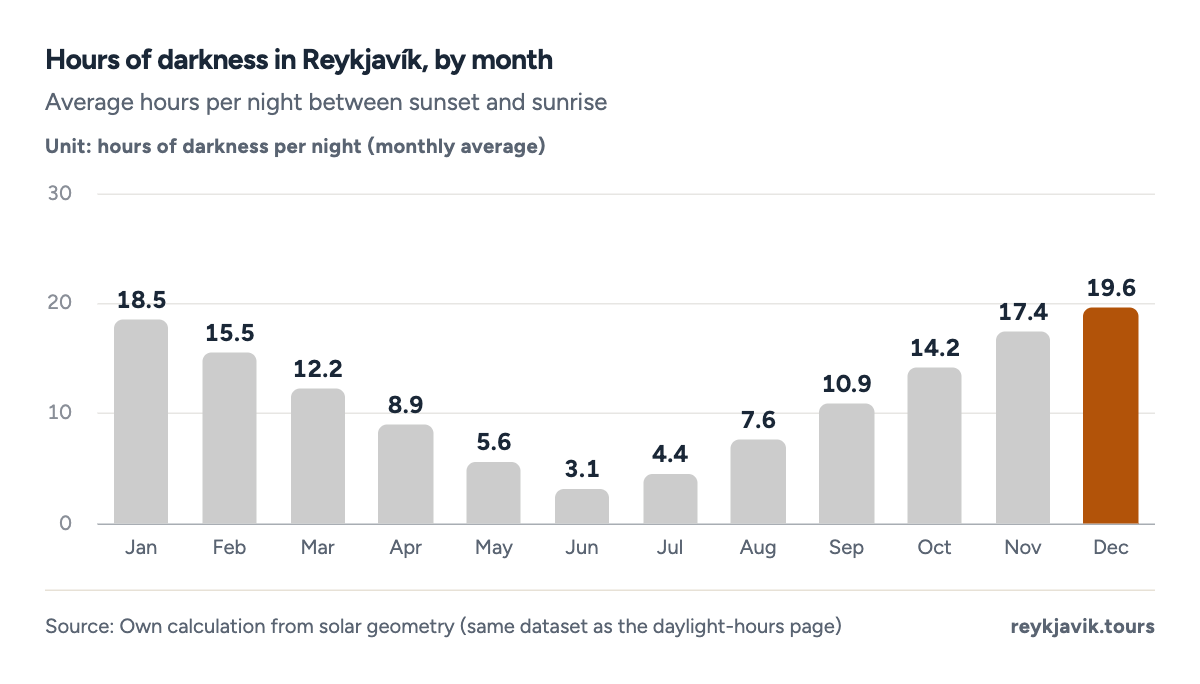
- January nights average 18.4 hours of darkness - the aurora window is enormous.
- From late May to early August the sky never gets properly dark: no aurora season.
- The usable season runs from early September to mid-April.
| January | 18.5 | 5.5 | 31.7 | Yes |
| February | 15.5 | 8.5 | 31.0 | Yes |
| March | 12.2 | 11.8 | 32.1 | Yes |
| April | 8.9 | 15.1 | 36.1 | Yes |
| May | 5.6 | 18.4 | 41.9 | No - too bright |
| June | 3.1 | 20.9 | 47.7 | No - too bright |
| July | 4.4 | 19.6 | 51.0 | No - too bright |
| August | 7.6 | 16.4 | 50.4 | No - too bright |
| September | 10.9 | 13.1 | 45.8 | Yes |
| October | 14.2 | 9.8 | 38.7 | Yes |
| November | 17.4 | 6.5 | 34.2 | Yes |
| December | 19.6 | 4.4 | 31.8 | Yes |
Northern lights Iceland weather by month: darkness and cold
The two curves that shape an aurora hunt - hours of darkness and temperature - pull in opposite directions. December and January deliver 18+ hours3 of darkness per night but hover near 31 °F4; by March the darkness is still a generous 13-14 hours and the temperature has hardly moved; by April the window shrinks fast[^sun]4.
How often do northern lights occur in Iceland per month, then? Roughly proportionally to the darkness column - every dark, clear night is a lottery ticket, and September-October and February-March offer the best mix of long nights, bearable cold and, statistically, more stable weather than midwinter.
A word on the "northern lights weather by month" question that searchers type in autumn: Iceland's weather does not do monthly averages politely. A September gale can close every region for two nights; a February high-pressure day can hand you the clearest sky of the year. The monthly table below is the honest long-run average, and the nightly Met Office forecast is the honest short-run answer - successful hunters plan with the first and decide with the second.
- 31.7JanJ
- 31.0FebF
- 32.1MarM
- 36.1AprA
- 41.9MayM
- 47.7JunJ
- 51.0JulJ
- 50.4AugA
- 45.8SepS
- 38.7OctO
- 34.2NovN
- 31.8DecD
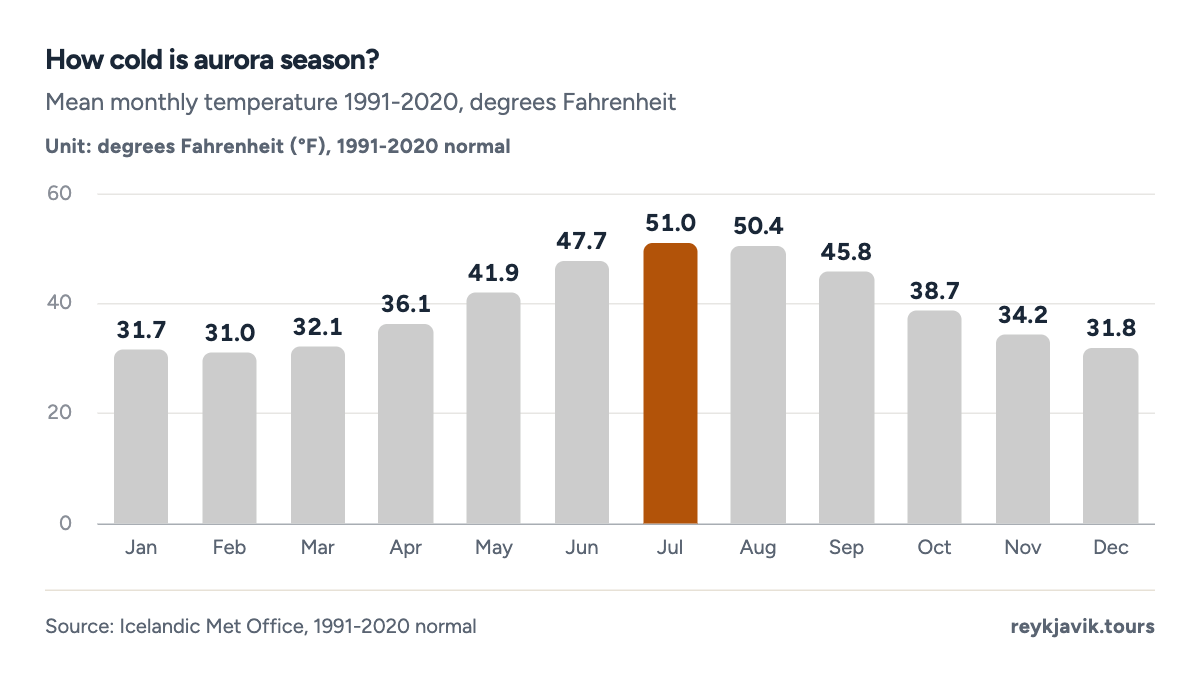
- Aurora-season temperatures hover between 31 and 43 °F - mild for the latitude.
- January and February are the coldest hunting months at about 31 °F.
- Dress for a 2-4 hour stationary wait, not for a walk: standing still is what gets cold.
How many days in Iceland to see northern lights?
Treat each night as an independent 47.5% draw - the midpoint of the operators' published range - and the arithmetic follows the binomial: one night, 47.5%1; two nights, 72%1; three, 85%1; four nights, 92%1. That is where the industry's "stay at least four nights" advice comes from1.
Two practical modifiers. First, tours offer free rebooking until you see the lights - so the effective odds for a flexible traveller approach certainty within a week. Second, self-drivers can chase breaks in the cloud using the Icelandic Met Office's cloud forecast, trading the tour's expertise for freedom - the Met Office publishes aurora and cloud maps every day at 18:002 in season2.
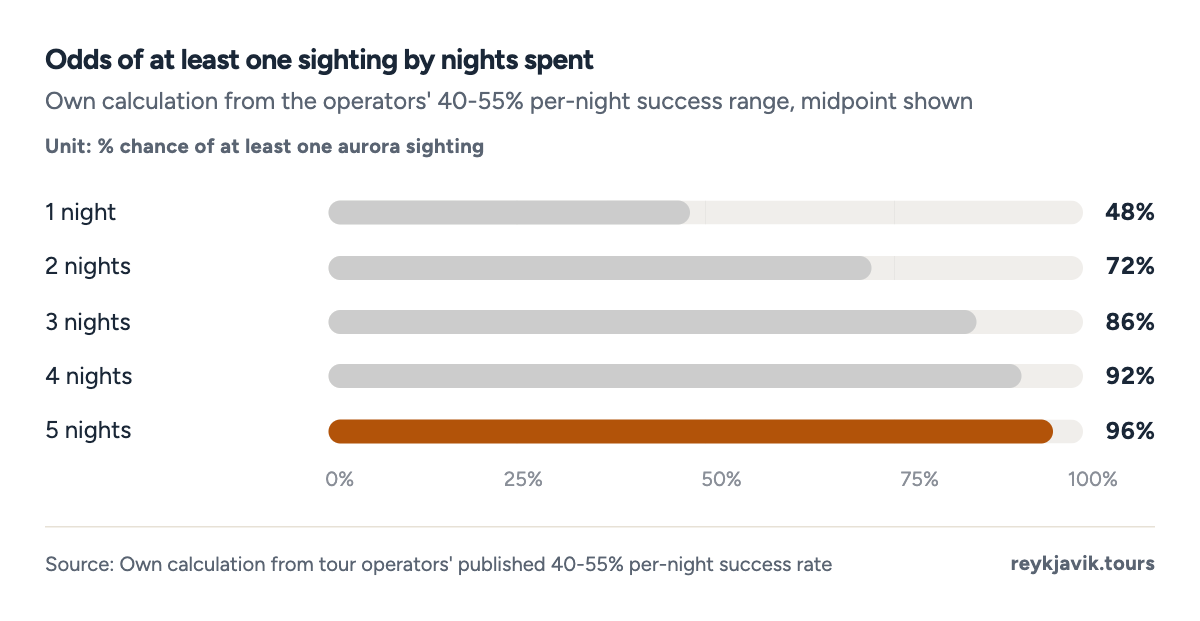
- One night gives you about a coin flip; four nights push the odds past 90%.
- This is why every serious guide recommends a minimum 4-night stay.
- The odds assume peak season - outside September-April, darkness itself is missing.
| 1 | 48 |
| 2 | 72 |
| 3 | 86 |
| 4 | 92 |
| 5 | 96 |
How much is a northern lights tour in Iceland?
For a northern lights tour Reykjavik price per person starts at ISK 9,9901 - about $781 - and most operators include a free retry if the sky stays closed. The boat tour from Reykjavík's Old Harbour sails away from city glow from $941, super jeeps chase clear skies far off-road from $1591, and a private guide starts around $1,0131. How much to see northern lights Iceland-wide, then: from about $78 per person, and the free-retry policy means you only pay once - even if it takes five attempts1.
Is the tour worth it against self-driving? For first-timers, usually yes: the guides read cloud and KP forecasts all day, know the dark-sky spots, carry tripods and - on many tours - a photographer who emails you the proof shot afterwards1.
City lights are a real but overstated problem. From central Reykjavík a KP-4 display punches through the glow; a KP-2 needs the countryside. The tour's value is not escaping the city - any taxi can do that - but escaping the city *in the right direction*: the guides watch the cloud satellite all evening and commit to the one region of the island with a gap, which on a broken-sky night is worth more than any camera setting2.
The price ladder buys three things: group size, distance and comfort. The coach follows the forecast to whichever region is clear, with 40-50 strangers and hot chocolate. The boat trades the road for the harbour, sailing beneath the city lights to where the skyline cannot interfere. The super jeep carries a handful of people to spots coaches cannot reach and stays flexible longest. And the private tour is simply the first three with your own schedule - at a price that explains why most visitors reserve it for the one night that must work, an engagement or an anniversary, then fall back to the coach for the rest1.
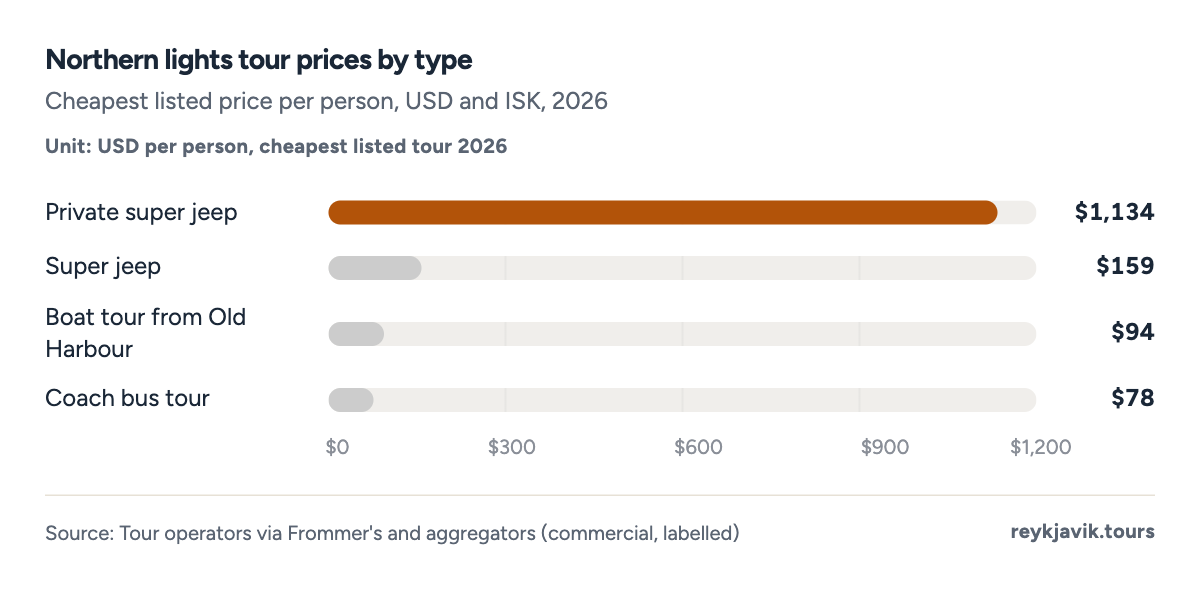
- The classic coach tour starts at about ISK 9,990 - roughly 78 dollars.
- A super jeep doubles the price for smaller groups and remote locations.
- Private tours start above 1,000 dollars - the sky is the same from the bus.
| Coach bus tour | 9,990 | 78 |
| Boat tour from Old Harbour | 12,100 | 94 |
| Super jeep | 20,400 | 159 |
| Private tour | 130,000 | 1,013 |
Solar cycle: why now is the best window in 20 years
How often does aurora borealis happen in Iceland, at the physics level? Aurora frequency follows an 11-year rhythm. Solar Cycle 25 peaked in late 2024-early 2025, exceeding the official NOAA-NASA forecast and delivering the strongest activity in about 20 years5; activity remains elevated through 2026 before the long decline toward the 2030 minimum5. In practical terms: big displays that used to be rare-event news have been showing up several times a season, and even KP-4 nights - ordinary in Iceland - have produced photographs that look like magazine covers.
The science also inverts the usual FOMO: the lights are not getting rarer between peaks. Iceland's position under the oval means even the solar minimum keeps the season's nightly odds close to the figures above - the maximum simply adds brightness, colour (red pillars) and southern-reach displays5.
For the record, the history cuts the other way too: the Maunder Minimum of the late 1600s practically erased the aurora from Icelandic skies for decades, and the mid-1800s delivered displays so vast they were measured from the Caribbean. Iceland's written records - chronicles, farm diaries, newspapers - are now used by solar physicists to reconstruct cycles back to the 1600s, making this one of the few countries where aurora tourism and palaeo-science read the same diaries5.
| KP 0-1 | Aurora possible on the northern horizon on clear nights |
| KP 2-3 | Good visible displays overhead in the countryside - most tour nights |
| KP 4-5 | Strong displays, visible even from Reykjavík's streetlights |
| KP 6+ | Storm level - rare; aurora visible far south of Iceland too |
Where and how to look
The lights arrive from the north, so the first rule is geometry: find a spot with an open northern horizon and no streetlight in it. From Reykjavík that means driving 20-45 minutes inland or up onto the heaths - Hellisheiði is where tour buses stop first, Þingvellir's lake plain is the classic dark site, and Grótta's lighthouse peninsula works on strong nights for anyone without a car1. The Met Office's aurora page pairs the activity forecast with a cloud map; the winning strategy on a cloudy evening is to drive toward the clearest patch, sometimes an hour ahead of the tour buses that left later with better information2.
Photography is its own reward system. Any recent phone on a night mode will catch a bright display, but a real camera wants a tripod, a wide lens at f/2.8 or faster, ISO 1600-3200 and 5-15 second exposures - and a spare battery kept warm in an inside pocket, because cold kills them in an hour. Focus manually on a distant light; autofocus hunts forever in the dark. The displays move slower than videos suggest: to the eye a strong aurora unfolds like a slow curtain, and photographs capture the colour the eye only half-sees, because night vision is nearly colour-blind2.
Where the lights are in the sky... and when
Timing within the night matters less than folklore says, but it is not random. Displays cluster around magnetic midnight - roughly 22:00 to 01:00 - and the Met Office's all-sky cameras suggest the window from about 22:30 to 03:00 for average nights2. Arrive by 21:30, dress as if you will stand still until midnight, and treat anything after 02:00 as a bonus.
Duration varies wildly: a substorm can flare from nothing to a full overhead corona in ten minutes and fade within twenty, while a KP-4 night can pulse on and off for hours. The tour operators' rebooking policies exist precisely because of this variance - the lights are not scheduled, only likely1.
Northern lights Iceland temperature by month: what to wear
The temperature column is milder than Iceland's latitude suggests - aurora-season means hover between 31 and 43 °F4 - but aurora hunting is stationary: you stand in a field for two or three hours at midnight, often in wind. Wind chill on the heath can feel 15 degrees colder than the town number4.
The local formula: thermal base, insulating middle, windproof shell, and triple the gloves you think you need - camera operation is what makes fingers cold. Boots with real soles; the best spots are gravel parking areas, not cliffs. And if February's 31 °F4 feels daunting, remember the same night has an 87%3 chance of being dark enough - the cold is the entry fee, the sky is the product.
| Grótta lighthouse | Within the city | Coastal dark spot; good for a quick KP-4+ night |
| Þingvellir National Park | About 45 min | Dark inland skies; tour buses' classic stop |
| Reykjanes peninsula | 30-50 min | Dark coasts; check road and wind warnings |
| Hellisheiði heath | 30 min | High ground above city glow; tours stop here first |
Conclusions
- The season is early September to mid-April - about 230 dark nights a year; from May to July the sky never gets dark enough to compete3.
- Per night, expect a coin flip: operators publish 40-55% success, because cloud - not aurora absence - is what kills most attempts1.
- Four nights = 92% odds of at least one display; every extra night is insurance, and free-retry tours make the paid attempts effectively unlimited1.
- Prices start at $781 for the classic coach hunt and scale to $1,000+ for private chases - the free-retry policy, not the vehicle, is what you are buying1.
- Timing the decade matters less than timing the week: Solar Cycle 25's peak has padded the displays through 2026, but under the auroral oval Iceland's nightly odds barely move between cycle phases5.
Methodology
- Darkness hours: Reykjavík, monthly averages, 2026 solar geometry
- Temperatures: 1991-2020 normal, country mean (IMO)
- Tour success rates and prices: 2026 operator listings (commercial, labelled)
- Solar cycle: NOAA-NASA Cycle 25 panel
Definition. Aurora season = the part of the year with astronomical darkness (sun lower than about -6° ... in practice, nights darker than civil twilight). Success rate = the share of tour departures on which customers see aurora, as published by operators.
Data sources. Own solar-geometry calculation for darkness hours (identical dataset to the daylight-hours page); Icelandic Met Office 1991-2020 temperature normal and daily aurora/cloud forecast; NOAA-NASA Solar Cycle 25 prediction panel; tour prices and success rates compiled from operator listings via Frommer's and aggregators (commercial, labelled).
Calculations. Hours of darkness = 24 minus the monthly average daylight hours for Reykjavík. Odds by stay length use the binomial distribution with p = 0.475 (midpoint of the 40-55% operator range): P(≥1 sighting) = 1 - (1 - p)^n. ISK prices convert at the 2025 average of 128.37 ISK per USD. Fahrenheit values are the Celsius normals converted.
Limitations. The 40-55% success rate is operators' own aggregate for peak-season departures and varies by month, weather year and operator. Darkness hours are astronomical averages - actual usable darkness depends on cloud and moon. Temperature normals are country means; hunting spots on heaths run colder with wind chill. Solar-cycle timing beyond 2026 follows the standard declining-phase expectation.
Sources
- Tour operators via Frommer's and Iceland tour aggregators. “Northern lights tour prices and 40-55% per-night success rates, 2026.” commercial, labelled, 2026. frommers.com. Accessed 2026-09-17. Back to text
- Icelandic Met Office. “Aurora forecast and cloud-cover maps for Iceland.” IMO, 2026. en.vedur.is. Accessed 2026-09-17. Back to text
- Own calculation from solar geometry. “Hours of daylight and darkness per month, Reykjavík (same dataset as the daylight-hours page).” Reykjavik Tours, 2026. reykjavik.tours. Accessed 2026-09-17. Back to text
- Icelandic Met Office. “Monthly mean temperature 1991-2020, country average.” IMO (Veðurstofa Íslands), 2021. vedur.is. Accessed 2026-09-17. Back to text
- NOAA / NASA Solar Cycle 25 Prediction Panel. “Solar Cycle 25 peaked late 2024-2025, strongest in about 20 years.” NOAA Space Weather Prediction Center, 2025. swpc.noaa.gov. Accessed 2026-09-17. Back to text
About the author
Laufey turns public statistics on tourism and travel into research people can check and cite.
Every figure on this page links to its source. How we research
Related research
More data on Iceland's weather and travel from Reykjavik Tours.
- Travel planningHow Many Miles Is the Ring Road in Iceland? (2026 Data)822 mi the Ring Road around IcelandRead the research →
- WeatherIceland Daylight Hours by Month (2026 Data)21.2 h of daylight in Reykjavík on the longest dayRead the research →
- WeatherHow Much Snow Does Iceland Get? (2026 Data)55 days a year with snow on the ground in ReykjavíkRead the research →
- WeatherIceland Temperature by Month (2026 Data)39 °F average temperature in IcelandRead the research →
- WeatherIceland Weather by Month (2026 Data)4.5 in rain in September, Iceland's wettest monthRead the research →
- WeatherAverage Wind Speed in Iceland (2026 Data)5.2 m/s average wind speed in IcelandRead the research →