Iceland Daylight Hours by Month (2026 Data)
How many hours of daylight and sunshine Iceland gets in every month, sunrise and sunset times, midnight sun, darkness and the time difference to the US.
- Published
- Updated
- 6 sources
- 165 statistics
- 11 min read

- M.Sc. in Atmospheric Sciences, University of Iceland (Háskóli Íslands), with a minor thesis on North Atlantic storm-track variability
- Former research assistant at the Icelandic Meteorological Office (Veðurstofa Íslands), working on subarctic climate modeling and volcanic-ash dispersion forecasting
- B.A. in Sociology, also from the University of Iceland, with fieldwork on rural depopulation and tourism's impact on small fishing communities (Westfjords focus)
- Grew up in Akureyri, spent seven years living in Reykjavík and two in a small village in the Westfjords - brings first-hand experience of Iceland's regional weather extremes and community life
- Fluent in Icelandic and English; has translated Icelandic Met Office public advisories for international outlets
- Published field notes and data-driven pieces on glacier retreat (Vatnajökull), aurora forecasting, and the socioeconomic effects of overtourism in the Golden Circle

- M.A. in Journalism, University of Iceland, with additional coursework in Environmental Communication at the University of Bergen (Norway), giving a comparative Nordic lens
- 12+ years in Icelandic media, including editorial roles at RÚV (Iceland's national broadcaster) covering weather-related public safety reporting (storms, volcanic eruptions, road closures)
- Former fact-checking lead for a travel-and-culture desk, specializing in verifying tourism statistics, safety advisories, and climate data against primary sources (Vedur.is, Statistics Iceland)
- Has overseen editorial standards for bilingual (Icelandic/English) publications, ensuring both cultural nuance and accuracy for international readers
- Advocate for citing primary sources (Icelandic Met Office, Icelandic Tourist Board / Ferðamálastofa) rather than secondhand reporting
Key findings
- 21.2 hoursReykjavík's daylight ranges from 4.1 hours on 21 December to 21.2 hours on 21 June.
- 32 daysGrímsey, on the Arctic Circle, has 32 days of midnight sun, from 6 June to 7 July.
- 1,368 hoursReykjavík averages 1,368 hours of measured sunshine a year (1991–2020).
- 13 hoursReykjavík gets about 13 hours of sunshine in the whole of December, and Akureyri almost none.
- 13:30The sun is highest over Reykjavík at about 13:30 clock time, not at noon.
- 5 hoursIceland is 5 hours ahead of New York in winter and 4 hours ahead during US daylight saving time.
- 1968Iceland has kept Greenwich Mean Time all year, with no daylight saving time, since 1968.
- 6.7 minutesDaylight in Reykjavík changes by up to 6.7 minutes a day in spring and autumn.
In Iceland, the length of the day is almost a different country from one season to the next. On 21 June the sun is above the horizon in Reykjavík for 21 h 10 min1, rising before 3 a.m. and setting just after midnight. Six months later it manages 4 h 07 min1, and it never climbs more than 2.4°1 above the horizon. On the island of Grímsey, which the Arctic Circle crosses, the sun does not set at all for 32 days1.
Daylight is only part of the story. Iceland's clock runs about an hour ahead of the sun, so solar noon in Reykjavík falls around 13:30,2 and clouds cut the sunshine that actually reaches the ground: Reykjavík gets 1,368 hours3 of sunshine a year, 30%31 of the time the sun is up. This report calculates sunrise, sunset and day length for seven Icelandic towns, checks the results against the University of Iceland almanac, and adds three decades of Icelandic Met Office sunshine measurements and the time difference to the US.
How many hours of daylight in Iceland
Day length in Iceland depends mostly on how far north you are. At the June solstice, Vík on the south coast has 20 h 36 min1 of daylight and Akureyri in the north 23 h 37 min1. At the December solstice the order reverses: Vík keeps 4 h 31 min1, while Akureyri drops to 3 h 04 min1 and Grímsey to 2 h 12 min1.
Over a whole year the differences almost cancel out. Reykjavík has about 4,567 hours1 with the sun above the horizon, Grímsey 4,6491. What changes is when the light comes: Iceland trades dark winters for bright summer nights.
- 5JanJ
- 9FebF
- 12MarM
- 15AprA
- 18MayM
- 21JunJ
- 20JulJ
- 16AugA
- 13SepS
- 10OctO
- 7NovN
- 4DecD
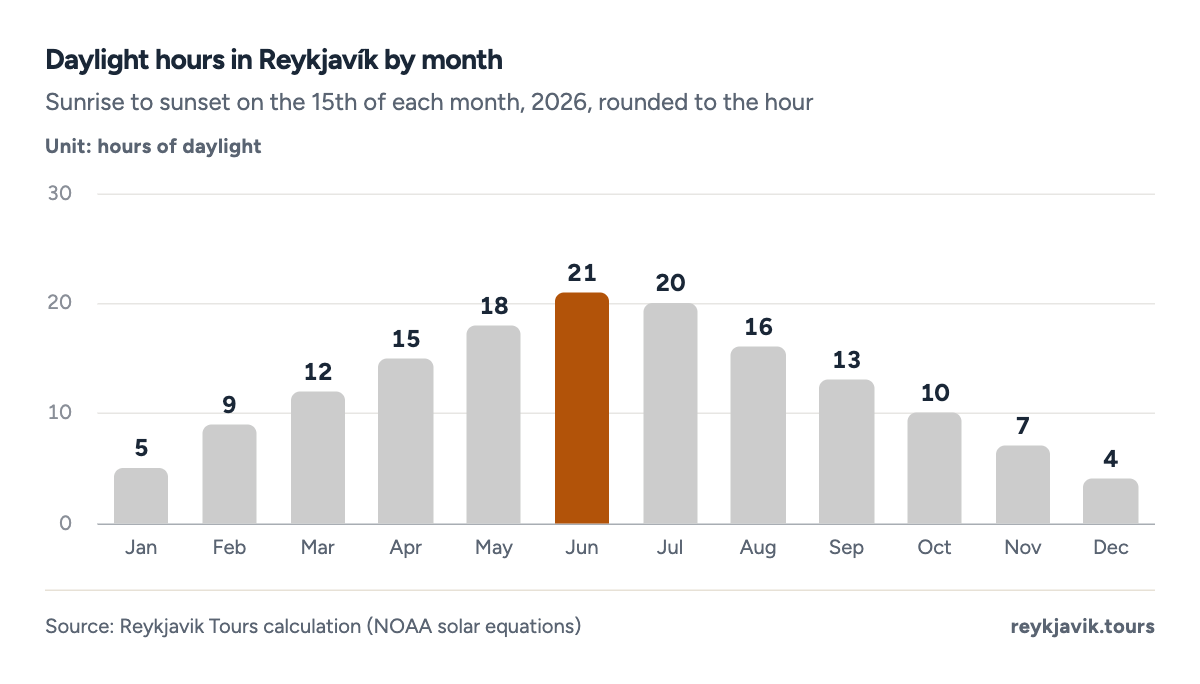
- Mid-June brings about 21 h of daylight.
- Mid-December brings about 4 h.
- Reykjavík
- Akureyri
- Vík
- Grímsey
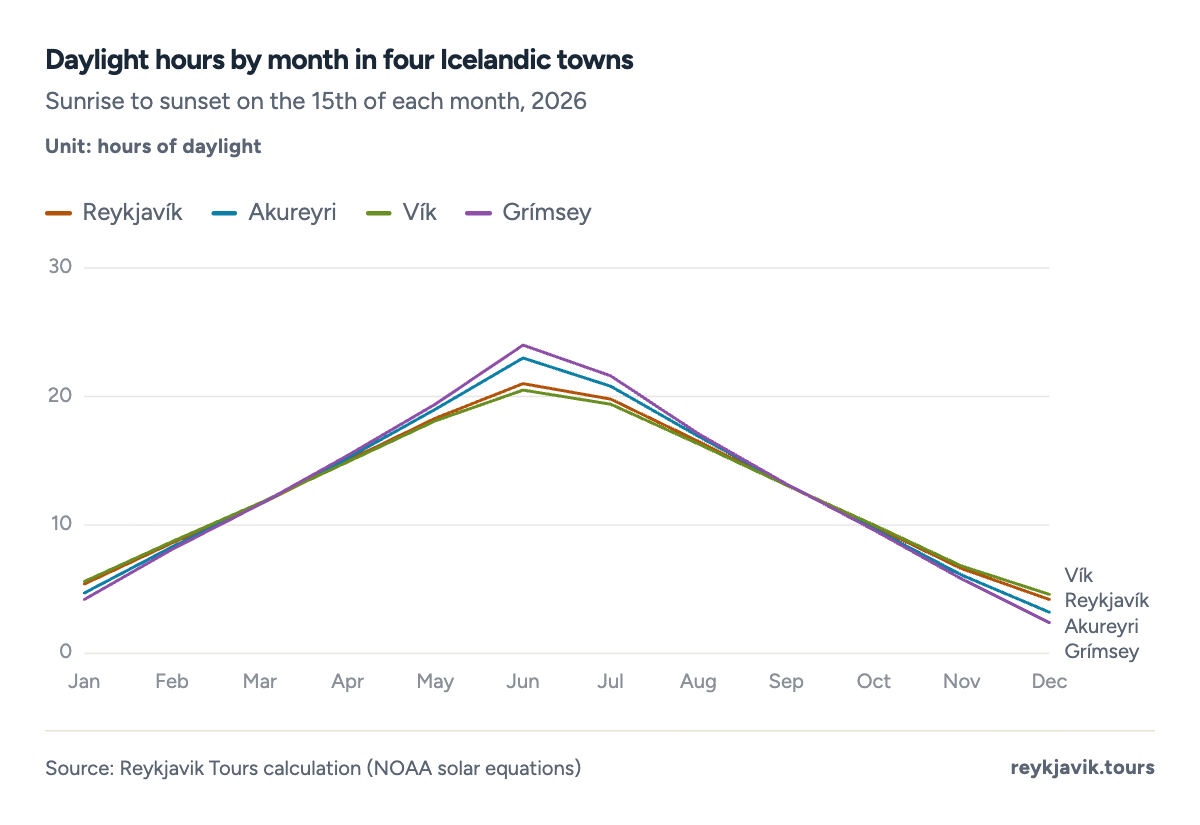
- Grímsey reaches 24.0 h in mid-June.
- Vík keeps 4.6 h in mid-December.
| January | 5.4 | 4.7 | 4.5 | 4.9 | 5.3 | 5.6 | 4.2 |
| February | 8.6 | 8.3 | 8.2 | 8.4 | 8.6 | 8.7 | 8.1 |
| March | 11.6 | 11.6 | 11.6 | 11.6 | 11.6 | 11.7 | 11.6 |
| April | 15.0 | 15.2 | 15.3 | 15.2 | 15.0 | 14.9 | 15.4 |
| May | 18.3 | 19.0 | 19.1 | 18.8 | 18.4 | 18.1 | 19.4 |
| June | 21.0 | 23.0 | 24.0 | 22.2 | 21.1 | 20.5 | 24.0 |
| July | 19.8 | 20.8 | 21.1 | 20.5 | 19.9 | 19.4 | 21.6 |
| August | 16.5 | 16.9 | 17.0 | 16.8 | 16.5 | 16.3 | 17.1 |
| September | 13.1 | 13.2 | 13.2 | 13.2 | 13.1 | 13.1 | 13.2 |
| October | 9.9 | 9.7 | 9.7 | 9.8 | 9.9 | 10.0 | 9.6 |
| November | 6.6 | 6.1 | 5.9 | 6.2 | 6.5 | 6.8 | 5.8 |
| December | 4.2 | 3.2 | 2.9 | 3.5 | 4.2 | 4.6 | 2.4 |
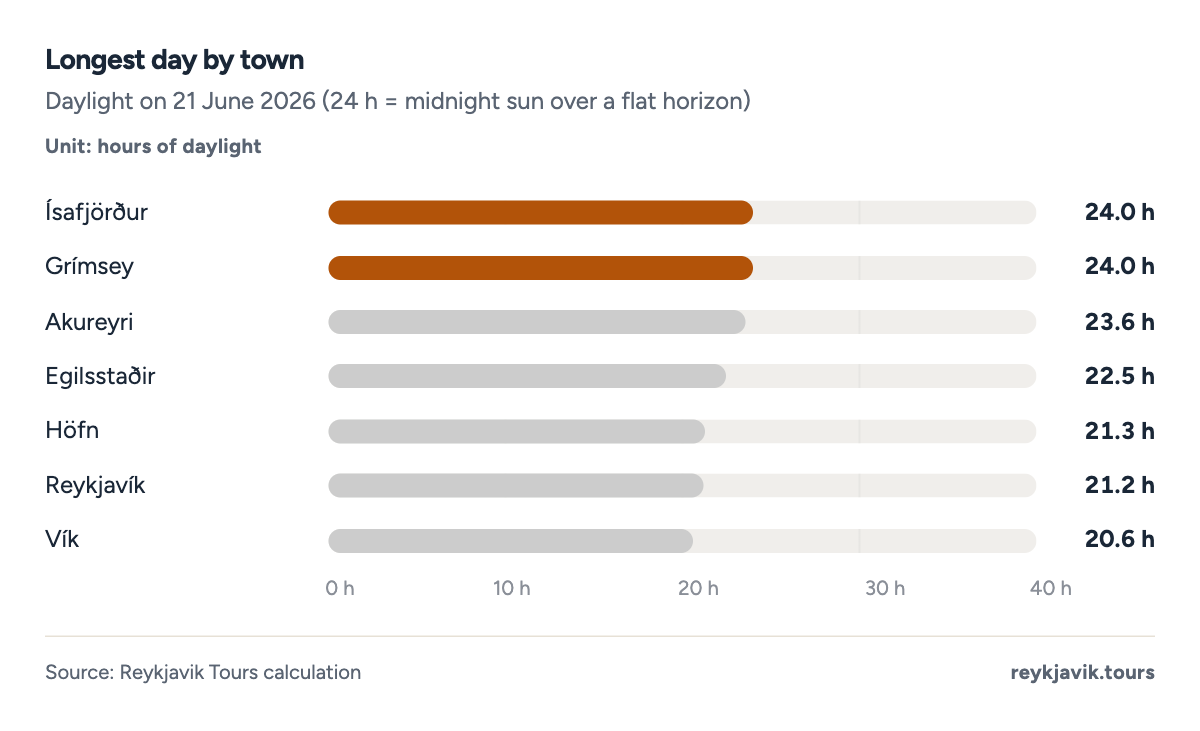
- Grímsey and Ísafjörður reach 24 h over a flat horizon.
- Vík has 20.6 h.
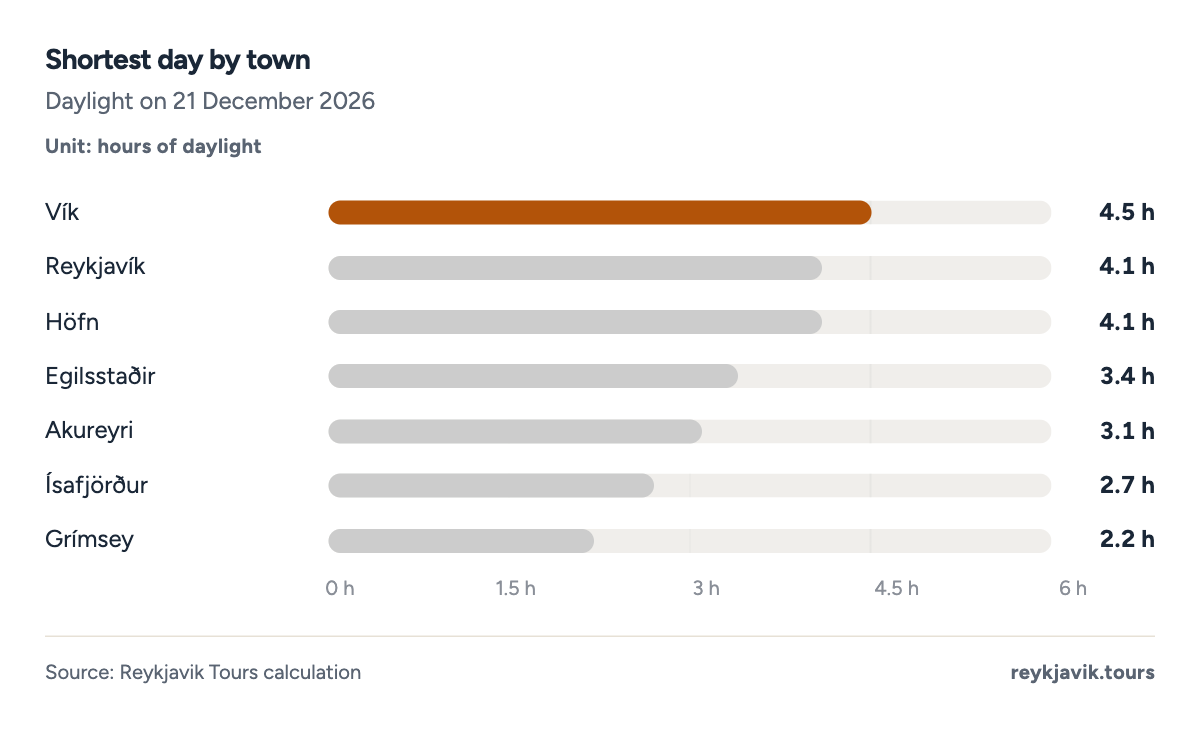
- Vík keeps 4.5 h of daylight.
- Grímsey gets 2.2 h.
| Reykjavík | 02:54 | 00:04 | 21.2 | 11:22 | 15:30 | 4.1 |
| Akureyri | 01:26 | 01:02 | 23.6 | 11:38 | 14:43 | 3.1 |
| Ísafjörður | no sunset | no sunset | 24.0 | 12:09 | 14:52 | 2.7 |
| Egilsstaðir | 01:45 | 00:13 | 22.5 | 11:14 | 14:38 | 3.4 |
| Höfn | 02:25 | 23:40 | 21.3 | 10:57 | 15:01 | 4.1 |
| Vík | 02:59 | 23:35 | 20.6 | 10:59 | 15:30 | 4.5 |
| Grímsey | no sunset | no sunset | 24.0 | 12:04 | 14:16 | 2.2 |
- Grímsey
- Reykjavík
- Vík
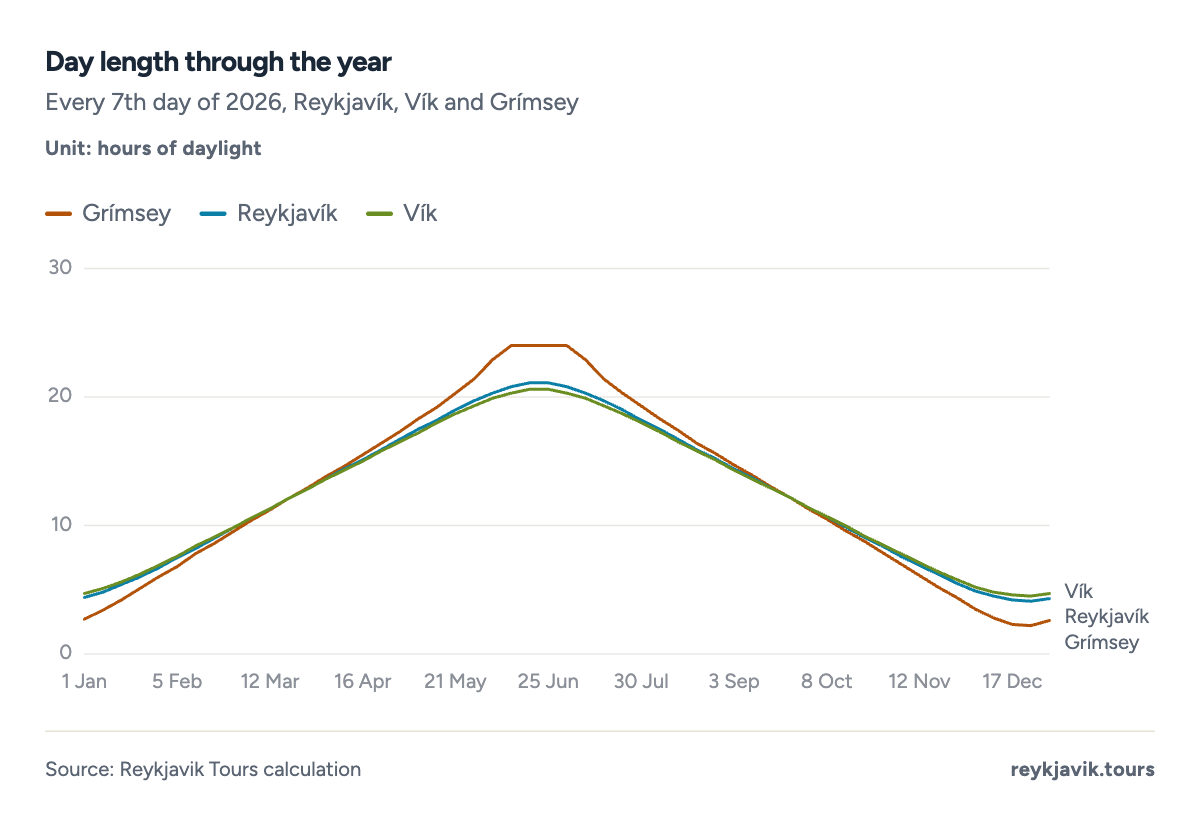
- Grímsey's line flattens at 24 h around midsummer.
- All three towns meet near 12 h at the equinoxes.
Iceland is also further north than the other Nordic capitals. On 21 December, Oslo has 5 h 54 min1 of daylight, Stockholm 6 h 05 min1 and Helsinki 5 h 49 min1, all well above Reykjavík. New York, much further south, keeps 9 h 15 min1 on its shortest day and gets only 15 h 06 min1 on its longest.
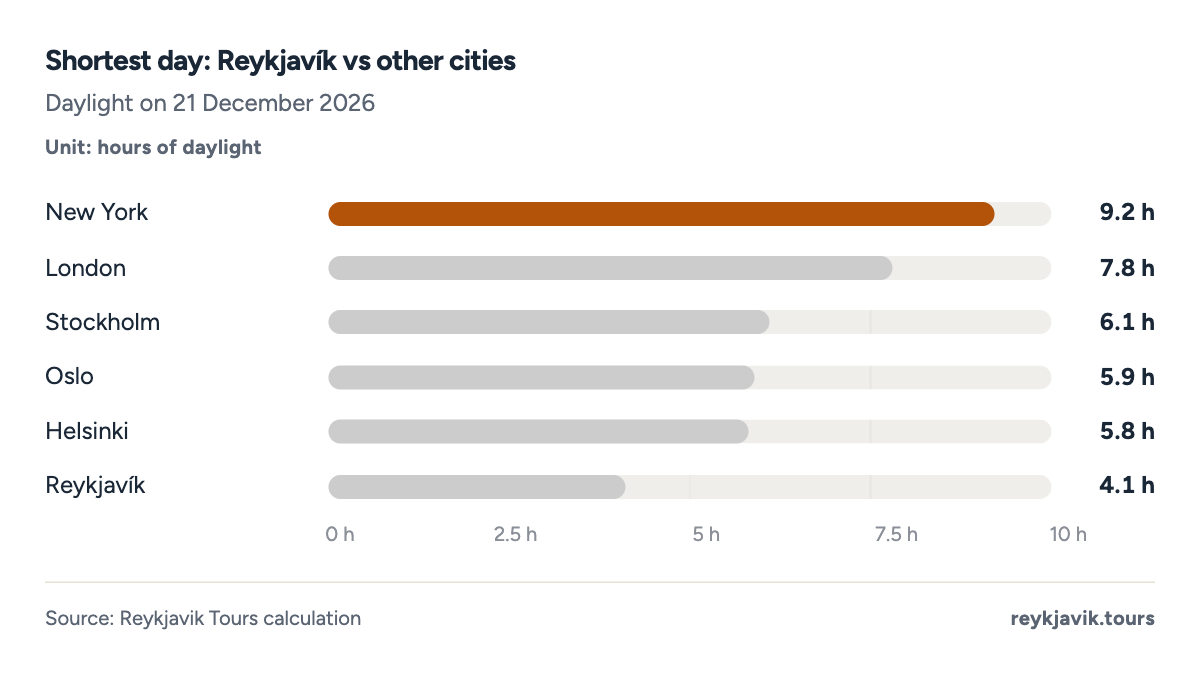
- New York keeps 9.2 h.
- Reykjavík has 4.1 h.
- Reykjavík
- Oslo
- London
- New York
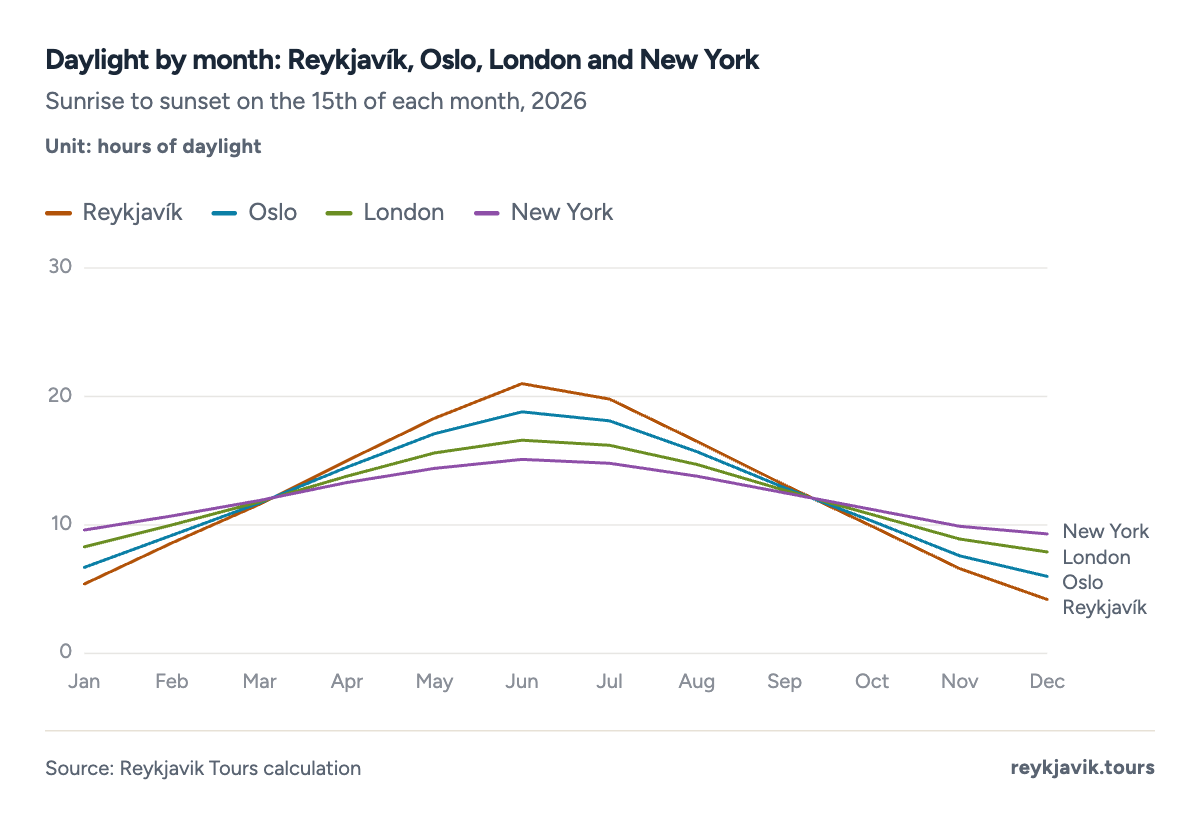
- In mid-June Reykjavík has 21.0 h against New York's 15.1 h.
- In mid-December it has 4.2 h against 9.3 h.
| Reykjavík | 21.2 | 4.1 | 4,567 |
| Oslo | 18.8 | 5.9 | 4,520 |
| Stockholm | 18.6 | 6.1 | 4,516 |
| Helsinki | 18.9 | 5.8 | 4,522 |
| London | 16.6 | 7.8 | 4,480 |
| New York | 15.1 | 9.2 | 4,456 |
Month by month
How many hours of daylight in Iceland in January
On 15 January, Reykjavík has 5 h 22 min1 of daylight, from sunrise at 10:561 to sunset at 16:171. Akureyri has 4 h 40 min1 and Vík 5 h 38 min1. The sun rises late in the morning and stays low, so even the brightest hours feel like dusk.
How many hours of daylight in Iceland in February
On 15 February, Reykjavík has 8 h 34 min1 of daylight, from sunrise at 09:251 to sunset at 17:591. Akureyri has 8 h 18 min1 and Vík 8 h 41 min1. Across February, Reykjavík gains more than 3 hours1 of daylight, from 1 February to 1 March.
How many hours of daylight in Iceland in March
On 15 March, Reykjavík has 11 h 38 min1 of daylight, from sunrise at 07:481 to sunset at 19:261. Akureyri has 11 h 37 min1 and Vík 11 h 39 min1. By the spring equinox on 20 March, day and night are roughly equal.
How many hours of daylight in Iceland in April
On 15 April, Reykjavík has 15 h 01 min1 of daylight, from sunrise at 05:571 to sunset at 20:581. Akureyri has 15 h 15 min1 and Vík 14 h 55 min1. April days lengthen by an average of 6.6 minutes1 a day.
How many hours of daylight in Iceland in May
On 15 May, Reykjavík has 18 h 20 min1 of daylight, from sunrise at 04:141 to sunset at 22:341. Akureyri has 18 h 58 min1 and Vík 18 h 05 min1. From 20 May1, the sun no longer sinks more than 6° below the horizon at night in Reykjavík.
How many hours of daylight in Iceland in June
On 15 June, Reykjavík has 21 h 02 min1 of daylight, from sunrise at 02:571 to sunset at 23:591. Akureyri has 23 h 02 min1 and Vík 20 h 29 min1. The longest days of the year: the sun sets just after midnight around the solstice.
How many hours of daylight in Iceland in July
On 15 July, Reykjavík has 19 h 48 min1 of daylight, from sunrise at 03:401 to sunset at 23:271. Akureyri has 20 h 48 min1 and Vík 19 h 25 min1. July keeps nearly all of June's light, and nights stay bright.
How many hours of daylight in Iceland in August
On 15 August, Reykjavík has 16 h 29 min1 of daylight, from sunrise at 05:181 to sunset at 21:471. Akureyri has 16 h 52 min1 and Vík 16 h 20 min1. August loses daylight fastest of the summer months, 6.57 minutes1 a day on average.
How many hours of daylight in Iceland in September
On 15 September, Reykjavík has 13 h 08 min1 of daylight, from sunrise at 06:491 to sunset at 19:571. Akureyri has 13 h 13 min1 and Vík 13 h 05 min1. Around the autumn equinox on 23 September, day and night are equal again.
How many hours of daylight in Iceland in October
On 15 October, Reykjavík has 9 h 54 min1 of daylight, from sunrise at 08:161 to sunset at 18:101. Akureyri has 9 h 44 min1 and Vík 9 h 58 min1. October days shorten by an average of 6.49 minutes1 a day.
How many hours of daylight in Iceland in November
On 15 November, Reykjavík has 6 h 34 min1 of daylight, from sunrise at 09:561 to sunset at 16:301. Akureyri has 6 h 04 min1 and Vík 6 h 47 min1. Daylight keeps shrinking by an average of 6.04 minutes1 a day.
How many hours of daylight in Iceland in December
On 15 December, Reykjavík has 4 h 14 min1 of daylight, from sunrise at 11:161 to sunset at 15:301. Akureyri has 3 h 13 min1 and Vík 4 h 37 min1. The shortest days: the sun is up for only about four hours around the solstice.
Reykjavik daylight hours by month
The table and charts below give Reykjavík's day month by month: sunrise, sunset, the hours of daylight and the longer period of usable light that includes civil twilight, when the sun is less than 6° below the horizon. In mid-December the sun is up for 4 h 14 min1, but twilight stretches usable light to about 6 h 50 min1.
Iceland sunrise and sunset by month
Sunrise in Reykjavík moves from 11:161 in mid-December to 02:571 in mid-June, and sunset from 15:301 to 23:591. These times use Iceland's clock, which is Greenwich Mean Time all year. The University of Iceland almanac, as printed in the government's 2018 report on standard time, gives light in Reykjavík on 15 January from 9:482 to 17:272, matching our twilight calculation for the same day within a few minutes.
- Sunset
- Solar noon
- Sunrise
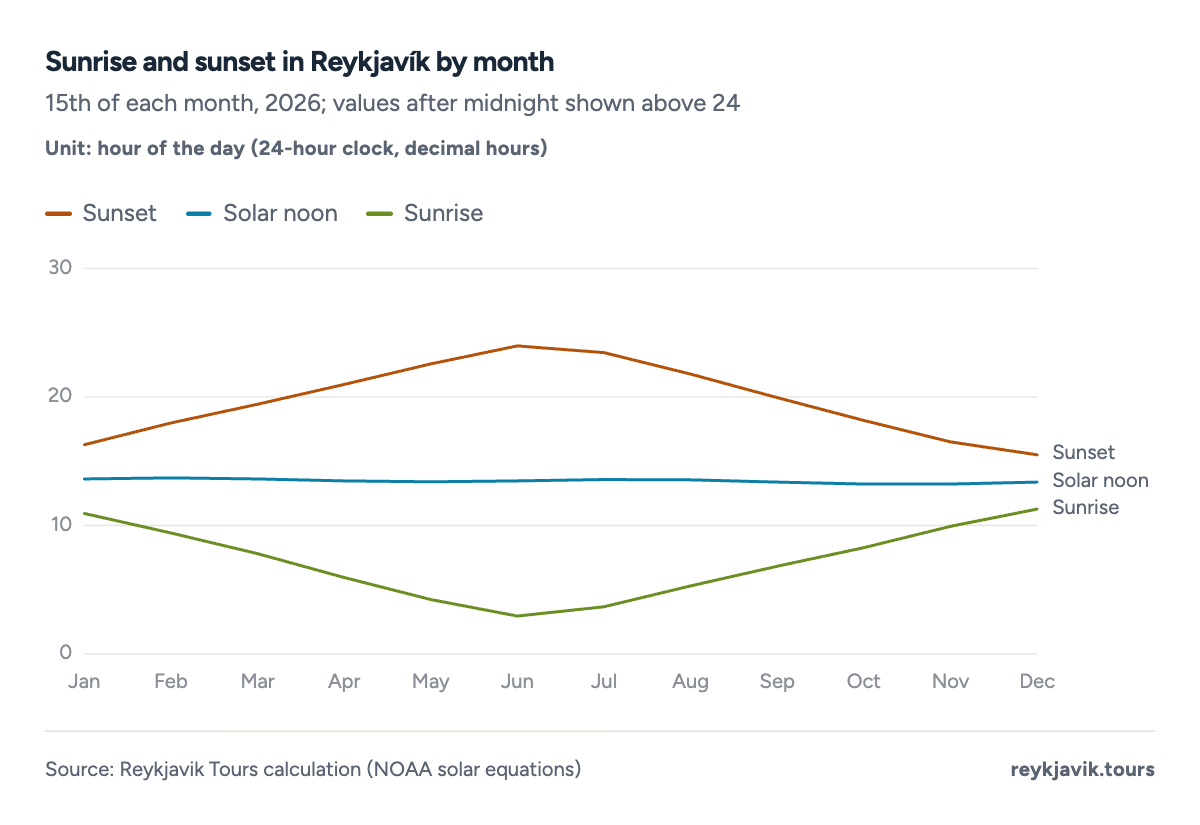
- Mid-June sunset comes at 23:59.
- Mid-December sunrise comes at 11:16.
- Light incl. twilight
- Daylight
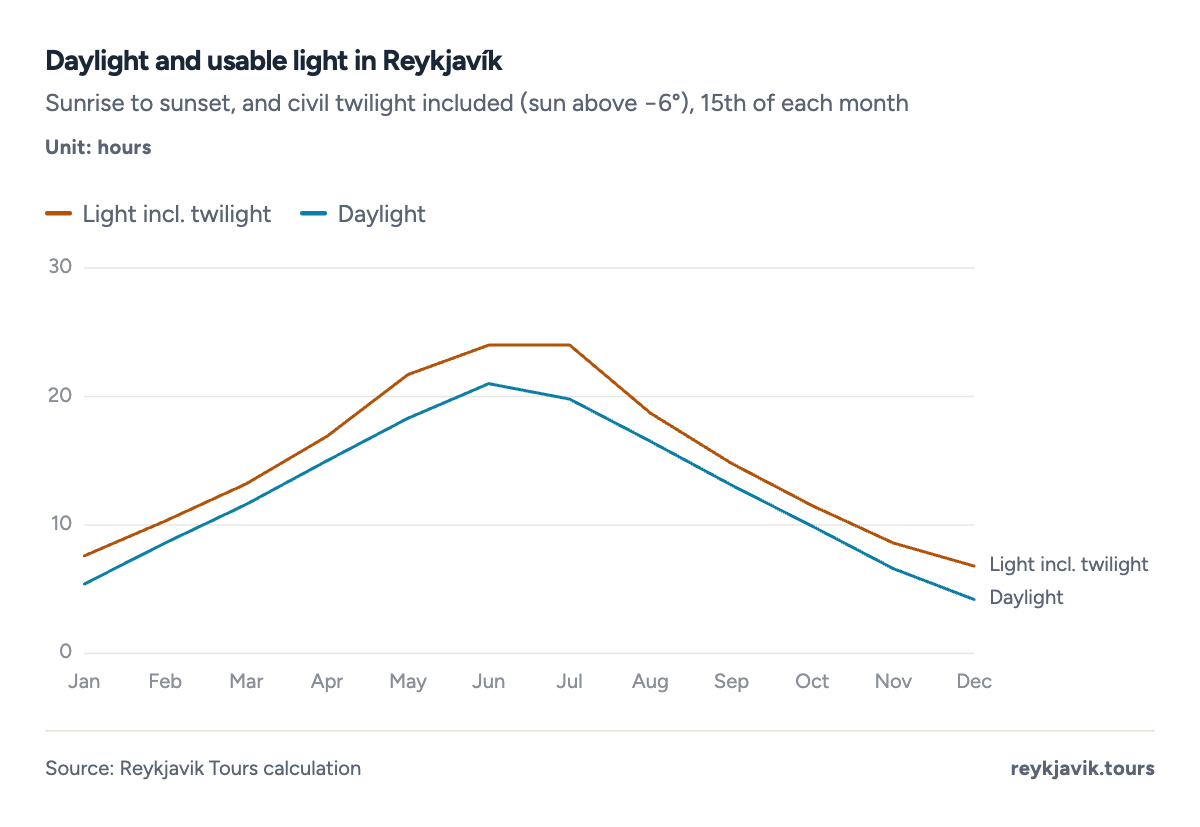
- Twilight adds about 2.6 h of usable light in mid-December.
- From 20 May to 24 July usable light lasts 24 h.
| January | 10:56 | 16:17 | 13:37 | 5.36 | 7.62 |
| February | 09:25 | 17:59 | 13:42 | 8.57 | 10.29 |
| March | 07:48 | 19:26 | 13:37 | 11.64 | 13.22 |
| April | 05:57 | 20:58 | 13:28 | 15.02 | 16.86 |
| May | 04:14 | 22:34 | 13:24 | 18.34 | 21.71 |
| June | 02:57 | 23:59 | 13:28 | 21.03 | 24.0 |
| July | 03:40 | 23:27 | 13:34 | 19.8 | 24.0 |
| August | 05:18 | 21:47 | 13:33 | 16.49 | 18.68 |
| September | 06:49 | 19:57 | 13:23 | 13.13 | 14.76 |
| October | 08:16 | 18:10 | 13:13 | 9.9 | 11.52 |
| November | 09:56 | 16:30 | 13:13 | 6.57 | 8.56 |
| December | 11:16 | 15:30 | 13:23 | 4.24 | 6.84 |
| Reykjavík | 15 Jan | 9:48 | 17:27 | 13:37 | 7.65 |
| Reykjavík | 1 Feb | 8:42 | 18:43 | 13:42 | 10.02 |
| Reykjavík | 12 Mar | 7:11 | 20:06 | 13:38 | 12.92 |
| Reykjavík | 16 Apr | 4:58 | 22:00 | 13:28 | 17.03 |
| Reykjavík | 14 May | 2:41 | 00:14 (next day) | 13:24 | 21.55 |
| Reykjavík | 18 Jun | bright all day | 13:29 | 24.0 | |
| Reykjavík | 16 Jul | bright all day | 13:34 | 24.0 | |
| Reykjavík | 13 Aug | 4:03 | 22:58 | 13:33 | 18.92 |
| Reykjavík | 17 Sep | 6:07 | 20:36 | 13:22 | 14.48 |
| Reykjavík | 15 Oct | 7:28 | 18:57 | 13:14 | 11.48 |
| Reykjavík | 12 Nov | 8:47 | 17:35 | 13:12 | 8.8 |
| Reykjavík | 17 Dec | 10:00 | 16:48 | 13:24 | 6.8 |
| Ísafjörður | 15 Jan | 10:08 | 17:17 | 13:42 | 7.15 |
| Ísafjörður | 12 Feb | 8:53 | 18:42 | 13:47 | 9.82 |
| Ísafjörður | 12 Mar | 7:14 | 20:13 | 13:42 | 12.98 |
| Ísafjörður | 16 Apr | 4:47 | 22:21 | 13:32 | 17.57 |
| Ísafjörður | 14 May | bright all day | 13:29 | 24.0 | |
| Ísafjörður | 18 Jun | bright all day | 13:34 | 24.0 | |
| Ísafjörður | 16 Jul | bright all day | 13:39 | 24.0 | |
| Ísafjörður | 13 Aug | 3:40 | 23:30 | 13:37 | 19.83 |
| Ísafjörður | 17 Sep | 6:05 | 20:47 | 13:27 | 14.7 |
| Ísafjörður | 15 Oct | 7:35 | 19:00 | 13:18 | 11.42 |
| Ísafjörður | 12 Nov | 9:03 | 17:29 | 13:17 | 8.43 |
| Ísafjörður | 17 Dec | 10:24 | 16:33 | 13:28 | 6.15 |
| Akureyri | 15 Jan | 9:44 | 17:00 | 13:22 | 7.27 |
| Akureyri | 12 Feb | 8:32 | 18:23 | 13:27 | 9.85 |
| Akureyri | 12 Mar | 6:54 | 19:52 | 13:22 | 12.97 |
| Akureyri | 16 Apr | 4:31 | 21:57 | 13:12 | 17.43 |
| Akureyri | 14 May | bright all day | 13:09 | 24.0 | |
| Akureyri | 18 Jun | bright all day | 13:13 | 24.0 | |
| Akureyri | 16 Jul | bright all day | 13:18 | 24.0 | |
| Akureyri | 13 Aug | 3:26 | 23:04 | 13:17 | 19.63 |
| Akureyri | 17 Sep | 5:46 | 20:25 | 13:07 | 14.65 |
| Akureyri | 15 Oct | 7:15 | 18:40 | 12:58 | 11.42 |
| Akureyri | 12 Nov | 8:40 | 17:12 | 12:56 | 8.53 |
| Akureyri | 17 Dec | 9:59 | 16:17 | 13:08 | 6.3 |
| Norðfjörður | 15 Jan | 9:23 | 16:46 | 13:04 | 7.38 |
| Norðfjörður | 12 Feb | 7:12 | 18:07 | 13:09 | 10.92 |
| Norðfjörður | 12 Mar | 6:37 | 19:34 | 13:05 | 12.95 |
| Norðfjörður | 16 Apr | 4:18 | 21:35 | 12:55 | 17.28 |
| Norðfjörður | 14 May | 1:30 | 00:29 (next day) | 12:51 | 22.98 |
| Norðfjörður | 18 Jun | bright all day | 12:56 | 24.0 | |
| Norðfjörður | 16 Jul | bright all day | 13:01 | 24.0 | |
| Norðfjörður | 13 Aug | 3:17 | 22:39 | 13:00 | 19.37 |
| Norðfjörður | 17 Sep | 5:30 | 20:06 | 12:49 | 14.6 |
| Norðfjörður | 15 Oct | 6:56 | 18:23 | 12:41 | 11.45 |
| Norðfjörður | 12 Nov | 8:20 | 16:57 | 12:39 | 8.62 |
| Norðfjörður | 17 Dec | 9:36 | 16:05 | 12:51 | 6.48 |
| Vestmannaeyjar | 15 Jan | 9:36 | 17:25 | 13:30 | 7.82 |
| Vestmannaeyjar | 12 Feb | 8:33 | 18:39 | 13:35 | 10.1 |
| Vestmannaeyjar | 12 Mar | 7:05 | 19:59 | 13:31 | 12.9 |
| Vestmannaeyjar | 16 Apr | 4:56 | 21:48 | 13:21 | 16.87 |
| Vestmannaeyjar | 14 May | 2:52 | 23:48 | 13:17 | 20.93 |
| Vestmannaeyjar | 18 Jun | bright all day | 13:22 | 24.0 | |
| Vestmannaeyjar | 16 Jul | bright all day | 13:27 | 24.0 | |
| Vestmannaeyjar | 13 Aug | 4:05 | 22:44 | 13:26 | 18.65 |
| Vestmannaeyjar | 17 Sep | 6:02 | 20:27 | 13:16 | 14.42 |
| Vestmannaeyjar | 15 Oct | 7:21 | 18:52 | 13:07 | 11.52 |
| Vestmannaeyjar | 12 Nov | 8:37 | 17:32 | 13:05 | 8.92 |
| Vestmannaeyjar | 17 Dec | 9:47 | 16:47 | 13:17 | 7.0 |
Does Iceland have total darkness
No part of Iceland has polar night, a day when the sun never rises. Even on Grímsey, the northernmost inhabited place, the sun is above the horizon for 2 h 12 min1 on 21 December, although it barely clears the horizon. Over a whole year in Reykjavík, about 4,567 hours1 have the sun up, 862 hours1 are twilight, and 3,331 hours1 are darker than civil twilight, most of them on long winter nights.
The opposite, the midnight sun, only happens at the very top of the country. Over a flat sea horizon, the sun stays up on Grímsey from 6 June1 to 7 July1. In Reykjavík the sun sets for a few hours even at midsummer, but from 20 May1 to 24 July1, 66 nights1 in all, it never sinks more than 6° below the horizon, so the sky stays in twilight until morning.
- Daylight4,56752.1%
- Darker than civil twilight3,33138%
- Civil twilight8629.8%
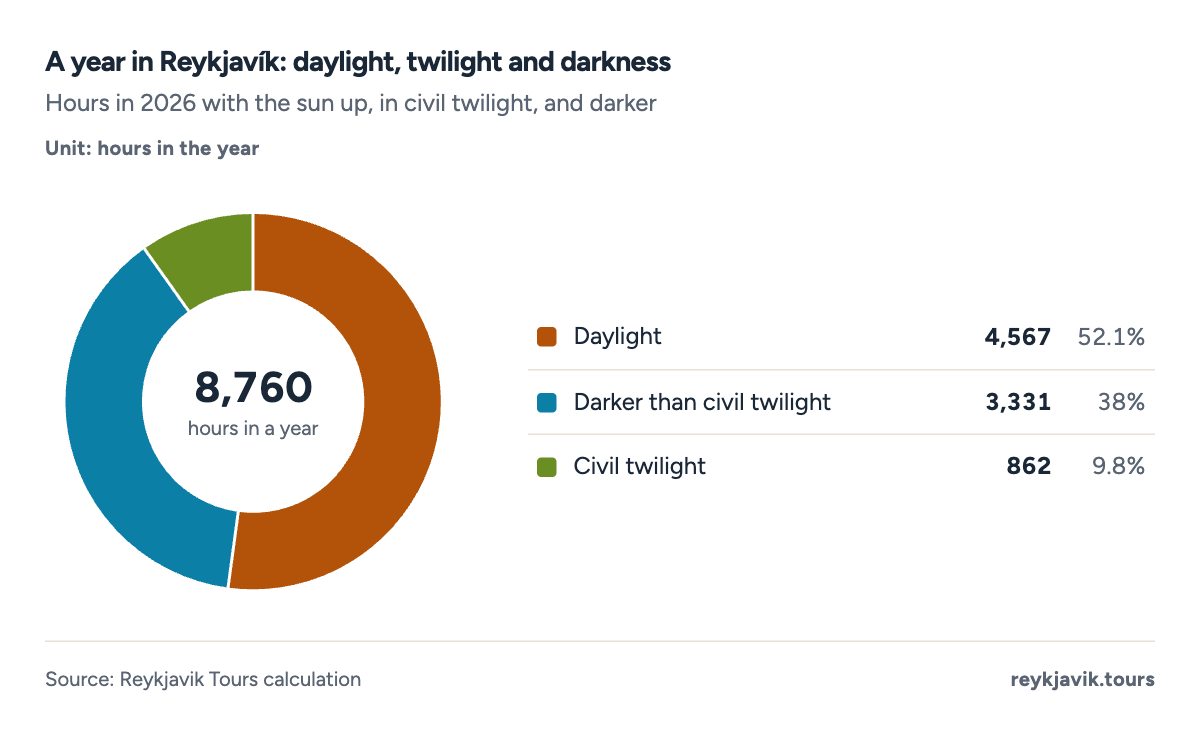
- The sun is up for 4,567 hours of the year.
- Twilight adds 862 hours.
Daylight changes fast
Near the equinoxes, Reykjavík's day length changes by several minutes every day. The fastest gain in 2026 is 6.7 minutes1 a day around 1 May1, and the fastest loss 6.6 minutes1 a day around 11 August1. Around the solstices the change slows almost to zero. Across March, days lengthen by an average of 6.54 minutes1 a day; in December the average change is only 2.37 minutes1.
- 5.1JanJ
- 6.5FebF
- 6.5MarM
- 6.6AprA
- 6.4MayM
- 2.8JunJ
- 5.4JulJ
- 6.6AugA
- 6.5SepS
- 6.5OctO
- 6.0NovN
- 2.4DecD
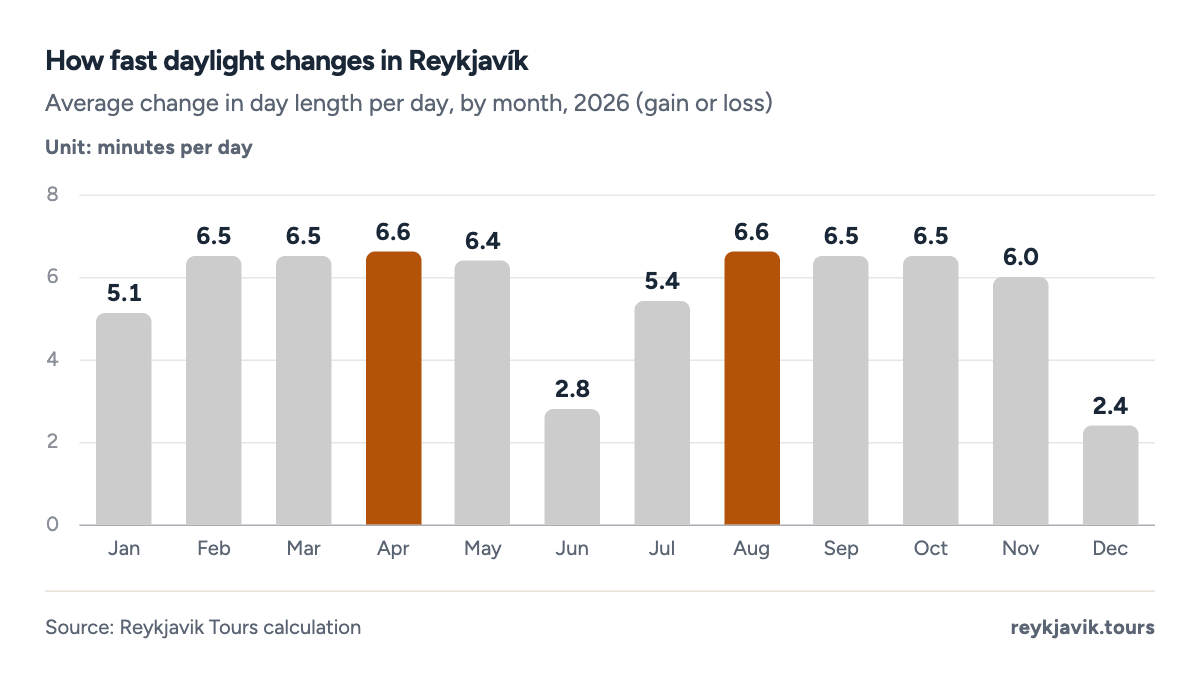
- April changes by 6.6 min a day on average.
- June changes by 2.8 min a day.
| January | 5.14 | 5.52 |
| February | 6.55 | 8.52 |
| March | 6.54 | 11.75 |
| April | 6.6 | 15.08 |
| May | 6.38 | 18.42 |
| June | 2.8 | 20.85 |
| July | 5.44 | 19.64 |
| August | 6.57 | 16.38 |
| September | 6.45 | 13.07 |
| October | 6.49 | 9.79 |
| November | 6.04 | 6.55 |
| December | 2.37 | 4.38 |
How many hours of sunlight in Iceland
Long days do not mean sunny days. The Met Office sunshine records used here, from Reykjavík and Akureyri, both show how cloudy Iceland is. Reykjavík's sunniest month is May, with 209 hours3 of sunshine on average in 1991–2020, and its darkest is December with 13 hours3. Akureyri in the north gets 0.3 hours3 in December and 190 hours3 in June.
Comparing measured sunshine with the hours the sun is up shows the effect of clouds. In Reykjavík, the sun shines for about 36.6%3 of possible daylight in May and only 9.3%3 in December.
- 23JanJ
- 62FebF
- 110MarM
- 165AprA
- 209MayM
- 190JunJ
- 183JulJ
- 165AugA
- 118SepS
- 92OctO
- 40NovN
- 13DecD
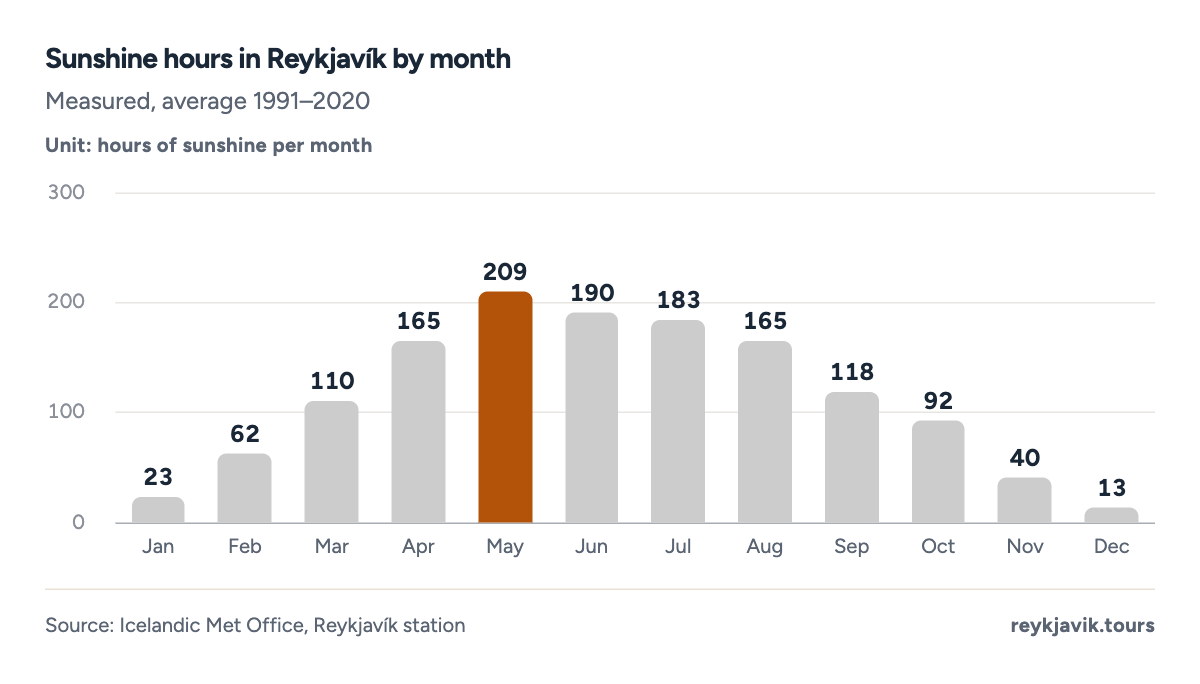
- May averages 209 h of sunshine.
- December averages 13 h.
- Reykjavík
- Akureyri
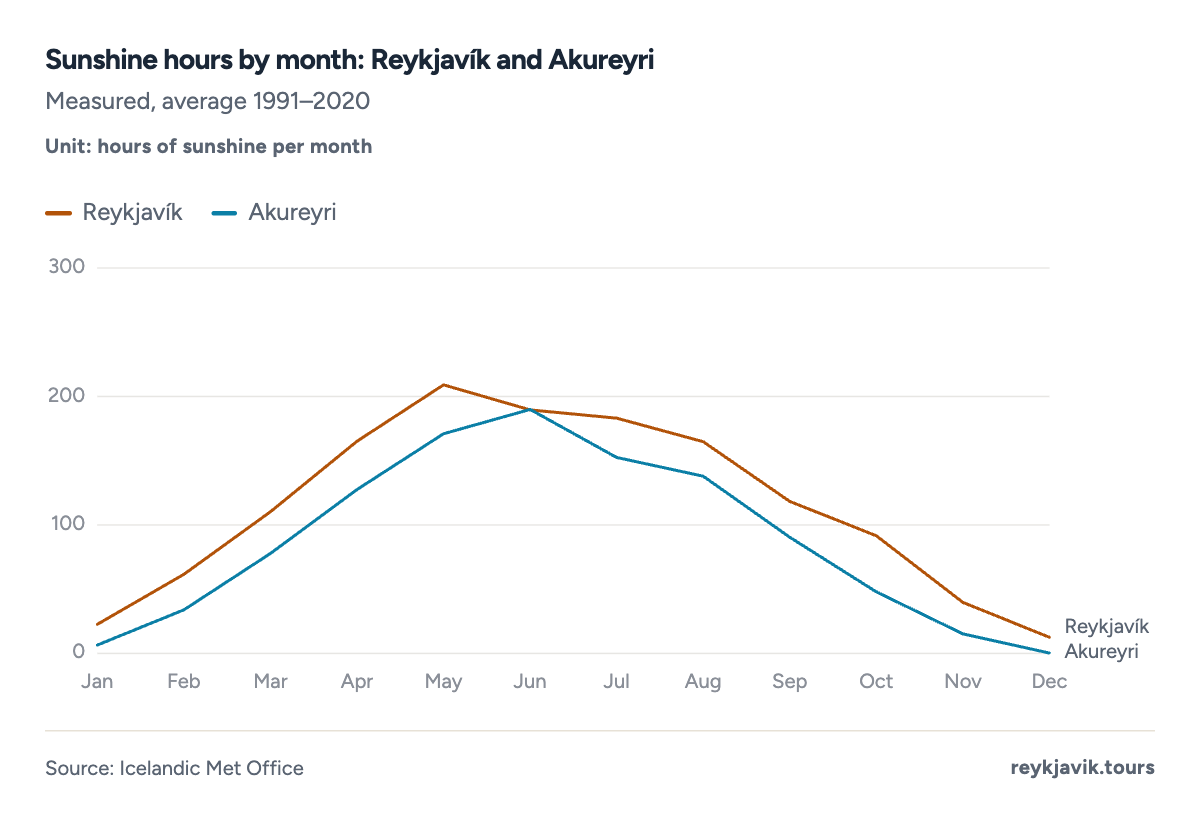
- Akureyri averages 0.3 h in December.
- In June Akureyri (189.9 h) matches Reykjavík.
- 13JanJ
- 26FebF
- 30MarM
- 36AprA
- 37MayM
- 30JunJ
- 30JulJ
- 32AugA
- 30SepS
- 30OctO
- 20NovN
- 9DecD
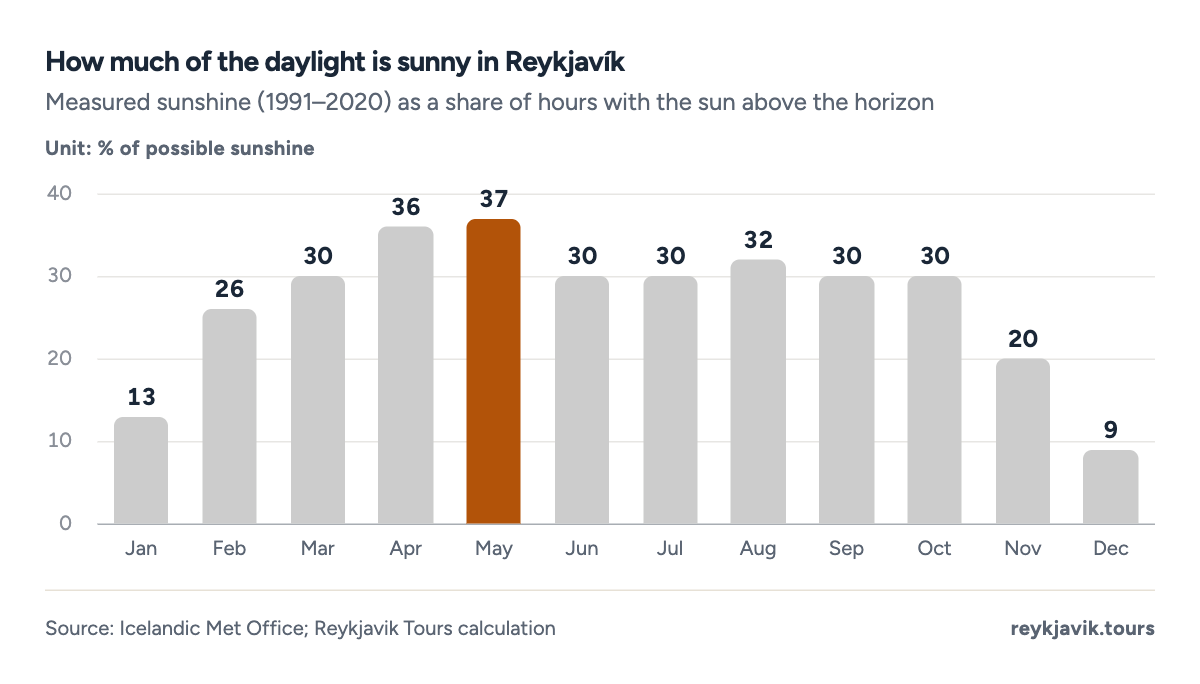
- May is sunniest at 37% of possible sunshine.
- December reaches 9%.
| January | 22.6 | 6.5 | 171 | 13.2 |
| February | 61.6 | 33.9 | 239 | 25.8 |
| March | 110.3 | 77.8 | 364 | 30.3 |
| April | 165.1 | 127.5 | 452 | 36.5 |
| May | 209.0 | 171.0 | 571 | 36.6 |
| June | 189.5 | 189.9 | 626 | 30.3 |
| July | 183.1 | 152.5 | 609 | 30.1 |
| August | 164.8 | 138.0 | 508 | 32.5 |
| September | 118.3 | 90.4 | 392 | 30.2 |
| October | 91.6 | 47.9 | 304 | 30.2 |
| November | 39.7 | 15.2 | 196 | 20.2 |
| December | 12.6 | 0.3 | 136 | 9.3 |
Reykjavik average annual sunshine hours
Reykjavík averaged 1,368 hours3 of sunshine a year in 1991–2020, and Akureyri 1,051 hours3. Individual years vary widely: the sunniest year in Reykjavík's record since 1949 was 20123 with 1,587 hours3, and the least sunny was 19833 with 943 hours3. Recent years have been above the long-term average: 1,495 hours3 in 2023, 1,4593 in 2024 and 1,4223 in 2025. The chart fits a straight line to every year since 1949 and extends it to 2050; it is a simple trend, not a forecast.
Projection: linear trend of 1949–2025 yearly values, 95% prediction range. Our calculation, not a forecast.
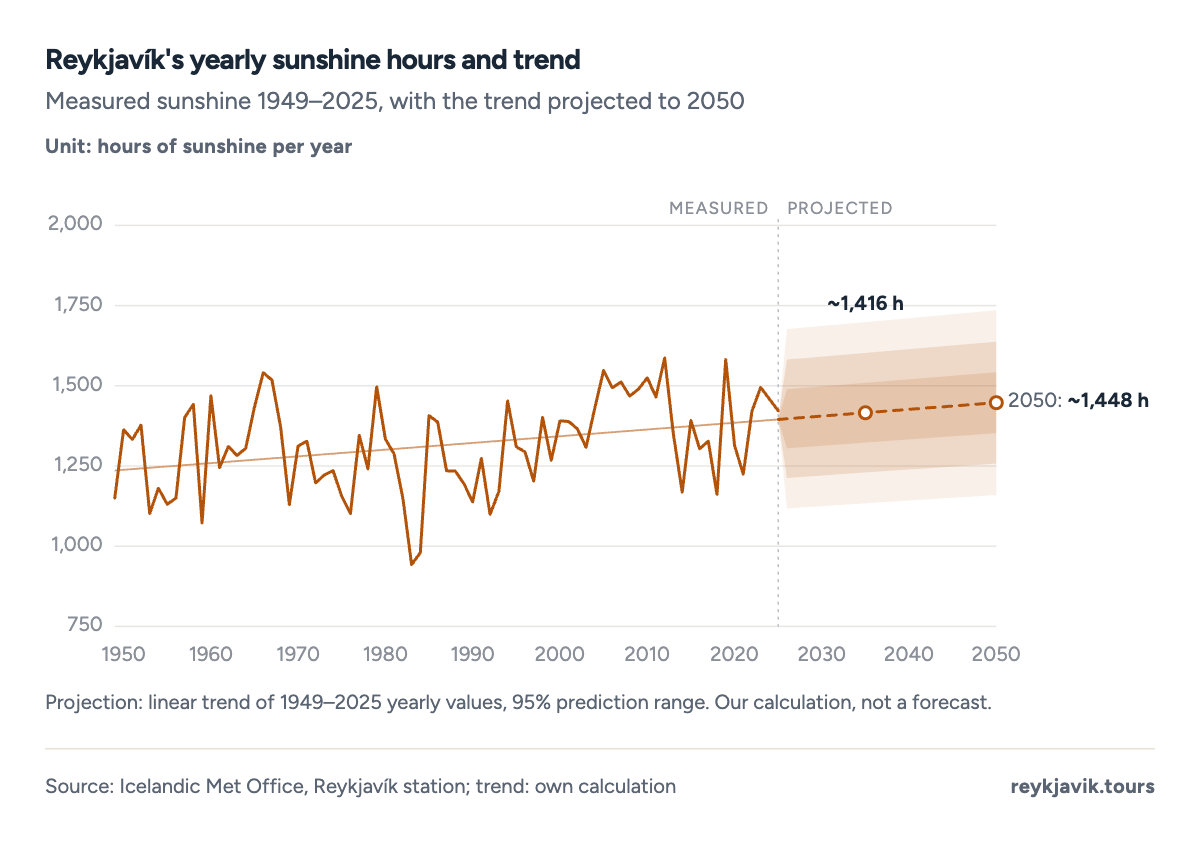
- The sunniest year was 2012 with 1,587 h.
- The least sunny was 1983 with 943 h.
| 2025 | 1,422.2 | - |
| 2024 | 1,459.3 | - |
| 2023 | 1,495.3 | 1257.1 |
| 2022 | 1,421.3 | 1191.2 |
| 2021 | 1,224.8 | 1291.1 |
| 2020 | 1,313.7 | 1278.8 |
| 2019 | 1,582.2 | 1070.4 |
| 2018 | 1,161.3 | 1016.4 |
| 2017 | 1,326.6 | 932.8 |
| 2016 | 1,303.6 | 1154.4 |
| 2015 | 1,392.0 | 897.2 |
| 2014 | 1,168.3 | 945.3 |
| 2013 | 1,350.2 | 1013.2 |
| 2012 | 1,587.1 | 1414.5 |
| 2011 | 1,465.1 | 979.1 |
| 2010 | 1,524.7 | 1096.7 |
| 2009 | 1,490.1 | 1050.9 |
| 2008 | 1,468.4 | 1089.1 |
| 2007 | 1,512.2 | 1057.9 |
| 2006 | 1,494.4 | 1034.0 |
| 2005 | 1,548.1 | 1095.9 |
| 2004 | 1,432.2 | 1052.1 |
| 2003 | 1,307.8 | 1024.9 |
| 2002 | 1,366.4 | 893.0 |
| 2001 | 1,389.1 | 1060.5 |
| 2000 | 1,391.4 | 1276.1 |
| 1999 | 1,268.5 | 1068.0 |
| 1998 | 1,402.5 | 1004.5 |
| 1997 | 1,202.9 | 915.5 |
| 1996 | 1,293.7 | 1063.8 |
| 1995 | 1,309.5 | 1011.2 |
| 1994 | 1,453.1 | 1026.2 |
| 1993 | 1,170.6 | 934.0 |
| 1992 | 1,099.1 | 930.0 |
| 1991 | 1,273.7 | 1144.2 |
| 1990 | 1,138.0 | 992.9 |
| 1989 | 1,195.1 | - |
| 1988 | 1,234.4 | - |
| 1987 | 1,235.3 | 1052.7 |
| 1986 | 1,387.0 | 1132.3 |
| 1985 | 1,406.8 | 979.7 |
| 1984 | 979.8 | 1039.0 |
| 1983 | 943.2 | 862.7 |
| 1982 | 1,149.4 | 1025.5 |
| 1981 | 1,288.5 | 886.5 |
| 1980 | 1,334.3 | 1109.4 |
| 1979 | 1,496.6 | 871.8 |
| 1978 | 1,240.7 | 1161.1 |
| 1977 | 1,345.6 | 1144.8 |
| 1976 | 1,101.9 | 1260.2 |
| 1975 | 1,156.4 | 1257.4 |
| 1974 | 1,235.6 | 1126.5 |
| 1973 | 1,222.2 | 1162.1 |
| 1972 | 1,197.4 | 934.2 |
| 1971 | 1,327.4 | 1075.0 |
| 1970 | 1,312.1 | 1043.9 |
| 1969 | 1,129.8 | 994.6 |
| 1968 | 1,371.4 | 1146.0 |
| 1967 | 1,518.0 | 1072.8 |
| 1966 | 1,541.4 | 916.0 |
| 1965 | 1,433.2 | 1121.8 |
| 1964 | 1,305.1 | 1033.8 |
| 1963 | 1,283.2 | 966.8 |
| 1962 | 1,310.8 | 944.1 |
| 1961 | 1,245.1 | 976.9 |
| 1960 | 1,468.7 | 1068.3 |
| 1959 | 1,072.7 | 920.3 |
| 1958 | 1,442.5 | 954.0 |
| 1957 | 1,401.4 | 1057.6 |
| 1956 | 1,149.9 | 782.5 |
| 1955 | 1,130.7 | 1128.0 |
| 1954 | 1,180.9 | 831.0 |
| 1953 | 1,102.1 | 960.5 |
| 1952 | 1,377.1 | 960.5 |
| 1951 | 1,333.0 | - |
| 1950 | 1,363.3 | - |
| 1949 | 1,149.8 | - |
Iceland cloud cover by month
Clouds explain most of the missing sunshine. Averaged across 30 Met Office weather stations for 1991–2020, cloud cover sits between 5.93 and 6.2 oktas3 in every month, meaning roughly three-quarters of the sky is covered on average whatever the season. The long light of summer and the short days of winter change far more than the clouds do.
- 6.2JanJ
- 6.1FebF
- 6.1MarM
- 6.0AprA
- 6.0MayM
- 5.9JunJ
- 6.2JulJ
- 6.1AugA
- 6.2SepS
- 6.2OctO
- 6.1NovN
- 6.1DecD
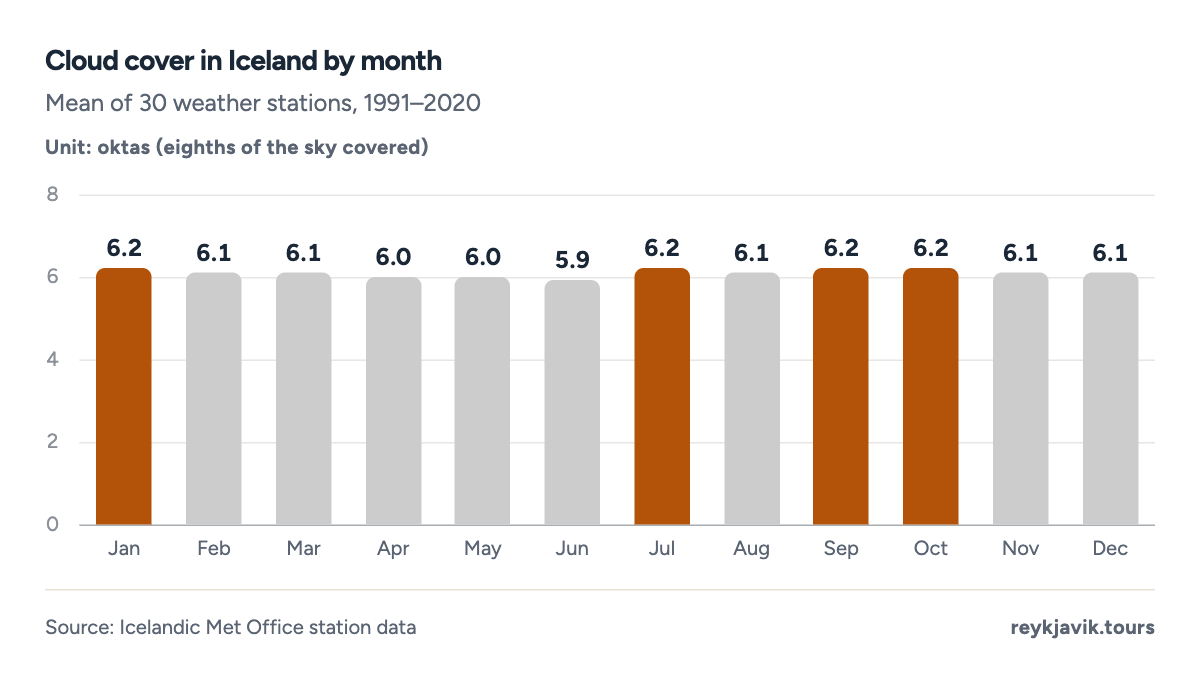
- Cloud cover never drops below 5.9 oktas.
- September averages 6.2 oktas.
| January | 6.16 | 5.95 |
| February | 6.09 | 5.91 |
| March | 6.13 | 5.88 |
| April | 5.99 | 5.74 |
| May | 5.96 | 5.73 |
| June | 5.88 | 5.98 |
| July | 6.17 | 6.09 |
| August | 6.14 | 5.96 |
| September | 6.19 | 6.01 |
| October | 6.18 | 5.71 |
| November | 6.09 | 5.7 |
| December | 6.07 | 5.78 |
How many hours ahead is Iceland
Iceland's clock has followed Greenwich Mean Time all year since 1968. The Act on time reckoning in Iceland states that hours are counted "all year round according to Greenwich mean time",4 and the country has not used daylight saving time since. Before 1968 the clock was moved forward in summer; the change made the summer time permanent.2
How many time zones in Iceland
Iceland has one time zone for the whole country, UTC+0. By its longitude it would belong in the zone one hour further west, UTC−1, and the government's 2018 report notes that this is why the sun is highest over Reykjavík at about 13:302 rather than 12:30. Our calculation puts solar noon in Reykjavík between 13:131 and 13:421 across the year. The report weighed moving the clock back an hour, keeping it, or starting schools later, and linked the late clock to shorter sleep among young people.2
How many hours ahead is Iceland from New York
Iceland is 5 hours5 ahead of New York in winter. Because the US moves its clocks forward from 8 March5 to 1 November5 in 2026 and Iceland does not, the gap shrinks to 4 hours5 for most of the year.
How many hours ahead is Iceland from Chicago
Chicago is 6 hours5 behind Iceland in winter and 5 hours5 behind during US daylight saving time. Denver is 75 and 6 hours5 behind.
How many hours ahead is Iceland from California
California is 8 hours5 behind Iceland in winter and 7 hours5 behind in summer. Europe works the other way: when the EU moves to summer time from 29 March6 to 25 October6 in 2026, cities such as Oslo and Berlin move a further hour ahead of Iceland.
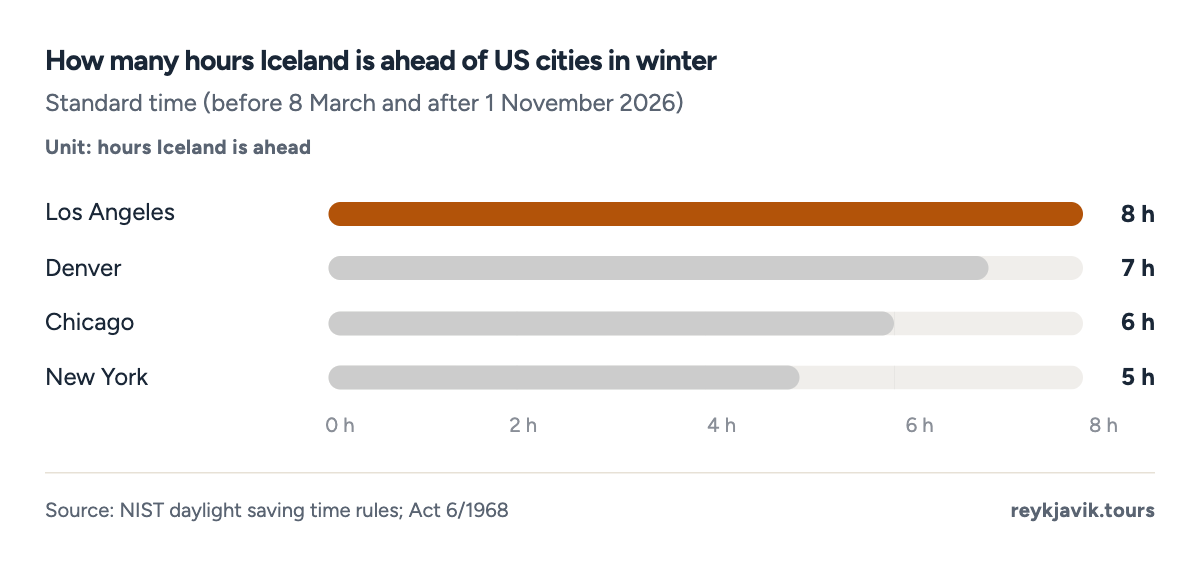
- Iceland is 8 h ahead of Los Angeles.
- It is 5 h ahead of New York.
| New York | +5 | +4 | 8 Mar – 1 Nov |
| Chicago | +6 | +5 | 8 Mar – 1 Nov |
| Denver | +7 | +6 | 8 Mar – 1 Nov |
| Los Angeles | +8 | +7 | 8 Mar – 1 Nov |
| Oslo | −1 | −2 | 29 Mar – 25 Oct |
| Berlin | −1 | −2 | 29 Mar – 25 Oct |
- 37JanJ
- 42FebF
- 37MarM
- 28AprA
- 24MayM
- 28JunJ
- 34JulJ
- 33AugA
- 23SepS
- 13OctO
- 13NovN
- 23DecD
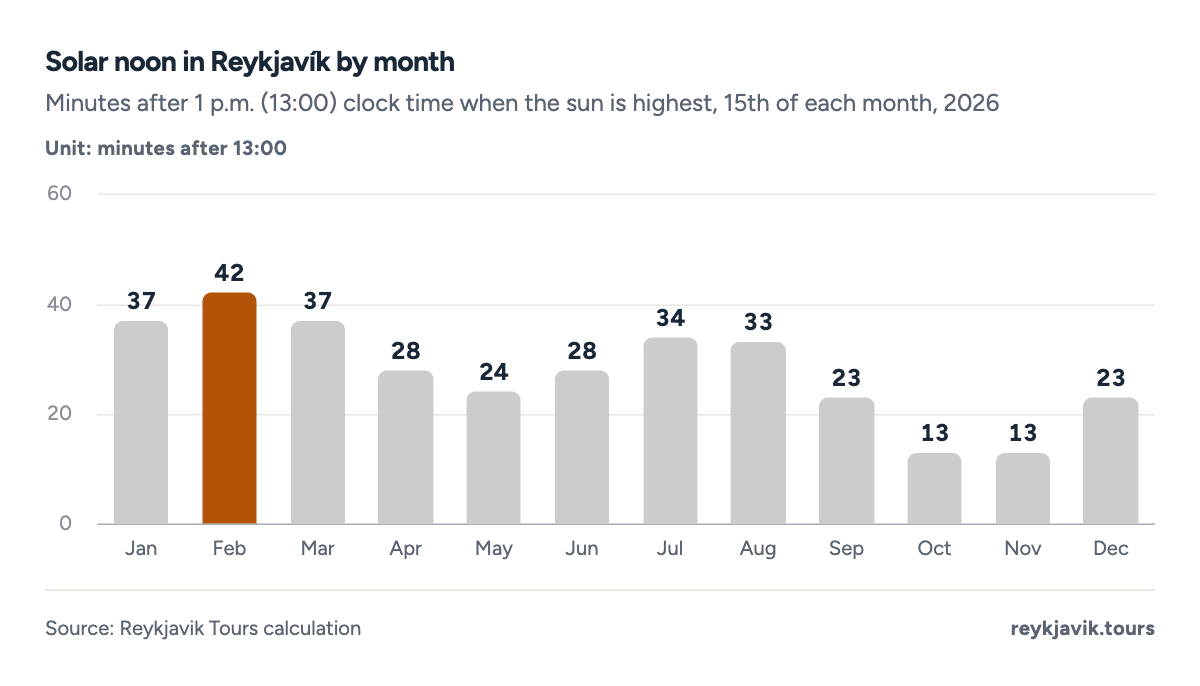
- Solar noon comes latest in February, at 13:42.
- It comes earliest in November, at 13:13.
Should Iceland turn its clock back?
Iceland used summer time on and off from 19172 and without a break from 19392 to 1968, when it chose to keep the summer clock all year. The 2018 report says the reasons were mainly commercial: being closer to Europe in time and making better use of daylight in waking hours, with dark winter mornings judged a smaller cost than light afternoons.2
A working group set up by the health minister argued the opposite in January 2018. It reported that most Icelandic teenagers are short of 2–3 hours2 of the sleep they need, and that Icelanders go to bed later and sleep less than people in neighbouring countries.2 Using the University of Iceland almanac, it estimated what turning the clock back one hour would change: hours of light in the morning would rise by 13%2 in the far west, and winter mornings that are light at 9 a.m. would increase by 642. The cost would be 3–4%2 fewer light hours across adults' waking day from 7 a.m. to 11 p.m., and 13%2 fewer between 3 p.m. and 9 p.m., mostly in April and August. The government's report put three options up for public discussion: keep the clock and encourage earlier bedtimes, move the clock back one hour, or keep it and start schools and workplaces later.2 The 1968 law is still in force.4
| Hours of light in the morning, far west of Iceland | +13% |
| Winter mornings light at 9 a.m. | +64 mornings |
| Hours of light in adults' waking day (7 a.m.–11 p.m.) | −3% to −4% |
| Hours of light 3 p.m.–9 p.m. | −13% |
What the daylight means for a trip
For travellers, Iceland's daylight shapes the day more than the temperature does. In mid-December the sun is up in Reykjavík from about 11:161 to 15:301, which leaves a few hours for driving and sightseeing in daylight; twilight stretches that to about 6 h 50 min1. Winter plans work best with short drives and the most important stops in the middle of the day.
From May to July the problem is the opposite: light lasts through the night, and in mid-June the sun sets in Reykjavík at 23:591. Days can be as long as energy allows, but sleep can suffer without dark curtains. And whatever the season, the clock runs about an hour ahead of the sun, so mornings are darker and evenings brighter than a visitor from elsewhere at the same latitude would expect.
Conclusions
- Iceland has no polar night and no endless summer sun on the mainland. Reykjavík's day swings between 4 h 07 min1 and 21 h 10 min1, and only Grímsey, on the Arctic Circle, gets true midnight sun, for 32 days1.
- Latitude inside Iceland matters more in winter than in summer. On the shortest day Vík has 4 h 31 min1 of daylight and Grímsey 2 h 12 min1, while over a whole year the towns end up within about 100 hours1 of each other.
- Light is plentiful, sunshine is not. Reykjavík's sun shines for at most about 36.6%3 of possible daylight in any month, and cloud cover stays near three-quarters of the sky all year.
- Iceland's clock runs about an hour ahead of the sun. A law from 1968 keeps Greenwich Mean Time all year, so solar noon in Reykjavík falls around 13:302, winter mornings stay dark late, and the time difference to the US changes twice a year even though Iceland's clock never moves.
Methodology
- Daylight for 2026
- 7 Icelandic towns, 5 other cities
- Sunshine 1949–2025
- Checked Sept 16, 2026
Definition. Daylight is the time between sunrise and sunset, when the top of the sun is above a flat horizon (sun centre 0.833° below the horizon, including refraction). Usable light adds civil twilight, until the sun is 6° below the horizon. Sunshine hours are hours of direct sunshine measured at weather stations. Times are local clock time, which in Iceland is UTC all year.
Data sources. Day length, sunrise and sunset calculated with NOAA's solar position equations,1 checked against the University of Iceland almanac table printed in the Government of Iceland's 2018 report on standard time.2 Measured sunshine and cloud cover from the Icelandic Met Office's monthly station values.3 Time zone from the Act on time reckoning in Iceland,4 US daylight saving dates from NIST5 and EU summer time from Directive 2000/84/EC.6
Calculations. For every day of 2026 and each place, sunrise, sunset and solar noon come from the solar declination and equation of time at local noon. Monthly figures use the 15th of the month. The yearly split adds daylight, civil twilight and the remaining hours over 365 days. Sunshine share divides measured monthly sunshine (1991–2020 average) by the hours the sun is above the horizon in that month.
Limitations. Calculations assume a flat horizon at sea level; mountains shorten the day in fjords and valleys, so places like Ísafjörður see less sun than calculated. Sunshine figures cover only the Reykjavík and Akureyri stations. Times can differ by a minute or two from other almanacs. The sunshine trend is a straight-line extrapolation, not a forecast.
Sources
- Reykjavik Tours research. “Sunrise, sunset and day length for Icelandic towns, 2026 (NOAA solar position equations).” Reykjavik Tours. gml.noaa.gov. Accessed 16 Sept. 2026. Back to text
- Stjórnarráð Íslands (Government of Iceland). “Staðartími á Íslandi: stöðumat og tillögur (Standard time in Iceland: assessment and proposals), with the Almanak Háskóla Íslands light-hours table.” Stjórnarráð Íslands, Dec. 2018. samradapi.island.is. Accessed 16 Sept. 2026. Back to text
- Veðurstofa Íslands (Icelandic Met Office). “Mánaðargildi veðurstöðva (monthly values for weather stations).” Veðurstofa Íslands. vedur.is. Accessed 16 Sept. 2026. Back to text
- Alþingi. “Lög um tímareikning á Íslandi nr. 6/1968 (Act on time reckoning in Iceland).” Alþingi, 5 Apr. 1968. althingi.is. Accessed 16 Sept. 2026. Back to text
- National Institute of Standards and Technology. “Daylight Saving Time.” NIST. nist.gov. Accessed 16 Sept. 2026. Back to text
- European Parliament and Council. “Directive 2000/84/EC on summer-time arrangements.” EUR-Lex, 19 Jan. 2001. eur-lex.europa.eu. Accessed 16 Sept. 2026. Back to text
About the author
Laufey turns public statistics on tourism and travel into research people can check and cite.
Every figure on this page links to its source. How we research
Related research
More data on Iceland's weather and travel from Reykjavik Tours.
- WeatherHow Much Snow Does Iceland Get? (2026 Data)55 days a year with snow on the ground in ReykjavíkRead the research →
- WeatherIceland Temperature by Month (2026 Data)39 °F average temperature in IcelandRead the research →
- WeatherIceland Weather by Month (2026 Data)4.5 in rain in September, Iceland's wettest monthRead the research →
- WeatherAverage Wind Speed in Iceland (2026 Data)5.2 m/s average wind speed in IcelandRead the research →
- Travel planningHow Often Can You See the Northern Lights in Iceland? (2026 Data)~50% chance of aurora on any dark-season nightRead the research →
- TravelHow Many Days in Iceland? (2026 Data)7.1 nights average stay of foreign visitorsRead the research →