Crime Rate of Iceland (2026 Data)
The crime rate of Iceland: 2,182 recorded offences per 100,000 people in 2024 - with murders per year, police, prisons, guns and tourist safety.
- Published
- Updated
- 9 sources
- 6 statistics
- 10 min read

- M.Sc. in Atmospheric Sciences, University of Iceland (Háskóli Íslands), with a minor thesis on North Atlantic storm-track variability
- Former research assistant at the Icelandic Meteorological Office (Veðurstofa Íslands), working on subarctic climate modeling and volcanic-ash dispersion forecasting
- B.A. in Sociology, also from the University of Iceland, with fieldwork on rural depopulation and tourism's impact on small fishing communities (Westfjords focus)
- Grew up in Akureyri, spent seven years living in Reykjavík and two in a small village in the Westfjords - brings first-hand experience of Iceland's regional weather extremes and community life
- Fluent in Icelandic and English; has translated Icelandic Met Office public advisories for international outlets
- Published field notes and data-driven pieces on glacier retreat (Vatnajökull), aurora forecasting, and the socioeconomic effects of overtourism in the Golden Circle

- M.A. in Journalism, University of Iceland, with additional coursework in Environmental Communication at the University of Bergen (Norway), giving a comparative Nordic lens
- 12+ years in Icelandic media, including editorial roles at RÚV (Iceland's national broadcaster) covering weather-related public safety reporting (storms, volcanic eruptions, road closures)
- Former fact-checking lead for a travel-and-culture desk, specializing in verifying tourism statistics, safety advisories, and climate data against primary sources (Vedur.is, Statistics Iceland)
- Has overseen editorial standards for bilingual (Icelandic/English) publications, ensuring both cultural nuance and accuracy for international readers
- Advocate for citing primary sources (Icelandic Met Office, Icelandic Tourist Board / Ferðamálastofa) rather than secondhand reporting
Key findings
- 2,182The crime rate of Iceland is 2,182 recorded offences per 100,000 people (2024).
- 2.4Iceland averages 2.4 murders per year - 41 homicides in 17 years, 7 of them in 2024.
- #1Iceland ranks #1 of 163 countries in the Global Peace Index, 17 years running.
- 140Iceland's prisons hold about 140 inmates in total, spread across five facilities.
- 31.7Iceland's gun ownership is 31.7 guns per 100 residents - high for Europe, rare in crime.
- 8Road deaths in Iceland fell to 8 in 2023 from a record 32 in 2000.
Iceland has been ranked the most peaceful country on Earth for 17 years in a row - #1 of 163 nations in the Global Peace Index1 - yet it still books roughly 8,400 recorded offences a year2. That mix is the real answer to how safe Iceland is: violent crime is rare enough that a single murder makes national news, while the everyday offences that fill the register are thefts, drug cases and burglaries that a visitor will almost certainly never notice.
This page counts Icelandic crime the way the police record it: the overall crime rate per 100,000 people and its 17-year trend, the homicides behind the "murders per year" headlines, the size of the police force and the prison system, how many guns Icelanders hold, and the fines and road risks that a tourist is statistically far more likely to meet than any criminal.
What is the crime rate of Iceland?
The crime rate of Iceland is 2,182 recorded offences per 100,000 people in 2024, according to police-recorded offences compiled by Eurostat3. That figure is the sum of the top-level offence categories - theft, drug offences, burglary, fraud, sexual violence and the rest - divided by the population. It has fallen by about a third since the 2009 peak of 3,302 per 100,000, and the long trend is still gently downward2.
What does that number mean in everyday terms? Out of every 100,000 residents, about 2,182 offences are recorded in a year - but these are offences, not offenders: many cases are attempted, minor or unsolved, and one person can account for several. The table below shows the whole series. The 2009 peak is no coincidence: it followed the financial crash, when policing and prosecutions surged; the steady decline since is partly better prevention and partly the gradual digitalisation of property crime away from the official statistics2.
If you ask how much crime is in Iceland compared with Europe, the honest framing is "lower than most, close to the Nordic average" - Iceland's property-crime rate sits below Sweden's and Denmark's, and its violence levels are far below theirs3. There is no neighborhood in Reykjavik a visitor needs to avoid for safety reasons; pickpocketing at hot springs and wet-wind car-door dents are the classic tourist "crimes" here4.
Projection: linear trend of 2008–2024 yearly values, 95% prediction range. Our calculation, not a forecast.
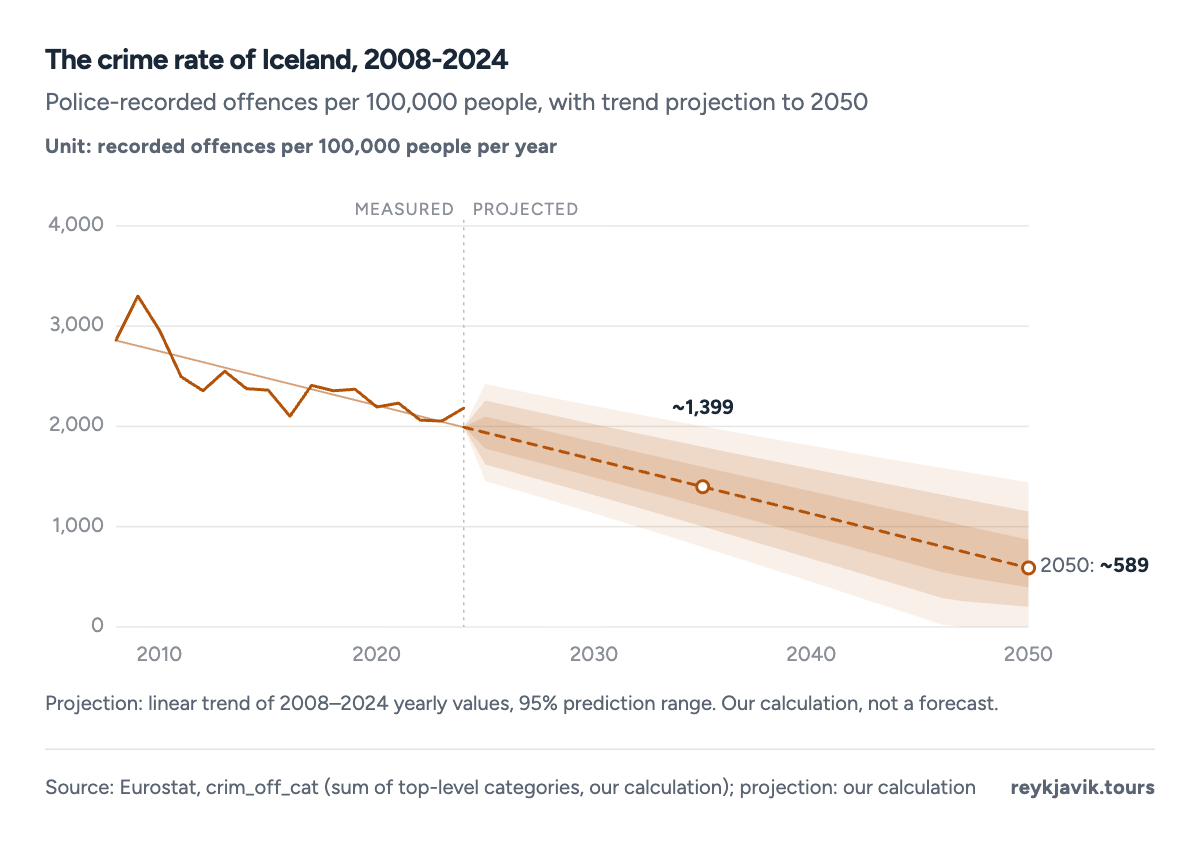
- The crime rate peaked at 3,302 offences per 100,000 people in 2009.
- In 2024 the rate was 2,182 per 100,000 - about a third below the 2009 peak.
- The trend projection falls below 1,500 per 100,000 by 2050 - our calculation, not a forecast.
Iceland crime rate percentage and per capita
In percentage terms, 2,182 recorded offences per 100,000 people works out to about 2.2% - meaning roughly two recorded offences for every 100 residents each year2. That is the per-capita reading people usually want: Iceland crime rate per capita is about 0.022 offences per person annually, or one recorded offence for every 45 Icelanders3.
Per-capita comparisons need one caution, and it is a big one: countries record offences differently. Iceland's register is considered unusually complete and inclusive - minor drug possessions and attempted thefts all enter it - while some countries record only reported crimes or apply thresholds. So Iceland at 2,182 per 100,000 is not directly comparable with, say, a US state at 2,500: the borders of "an offence" differ. Within the Nordics, where recording practice is similar, comparisons are meaningful - and there Iceland looks ordinary, as the next sections show2.
What the per-capita view does show clearly is scale. With 393,000 residents, Iceland's entire annual offence book - about 8,400 cases - would be a mid-sized day's workload for a single large European city's police force2.
Iceland murders per year
The annual murder count averages about 2.4 - 41 homicides were recorded across the 17 years from 2008 to 2024, our calculation from Eurostat's homicide count and the official population3. How many murders in Iceland happened in a single year ranged from zero (2008) to seven (2024), the year that broke the series record3. The recent years run high: 4 in 2022, 5 in 2023, 7 in 2024 - a cluster that Icelandic police linked partly to organised-crime disputes, and which lifted the homicide rate to 1.82 per 100,000 in 20244.
The Iceland murder rate per year is better understood as a coin-flip series than a trend: with a population under 400,000, every single killing adds about 0.26 to the per-100,000 rate, so one violent year can triple the statistic. That is why the 2024 "record" and the calm years around 2019 (one homicide) both deserve a pinch of salt - the underlying level is somewhere around two to three cases a year2.
Each case gets a name in Icelandic media, a trial, and typically a sentence of 5-16 years - there is no death penalty and life imprisonment does not exist; the longest fixed sentences run to about 16 years with post-custodial supervision4. The table below lists every year since 2008.
Projection: linear trend of 2008–2024 yearly values, 95% prediction range. Our calculation, not a forecast.
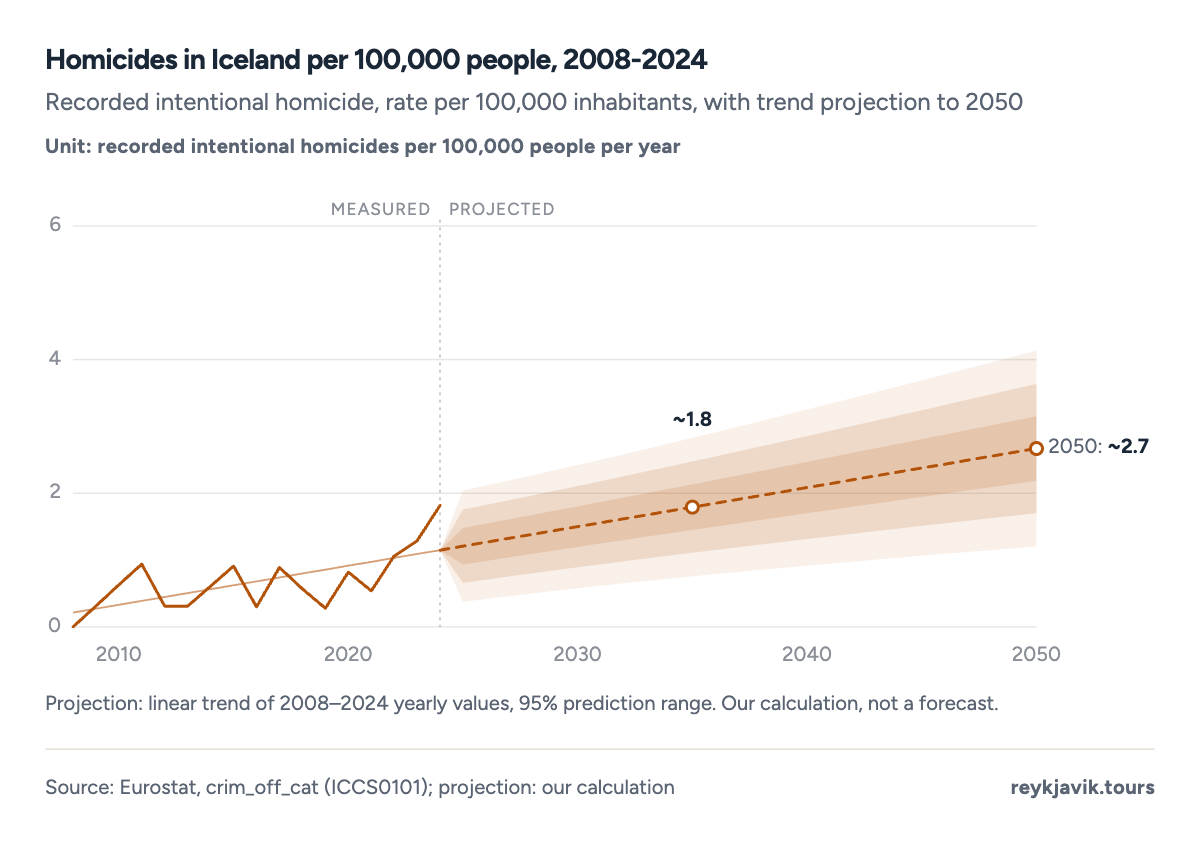
- Iceland recorded zero homicides in 2008 and its series high of 1.82 per 100,000 in 2024.
- With a population under 400,000, each single homicide moves the rate by about 0.26.
- The 95% projection band is wide - in a small country, one year says little.
| 2008 | 0.0 | 0.00 |
| 2009 | 1.0 | 0.31 |
| 2010 | 2.0 | 0.63 |
| 2011 | 3.0 | 0.94 |
| 2012 | 1.0 | 0.31 |
| 2013 | 1.0 | 0.31 |
| 2014 | 2.0 | 0.61 |
| 2015 | 3.0 | 0.91 |
| 2016 | 1.0 | 0.30 |
| 2017 | 3.0 | 0.89 |
| 2018 | 2.0 | 0.57 |
| 2019 | 1.0 | 0.28 |
| 2020 | 3.0 | 0.82 |
| 2021 | 2.0 | 0.54 |
| 2022 | 4.0 | 1.06 |
| 2023 | 5.0 | 1.29 |
| 2024 | 7.0 | 1.82 |
Is crime in Iceland rising or falling?
Both, depending on which line you read. The overall rate is falling: from 3,302 offences per 100,000 people in 2009 to 2,182 in 2024, a decline of about a third, and the trend projection continues gently downward3. The biggest crime in Iceland by volume - theft - has more than halved since 2009, from over 1,900 to about 1,000 offences per 100,000 people, a fall that mirrors what happened across Northern Europe as cash and unlocked bicycles disappeared from daily life3.
At the same time, two categories moved against the trend. Recorded sexual violence rose to 145 per 100,000 people in 2024 - driven largely by wider definitions, the 2018 consent-law reform and higher reporting willingness rather than by evidence of more violence, researchers caution4. And the drug-offence rate of about 459 per 100,000 stays stubbornly high for a country of 393,000, keeping Icelandic customs and police busy at Keflavik3.
The honest summary: Iceland is getting safer on property crime, flat-to-up on recorded sexual offences for definitional reasons, and freshly noisy on homicide because of the 2022-2024 cluster. None of it changes the everyday picture - the categories a visitor can actually influence (theft of an unattended bag, a rental-car break-in) are small, well-policed and rarely violent2.
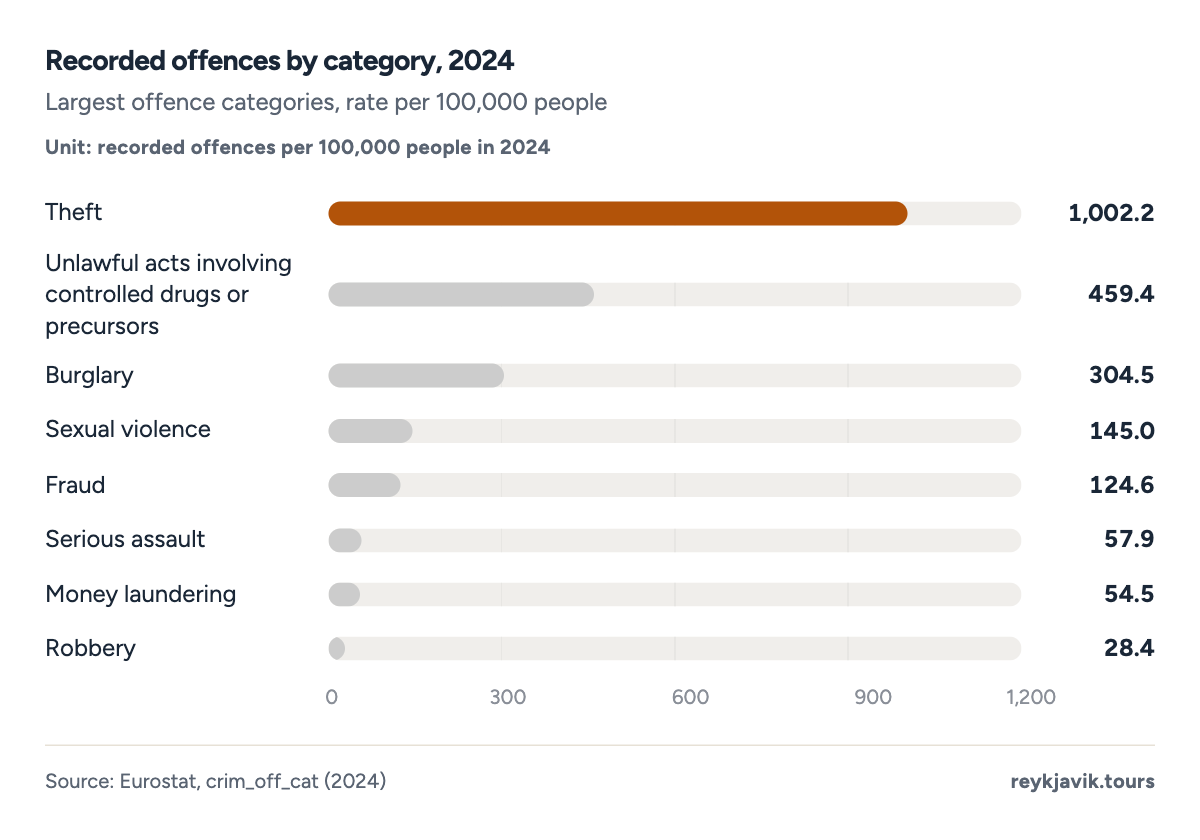
- Theft dominates with 1,002 offences per 100,000 people - about 3,844 cases in 2024.
- Drug offences follow at 459 per 100,000, then burglary at 305.
- Serious violent categories are small: robbery is 28 per 100,000.
- Theft45.9%45.9%
- Drug offences21.1%21.1%
- Burglary14.0%14%
- Sexual violence6.6%6.6%
- Other12.4%12.4%
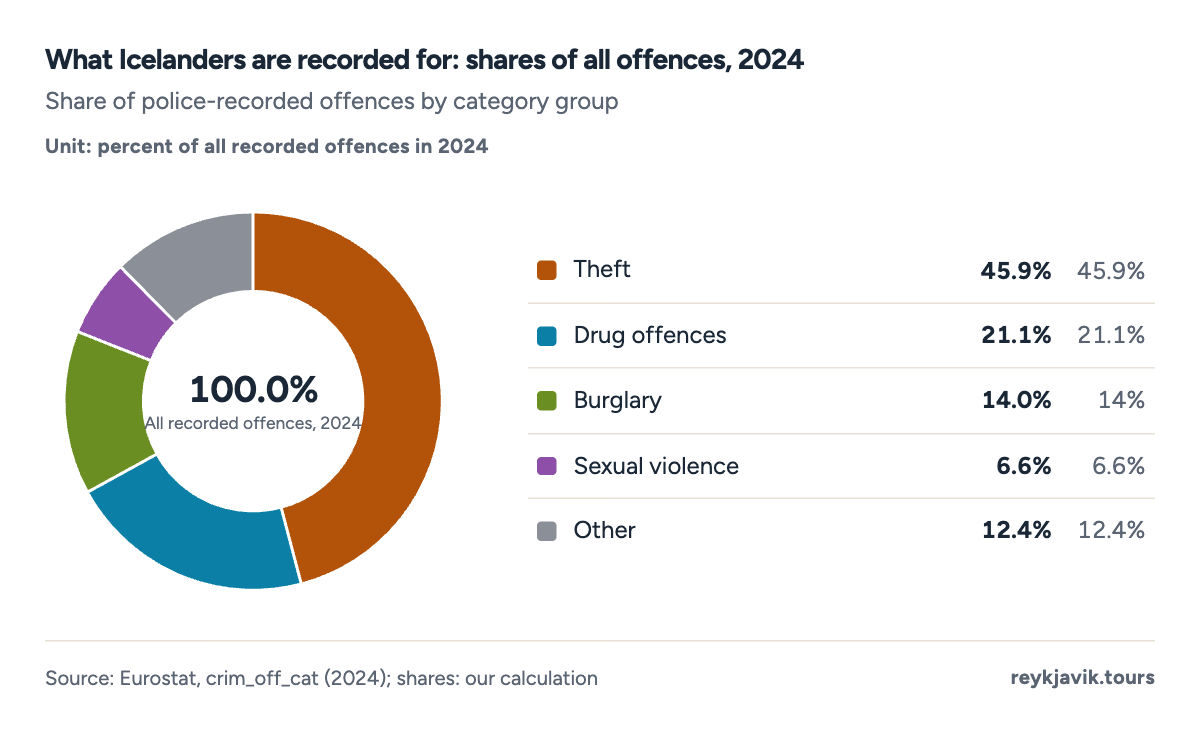
- Theft alone makes up 45.9% of all recorded offences in Iceland.
- Property and drug offences together account for over four in five recorded offences.
| Theft | 1,002.2 | 3,844 |
| Unlawful acts involving controlled drugs or precursors | 459.4 | 1,762 |
| Burglary | 304.5 | 1,168 |
| Sexual violence | 145.0 | 556 |
| Fraud | 124.6 | 478 |
| Serious assault | 57.9 | 222 |
| Money laundering | 54.5 | 209 |
| Robbery | 28.4 | 109 |
Iceland homicide rate per year: the Nordic neighbourhood
Compared with its Nordic neighbours, Iceland's homicide rate tells the same story in five bars: 1.29 per 100,000 in 2023, against Sweden's 1.15, Finland's 1.15, Denmark's 0.89 and Norway's 0.733. How many homicides in Iceland does that represent? Exactly five in 2023 - a number Sweden would record in a quiet weekend2.
The Nordic comparison is the fairest one available: similar recording standards, similar legal systems, similar prosperity. It shows Iceland inside the family, not an outlier - slightly above the Norwegian-Danish level, roughly level with Sweden and Finland, and all five dramatically below the global average of about 5.8 per 100,000 that the UN reports for reference4. Two of the last three years (2023, 2024) put Iceland at the top of the Nordic table, which says more about small-number randomness than about a Danish-style gap opening up2.
Why do tiny countries look bad in per-capita crime rankings? Denominators. One additional homicide in Iceland moves the rate by 0.26 per 100,000; in Germany the same case moves it by 0.001. Any single-year ranking of countries under a million people is mostly arithmetic noise, which is why this page always shows the multi-year series next to the ranking2.
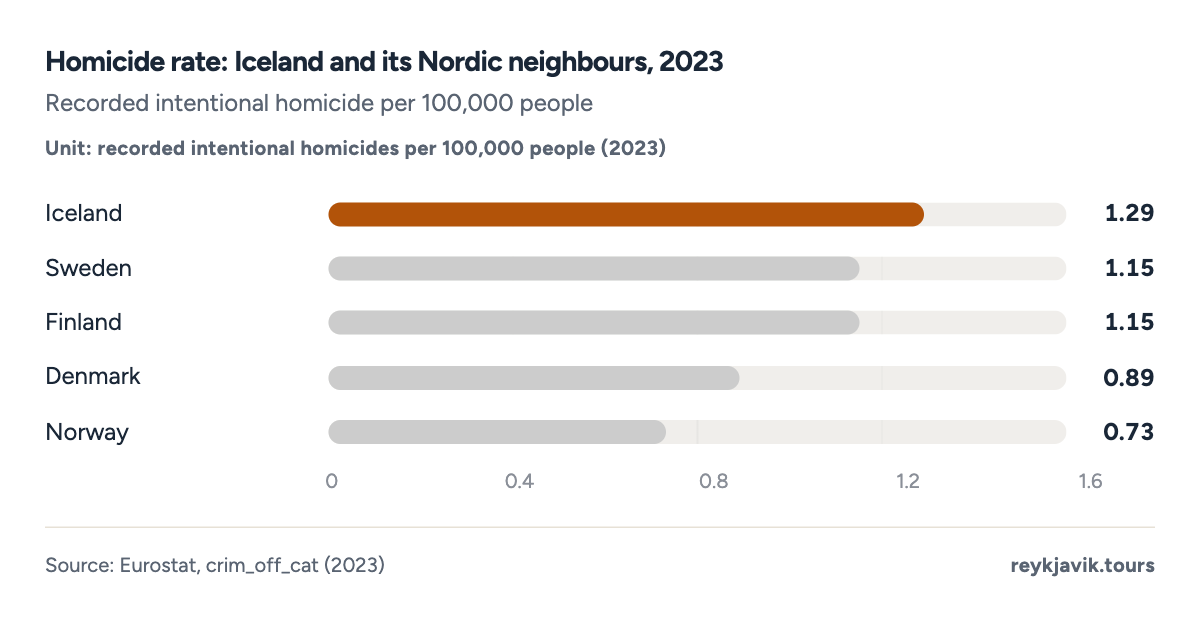
- Iceland's homicide rate in 2023 was 1.29 per 100,000 - the highest of the five Nordic countries.
- Norway, at 0.73 per 100,000, recorded the lowest rate among the Nordics.
| 2020 | 0.82 | 1.2 | 1.72 | 0.88 | 0.58 |
| 2021 | 0.54 | 1.09 | 1.7 | 0.72 | 0.54 |
| 2022 | 1.06 | 1.11 | 1.5 | 1.0 | 0.55 |
| 2023 | 1.29 | 1.15 | 1.15 | 0.89 | 0.73 |
| 2024 | 1.82 | 0.87 | 1.78 | 0.87 | 0.7 |
Police, prisons and the bankers
How many police in Iceland?
How many police in Iceland are on duty? Just over 700 sworn officers serve the whole country, with reserves called in for events - roughly one officer for every 550 residents6. The force hit about 786 employees in 2019 and dipped near 662 in 2020 after recruitment troubles; Eurostat's historic series shows 671-688 officers back in 2001-20073. How many police officers in Iceland carry weapons? None on regular patrol - Iceland's police are famously unarmed, with firearms locked in patrol cars and issued only by special authorisation6. How many cops are in Iceland per shift in Reykjavik on a Friday night is a different question - the capital region concentrates most of the force2.
How many prisons are in Iceland?
The count: five prisons - the closed institutions at Kvíabryggja and Akureyri, the women's prison at Sogn in Reykjavik, and the open prison at Holmsheidi, with Iceland's oldest prison, Litla-Hraun (opened 1929), closed in recent years7.
How many prisoners in Iceland?
The number: about 140 prisoners - the entire prison population of the country, against roughly 160 places, or about 36 prisoners per 100,000 residents, among the lowest rates in Europe7. For scale: the US imprisons about 14 times as many people per capita, and even the Nordic average runs near double Iceland's rate2.
How many bankers did Iceland jail?
Between 26 and 29 senior bankers and executives were sentenced by Icelandic courts - the most extensive prosecution of financial-crisis mismanagement anywhere in the world - with the 26 convictions counted by 2019 carrying a combined 74 years in prison4. Counts differ by source and cutoff date (29 by January 2016 by one tally), which is why the range is given rather than a single figure.
| Holmsheidi | Reykjavik area | Open prison, men |
| Sogn | Reykjavik | Prison for women |
| Kvíabryggja | Snæfellsnes, West Iceland | Closed prison |
| Akureyri | North Iceland | Closed prison |
| Litla-Hraun | South Iceland (Eyrarbakki) | Closed 2020s, Iceland's oldest prison |
| 2001 | 678 |
| 2002 | 678 |
| 2003 | 671 |
| 2004 | 679 |
| 2005 | 688 |
| 2006 | 683 |
| 2007 | 683 |
| 2019 | 786 |
| 2020 | 662 |
| 2024-25 | 700 |
Iceland gun ownership percentage
Iceland gun ownership percentage stands at 31.7 guns per 100 residents - an estimated 106,000 civilian-held firearms in the country, of which about 73,000 are on the official register8. How many guns in Iceland does that make in plain numbers? Roughly one firearm for every three people - high by European standards, and the reason the Small Arms Survey ranks Iceland among the world's top 15 civilian-armed nations8.
The paradox everyone asks about: guns are everywhere in Iceland, yet gun crime is nearly nonexistent. Firearms are overwhelmingly hunting rifles and shotguns held by licensed members of marksmanship associations; a licence requires a clean record, a medical check and an exam, and semi-automatic handguns are effectively banned8. Gun homicides are vanishingly rare - most years record none at all - and gun ownership per capita coexists with one of the world's lowest firearm-death rates4.
The comparison table shows where Iceland sits: just below Canada and Finland, well above the UK and Germany, and less than a third of the United States' rate8. Guns per capita Iceland keeps rising slightly - marksmanship club membership grew after each international success - but the ownership profile stays rural, licensed and long-gun-shaped2.
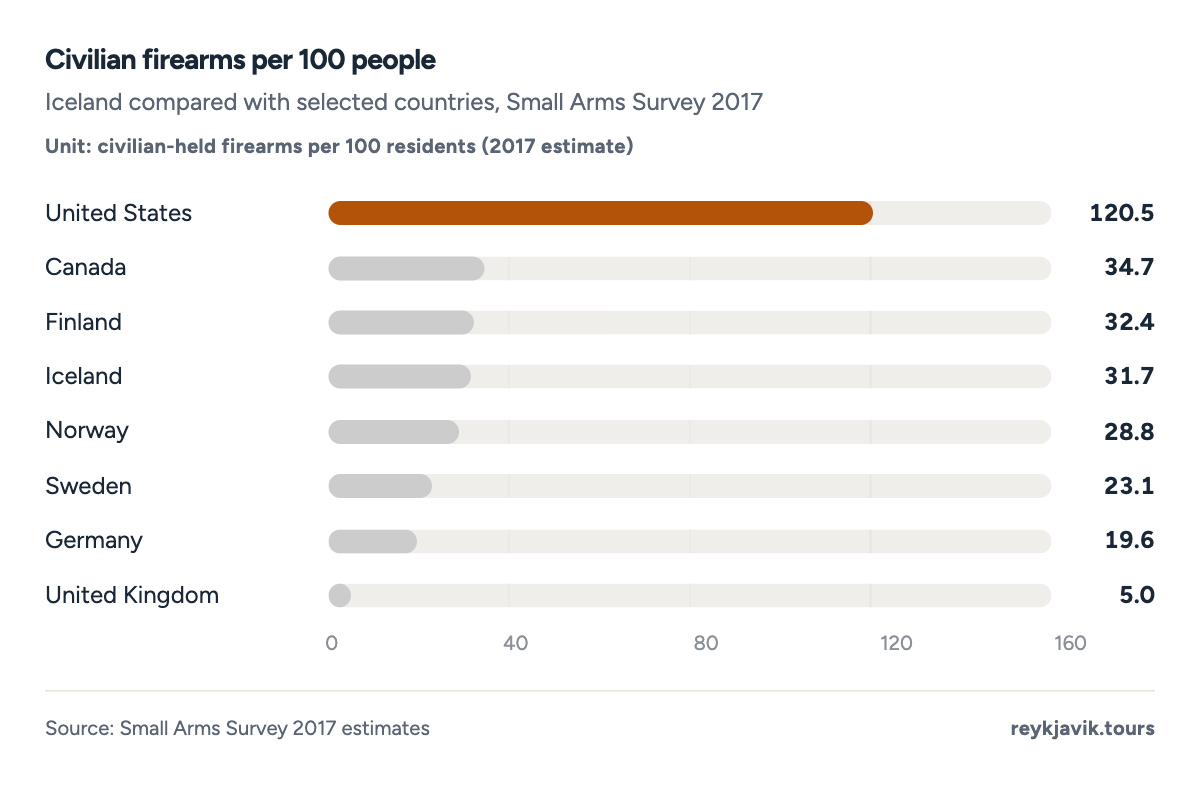
- Iceland's 31.7 guns per 100 residents put it just outside the world's top ten.
- The United States holds nearly four times as many firearms per person as Iceland.
- Among the Nordic countries only Finland (32.4) has a higher gun-ownership rate.
| United States | 120.5 |
| Canada | 34.7 |
| Finland | 32.4 |
| Iceland | 31.7 |
| Norway | 28.8 |
| Sweden | 23.1 |
| Germany | 19.6 |
| United Kingdom | 5.0 |
How much is a speeding ticket in Iceland?
The short answer: fines scale with how far over the limit you were caught, and the brackets rise steeply. Driving 26+ km/h over in a 30-35 zone costs at least ISK 40,000 - about $312; 36+ km/h over in a 50-60 zone starts at ISK 65,000 (~$506) and climbs; 41+ km/h over on an 80-90 rural road costs ISK 130,000-150,000 - roughly $1,013 to $1,1684. USD converted at ISK 128.37 = $1, the 2025 average rate of the Central Bank of Iceland2.
Two quirks of the Icelandic system matter to drivers:
- The schedule is the floor, not the bill: the official calculator at sektir.logreglan.is computes the exact income-linked amount per case4.
- Speeding is one of the few offences a tourist commits in Iceland more often than locals: single-lane ring-road monotony makes 41+ km/h over easy, and above 50 km/h over the limit police confiscate the licence on the spot4.
For perspective, speeding is not technically a "crime" in the register - it is an administrative violation - but the police issue tens of thousands of speeding sanctions a year on a road network that is only 12,900 km long. The chart below shows why rental companies preach cruise control2.
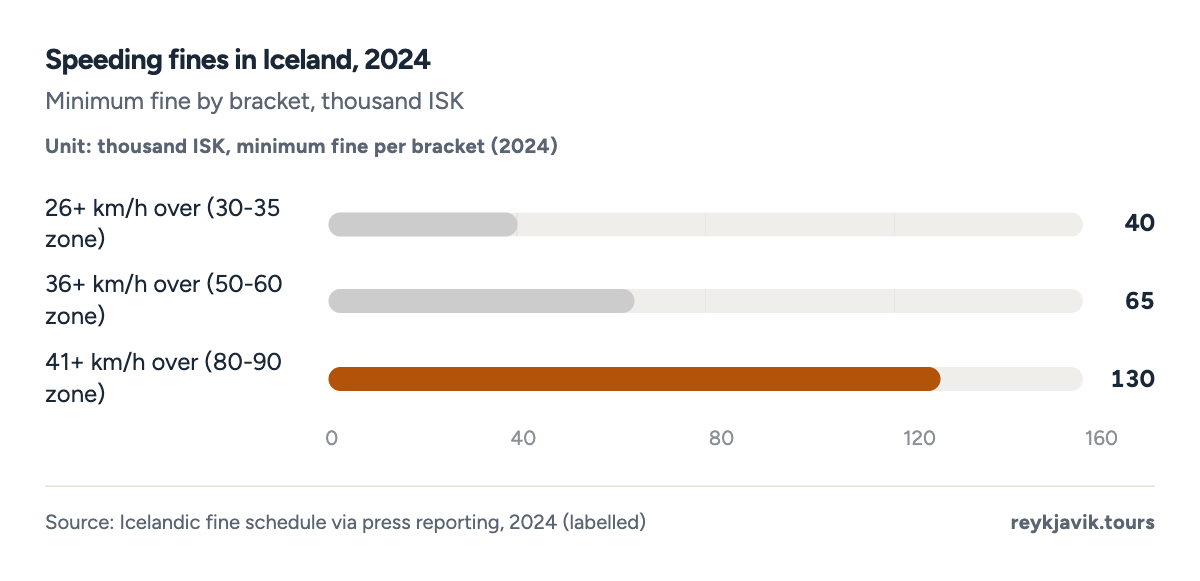
- Driving 41+ km/h over the limit on a rural road costs at least ISK 130,000 - about $1,013.
- Even the smallest listed bracket (26+ km/h over in a 30-35 zone) costs ISK 40,000 (~$312).
| 26+ km/h over (30-35 zone) | 40,000 | 312 |
| 36+ km/h over (50-60 zone) | 65,000 | 506 |
| 36+ km/h over (50-60 zone), high | 80,000 | 623 |
| 41+ km/h over (80-90 zone) | 130,000 | 1,013 |
| 41+ km/h over (80-90 zone), high | 150,000 | 1,168 |
Staying safe: tourists, black sand and the roads
How many tourists die in Iceland each year?
No official series exists, and the commonly quoted "about 25 a year" is an unofficial estimate, not a statistic - treat it as an order of magnitude only4. What is certain: the causes concentrate in nature, not crime - road accidents on gravel roads, drownings, and sweepings at the south coast's sneaker-wave beaches. Compared with roughly 2.3 million foreign visitors a year, even the high-end estimate is a rate of about one death per 90,000 visitors2.
How many people have died at Black Beach Iceland?
How many people have died at Black Beach Iceland - the famous Reynisfjara black sand beach? Six people have died there in wave incidents between 2007 and 2025, including a nine-year-old girl in August 2025, and more than a dozen other visitors have been rescued after being knocked down by sneaker waves4. Warning signs and a traffic-light closure system now operate at the beach. The simple rule is the entire survival manual: never turn your back on the ocean, and stay metres above the waterline4.
The roads: Iceland's real safety frontier
Roads are where Iceland's safety story is genuinely improving: 8 people died on Icelandic roads in 2023 and 13 in 2024, against a record 32 in 20009. The dead are overwhelmingly men (72.7% since 2015) and disproportionately over 65 - the age group with 13 of the 47 deaths of 2020-20249. For a visitor the pattern is specific: single-vehicle rollovers and head-on passes on gravel, in wind gusts that close the road signs every winter4.
Projection: linear trend of 1999–2024 yearly values, 95% prediction range. Our calculation, not a forecast.
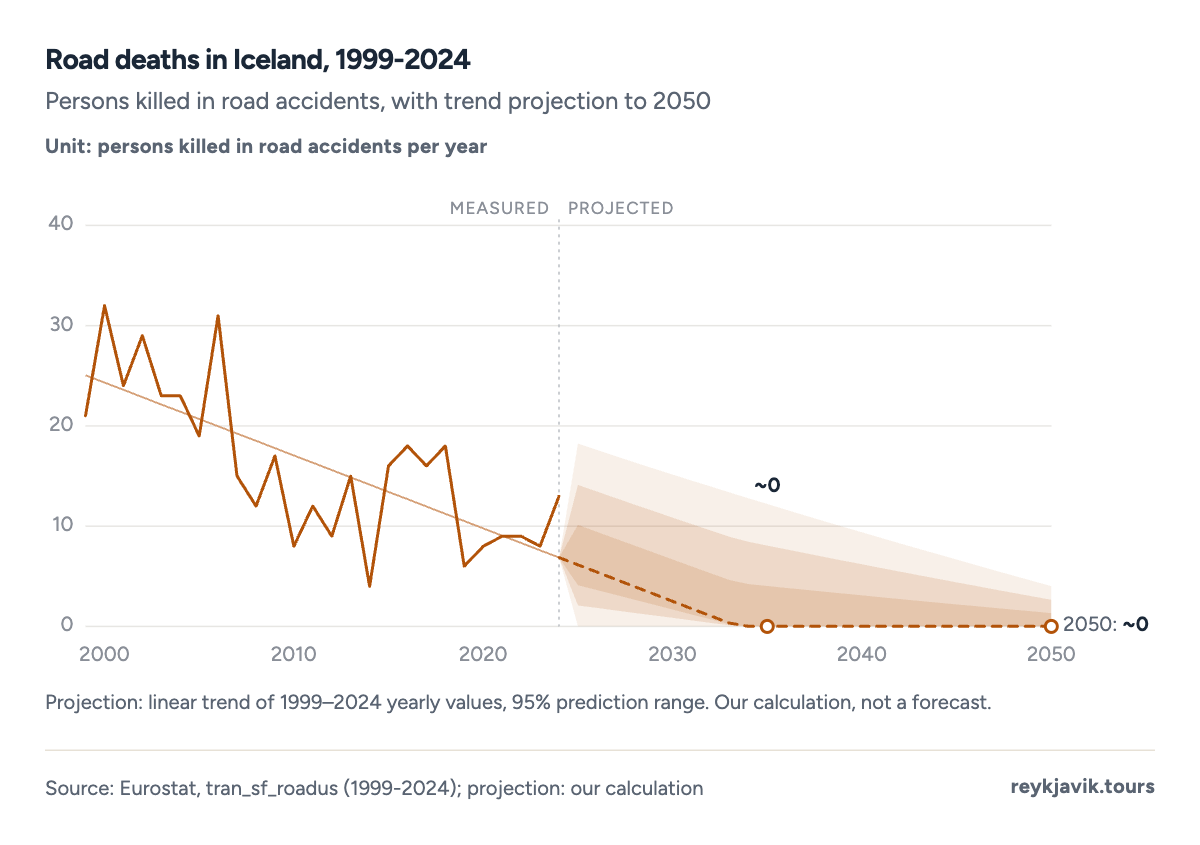
- The deadliest year was 2000 with 32 deaths; 2023 recorded 8.
- Deaths fell from about 23 a year in 1999-2007 to about 10 a year since 2019.
- The projection approaches single digits within a decade - our calculation, not a forecast.
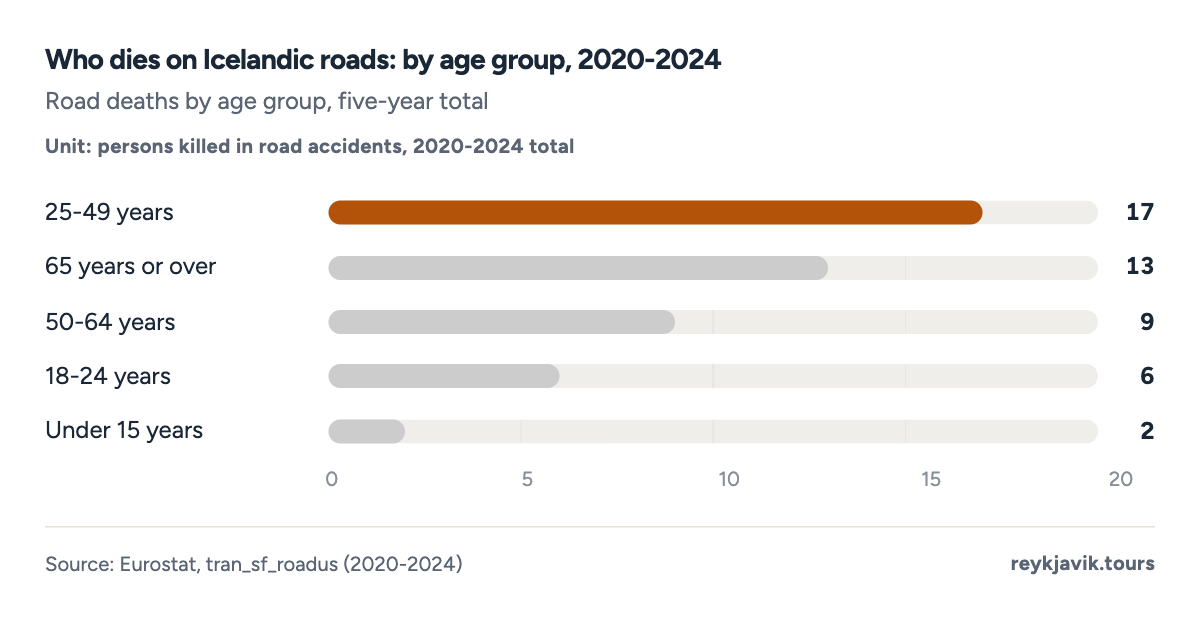
- Working-age adults (25-49) account for 17 of the 47 road deaths of 2020-2024.
- Drivers and passengers aged 65+ are the second-largest group, with 13 deaths.
- Men72.7%72.7%
- Women27.3%27.3%
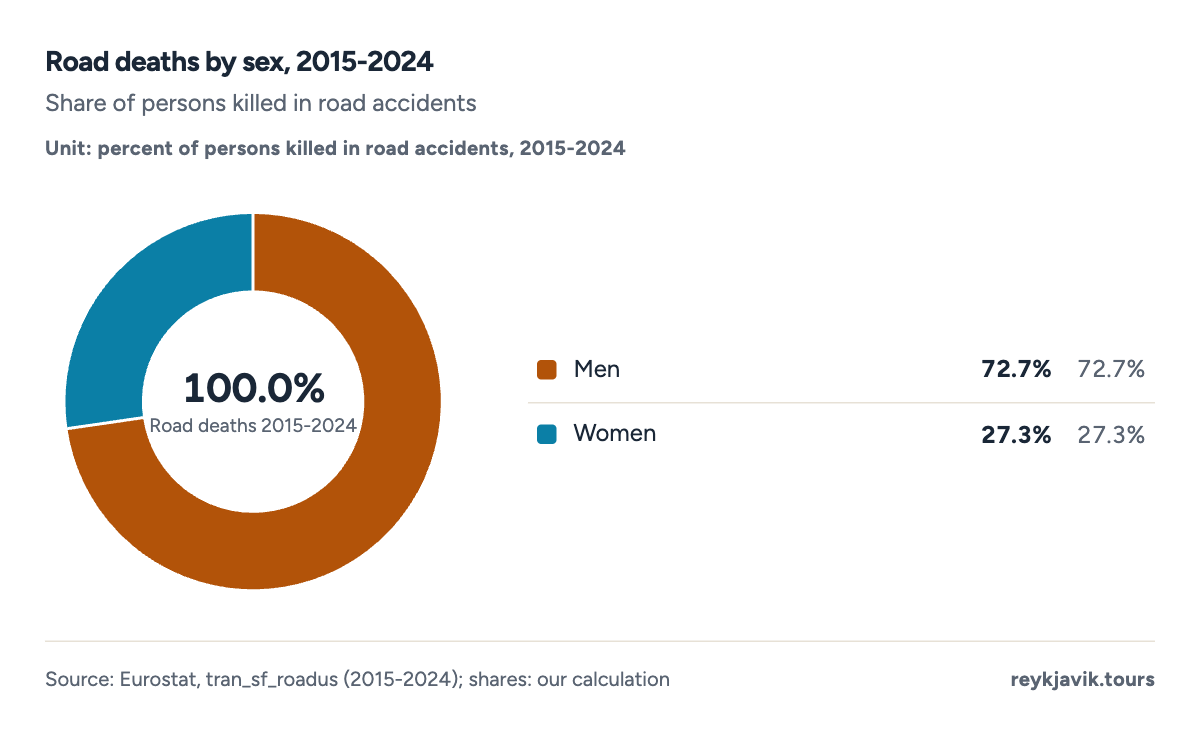
- Men account for 72.7% of road deaths - 88 of the 121 killed since 2015.
- Women made up the other 27.3% - 33 deaths in ten years.
| 1999 | 21.0 |
| 2000 | 32.0 |
| 2001 | 24.0 |
| 2002 | 29.0 |
| 2003 | 23.0 |
| 2004 | 23.0 |
| 2005 | 19.0 |
| 2006 | 31.0 |
| 2007 | 15.0 |
| 2008 | 12.0 |
| 2009 | 17.0 |
| 2010 | 8.0 |
| 2011 | 12.0 |
| 2012 | 9.0 |
| 2013 | 15.0 |
| 2014 | 4.0 |
| 2015 | 16.0 |
| 2016 | 18.0 |
| 2017 | 16.0 |
| 2018 | 18.0 |
| 2019 | 6.0 |
| 2020 | 8.0 |
| 2021 | 9.0 |
| 2022 | 9.0 |
| 2023 | 8.0 |
| 2024 | 13.0 |
| Less than 15 years | 2 |
| From 15 to 17 years | 0 |
| From 18 to 24 years | 6 |
| From 25 to 49 years | 17 |
| From 50 to 64 years | 9 |
| 65 years or over | 13 |
Conclusions
- The crime rate of Iceland sits at 2,182 recorded offences per 100,000 people in 2024, down about a third from the 2009 peak of 3,302 - property crime, not violence, drives the register3.
- The murder count averages 2.4 a year over 2008-2024, but the 2022-2024 cluster (4, 5, 7) pushed the 2024 rate to a series high of 1.82 per 100,000 - small-country arithmetic that swings with every case3.
- The Nordic comparison is the fairest benchmark: Iceland's homicide rate is level with Sweden's and Finland's, and the Global Peace Index has ranked it #1 of 163 countries for 17 straight years1.
- The state is small and mild: about 700 unarmed police officers, five prisons holding ~140 inmates (36 per 100,000 people), and 26-29 bankers jailed after 2008 - the only financial crisis prosecuted at scale anywhere6.
- For a visitor, the statistical dangers are not criminals but nature and driving: ISK 40,000-150,000 speeding fines, six wave deaths at Reynisfjara since 2007, and road deaths halved since 2000 yet still Iceland's most preventable risk9.
Methodology
- Recorded offences by category: 2008-2024, Iceland (Eurostat crim_off_cat)
- Road deaths: 1999-2024 (Eurostat tran_sf_roadus)
- Prisons, police, fines, guns, GPI: latest available years, see table sources
Definition. The 'crime rate' is the number of police-recorded offences per 100,000 inhabitants. Eurostat publishes Iceland by offence category, not as one total; the national total on this page sums the top-level categories, excluding child categories (rape inside sexual violence, residential burglary inside burglary, vehicle theft inside theft, bribery inside corruption) to avoid double counting. Implied homicide counts are rates multiplied by the 1 January population.
Data sources. Eurostat crim_off_cat (recorded offences by category, 2008-2024); Eurostat tran_sf_roadus (road deaths by year, age and sex); Eurostat demo_pjan (population); Small Arms Survey 2017 (civilian firearms); Institute for Economics and Peace, Global Peace Index 2025; World Prison Brief / Icelandic Prison Service (prisons); OSAC/US State Department and Icelandic press (police headcount, fines, Reynisfjara, 2008 prosecutions) - labelled.
Calculations. Offence totals and shares: sum of top-level Eurostat categories, our calculation. Homicide counts: rate x population. Prison rate: 140 inmates / 389,444 residents = 36 per 100,000. USD conversions at ISK 128.37 = $1 (2025 average, Central Bank of Iceland). Projections: ordinary least-squares trends with 95% prediction intervals, computed by the renderer; our calculation, not a forecast.
Limitations. Countries record offences differently, so cross-country levels are indicative only; within-Nordic comparisons are the most meaningful. Eurostat's Iceland offence series starts in 2008. With a population under 400,000, single homicides move per-capita rates by ~0.26 per 100,000. Police headcount since 2008 comes from labelled secondary sources (no official series published to Eurostat). Tourist-death estimates are unofficial. The banker-prosecution count differs by source (26-29); the range is reported.
Sources
- Institute for Economics and Peace. “Global Peace Index 2025 (Iceland ranked 1st of 163, score 1.095).” Institute for Economics and Peace, 2025. visionofhumanity.org. Accessed 2026-09-17. Back to text
- Reykjavik Tours. “Own calculations (labelled).” own calculation, 2026. reykjavik.tours. Accessed 2026-09-17. Back to text
- Eurostat. “Police-recorded offences by offence category (crim_off_cat), Iceland, 2008-2024.” European Commission - Eurostat, 2025. ec.europa.eu. Accessed 2026-09-17. Back to text
- Icelandic and international media. “Press reporting: speeding fines, Reynisfjara fatalities, 2008 banking prosecutions (labelled).” various (Iceland Review, Grapevine, FT, HuffPost), 2025. icelandreview.com. Accessed 2026-09-17. Back to text
- Eurostat. “Population on 1 January (demo_pjan), Iceland.” European Commission - Eurostat, 2025. ec.europa.eu. Accessed 2026-09-17. Back to text
- US State Department OSAC. “Iceland Country Security Report: police force size (labelled).” US Department of State, 2020. osac.gov. Accessed 2026-09-17. Back to text
- Icelandic Prison Service / World Prison Brief. “Iceland country profile: prison population and institutions (labelled aggregator).” World Prison Brief, Birkbeck University of London, 2025. prisonstudies.org. Accessed 2026-09-17. Back to text
- Small Arms Survey. “Global firearms holdings, 2017 (civilian-held guns per 100 residents).” Graduate Institute of International and Development Studies, Geneva, 2018. smallarmssurvey.org. Accessed 2026-09-17. Back to text
- Eurostat. “Road safety: persons killed in road accidents (tran_sf_roadus), Iceland, 1999-2024.” European Commission - Eurostat, 2025. ec.europa.eu. Accessed 2026-09-17. Back to text
About the author
Laufey turns public statistics on tourism and travel into research people can check and cite.
Every figure on this page links to its source. How we research
Related research
More data on Iceland's weather and travel from Reykjavik Tours.
- HousingAverage Rent in Iceland (2026 Data)ISK 269k average monthly rent in IcelandRead the research →
- HousingHow Much Is a House in Iceland? (2026 Data)$467k-779k typical capital-region apartmentRead the research →
- TransportHow Many Airports in Iceland? (2026 Data)33 airports in IcelandRead the research →
- Travel costsHow Much Are Hotels in Iceland? (2026 Data)$196 a night for a typical hotel roomRead the research →
- CurrencyIceland Rate of Exchange (2026 Data)120.4 ISK per US dollar (Iceland rate of exchange, Sep 2026)Read the research →
- Travel planningHow Many Miles Is the Ring Road in Iceland? (2026 Data)822 mi the Ring Road around IcelandRead the research →